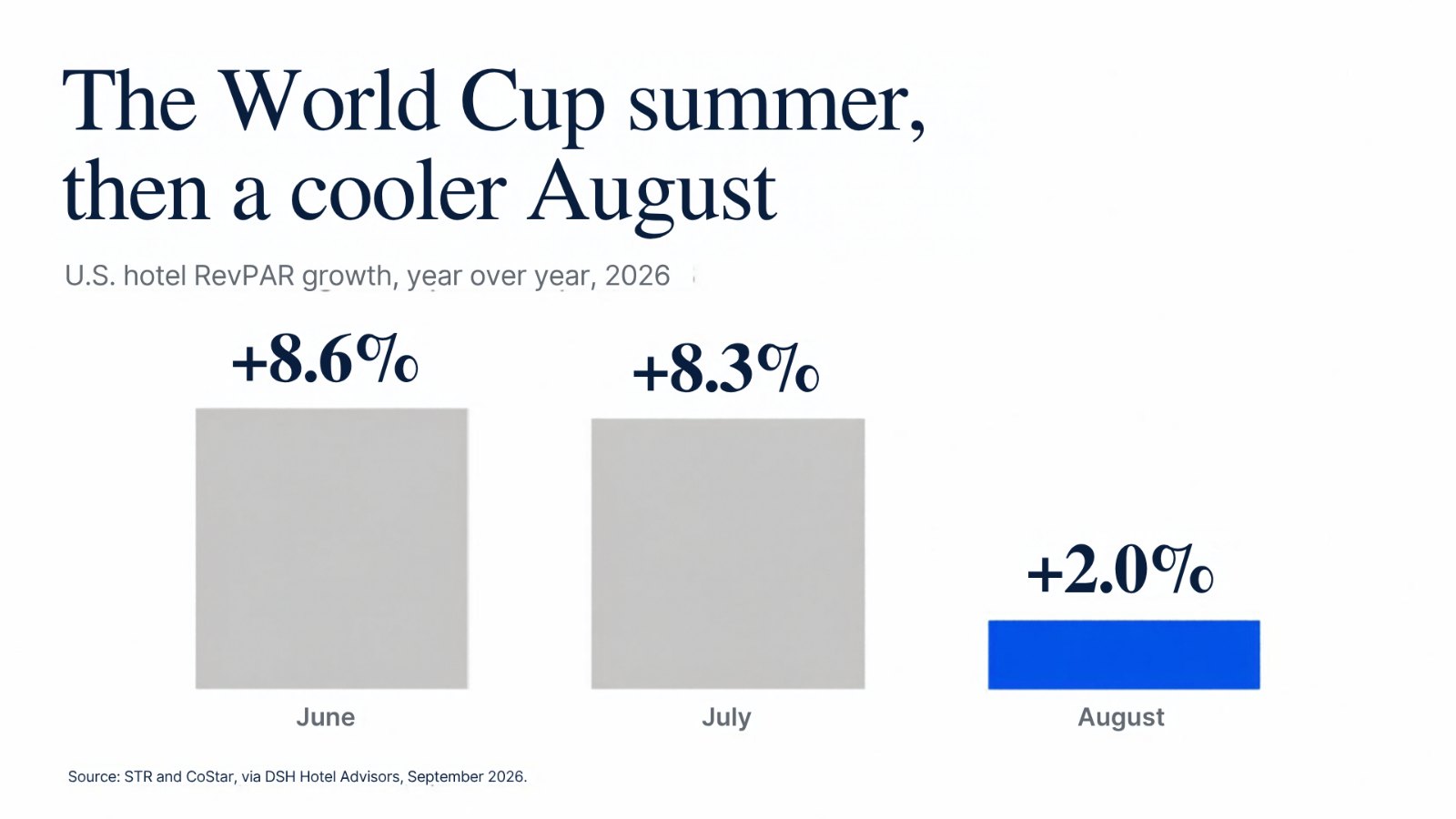
U.S. hotel revenue per available room grew 2% in August, according to STR data discussed by STR and CoStar analysts on September 24. That compares with growth of 8.3% in July and 8.6% in June, when the World Cup and the America 250 celebrations filled rooms across host cities. Average daily rate rose 1.5% in August and demand only 0.8%. CoStar’s forecast still calls for full-year 2026 RevPAR growth of 4.4%, which would make this one of the strongest years for the sector since the pandemic recovery.
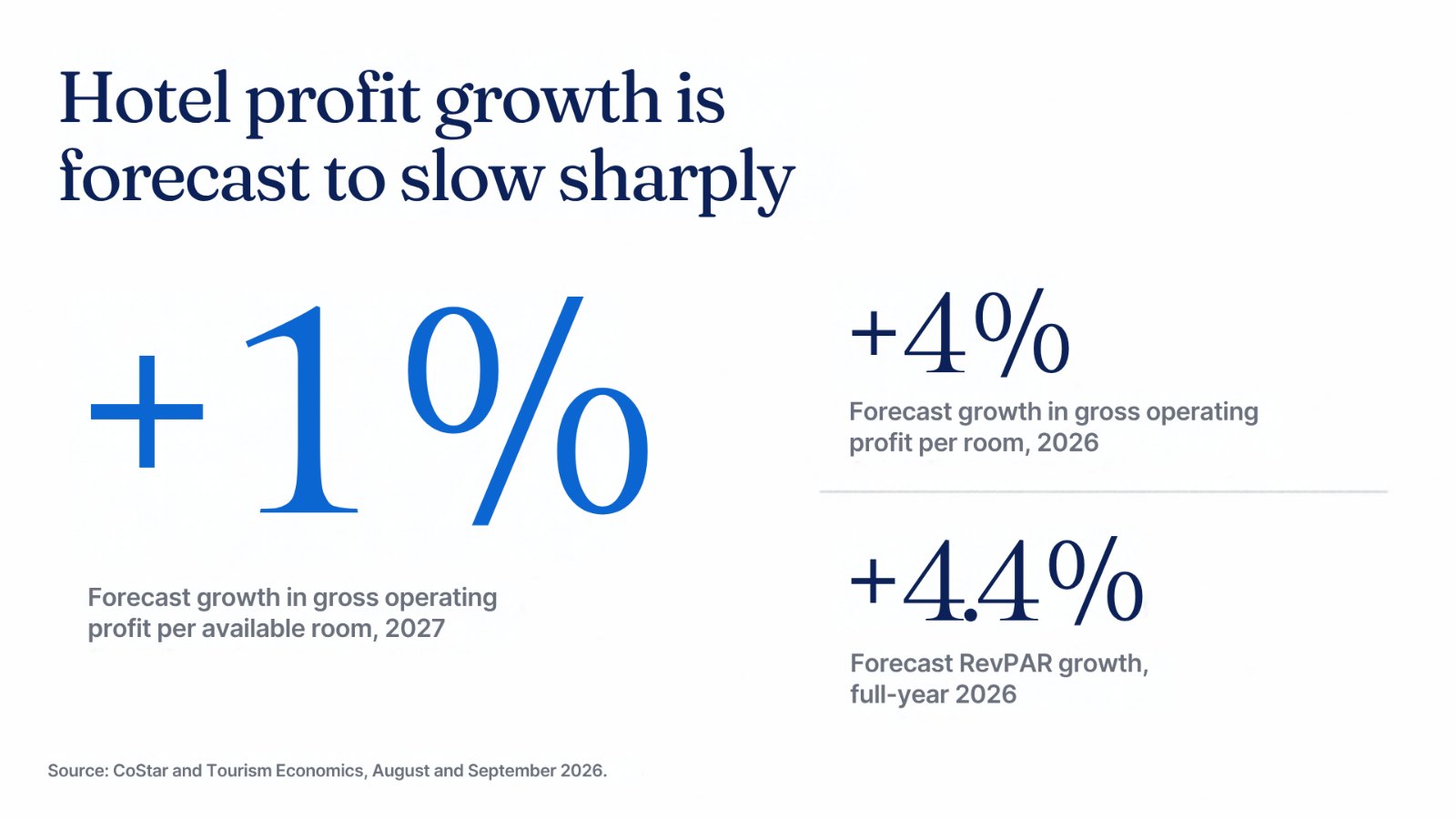
The August slowdown has been explained mainly by the calendar, and that explanation is largely correct for one month. We think the more important signal sits in the profit forecast underneath it. CoStar and Tourism Economics expect gross operating profit per available room to rise 4% this year and only 1% in 2027, with expenses growing faster than inflation in both years. The hotel market’s next phase will be decided by margins, and investors who price assets on 2026 results will be paying for a year that is unlikely to repeat.
The summer has been read as the start of a recovery
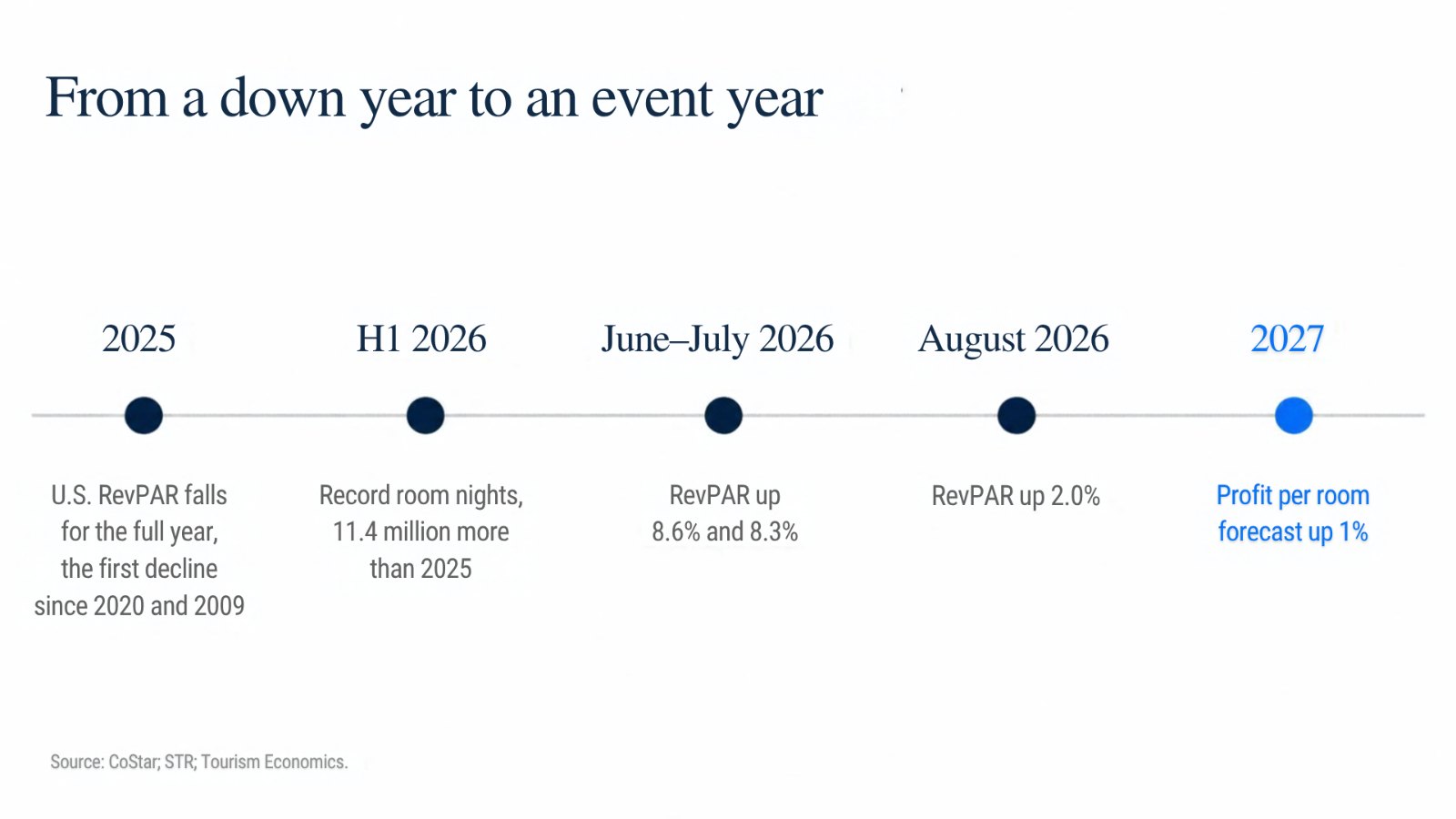
The case for a lasting upswing is easy to assemble. The industry sold a record number of room nights in the first half of 2026, 11.4 million more than in 2025, and room revenue rose by more than $5.4 billion, according to STR. In August, CoStar and Tourism Economics raised their 2026 RevPAR forecast by 1.6 percentage points and their occupancy forecast to 63.1%. Labor Day weekend set a record of 12.4 million room nights, up 3.6% from 2025.
Set against the year before, the improvement looks even larger. In 2025, U.S. RevPAR fell for the full year, which had last happened in 2020 and 2009, according to CoStar.
Much of the gain came from events that will not recur
The forecasters themselves have flagged the limits of that reading. STR’s president said the first-half gains were "fueled in part by the World Cup and America 250 celebrations," and she said the industry should expect softer results in mid-2027 because of difficult comparisons. CoStar’s analysts have said they will forecast 2027 by treating June and July separately from the rest of the year for exactly that reason.
The swing in the forecast shows how much of 2026 was unexpected. In early 2026, CoStar and Tourism Economics projected that 2027 RevPAR would grow 1.4%, below the historical average of about 3%. A year that outperforms because of a one-time event raises the base from which next year’s growth is measured, and it does little to change the underlying trend in travel demand.
Expenses have not slowed with revenue
The cost side is where the 2026 gains are most fragile. CoStar’s August forecast states that hotel expenses will rise faster than inflation in both 2026 and 2027. In 2026, rate growth was strong enough to absorb those costs, and profit per room is expected to rise 4%. In 2027, with RevPAR growth expected to slow and expenses still rising, the forecast for profit per room falls to 1%.
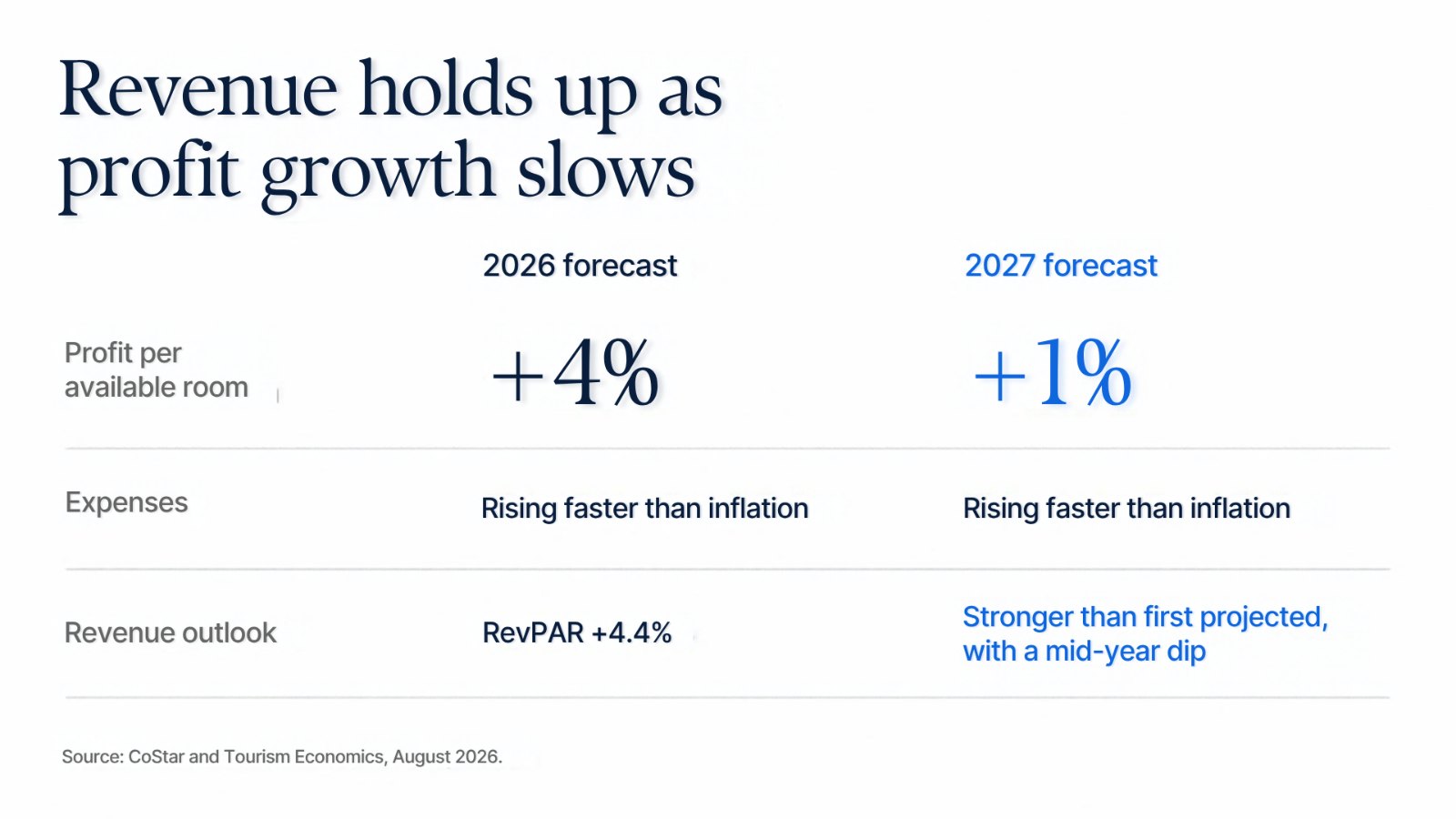
That gap matters more than the headline revenue numbers. Hotel values are set on net operating income, and a hotel’s income moves more than its revenue in either direction because so much of its cost base is fixed or tied to wages. A year of 1% profit growth, after a year of 4%, is a significant deceleration for an asset class that already carries higher cap rates than most commercial property.
“Investors who price assets on 2026 results will be paying for a year that is unlikely to repeat.”
Capital markets will price 2027 income
The interest rate environment adds weight to the profit outlook. The 10-year Treasury yield reached 5.3% on October 1, its highest level since 2002, according to Bisnow. Lenders at the same industry event said they expect to reduce leverage and stress underwriting rates. Buyers who finance hotel purchases in the coming months will need income that covers higher debt costs, and the income that matters for that test is the income the hotel will earn after the event year has passed.
Sellers, by contrast, will market trailing twelve-month results that include the World Cup summer. The likely result is a gap between asking prices based on 2026 trailing income and bids based on forward 2027 income, which tends to slow transaction volume until one side adjusts.
The main objection is that demand is broader than the events
A fair objection holds that the strength in 2026 rests on more than one tournament. Tourism Economics has pointed to stable labor markets, gains in household wealth and a recovery in group and business travel that extends beyond AI-related investment. Record Labor Day demand and record mid-September rates both came after the World Cup ended. On this view, 2027 will be softer only in June and July, and the rest of the year will continue the 2026 trend.
We think this objection is partly right. Demand outside the event months does look healthy, and CoStar now expects 2027 to be stronger than it first projected. The objection says little about costs, though. Even with healthy demand, the forecast for profit per room in 2027 is a quarter of this year’s, because expenses are expected to keep rising faster than inflation. Strong demand protects revenue, while margins depend on how fast costs rise.
Underwrite the year after the event
Through 2027, we expect RevPAR growth to settle closer to its historical average, with a visible dip in mid-2027 against World Cup comparisons. Hotel profitability will depend on labor productivity and cost control more than on rate growth, and owners with the scale to manage expenses will outperform. For investors, the short version is to underwrite hotels on 2027 income and to treat 2026 as an exceptional year.
August’s slowdown will probably be remembered as a calendar effect. The more lasting signal from this autumn’s data is that hotel revenue and hotel profit are about to grow at very different speeds.
Sources: STR and CoStar (via CoStar News and DSH Hotel Advisors, September 2026); CoStar and Tourism Economics U.S. hotel forecasts (November 2025, January 2026 and August 2026); Bisnow via CRE Daily.