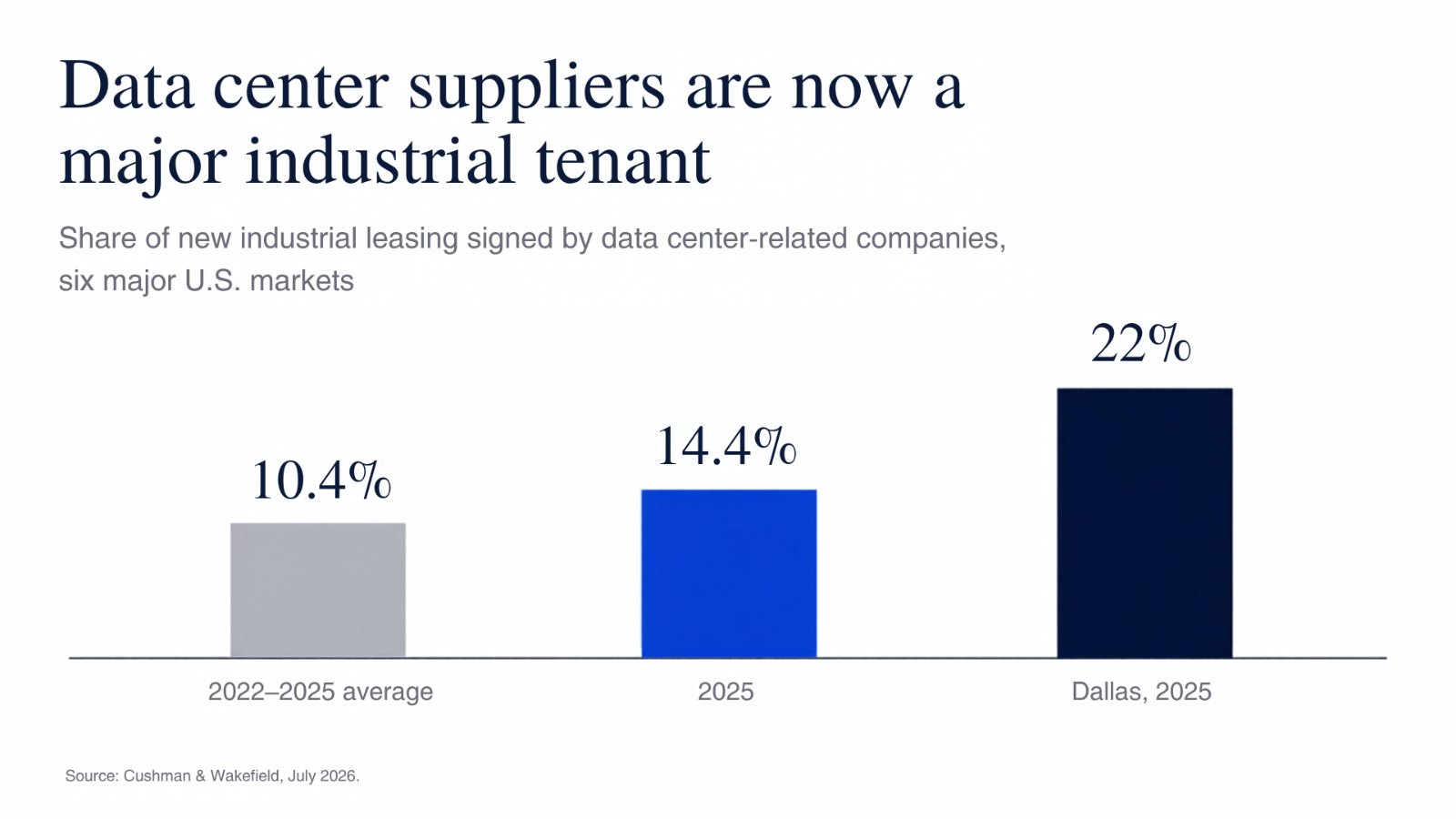
In late September, Commercial Real Estate Direct reported that companies tied to the data center industry signed a record 14.4% of all new industrial leases in 2025, citing a Cushman & Wakefield study of six major markets. Their leasing rose 44% in a year to 13.5 million square feet. In the same week, a developer in Irving, Texas, secured financing to convert a vacant 113,406-square-foot industrial building into a data center.
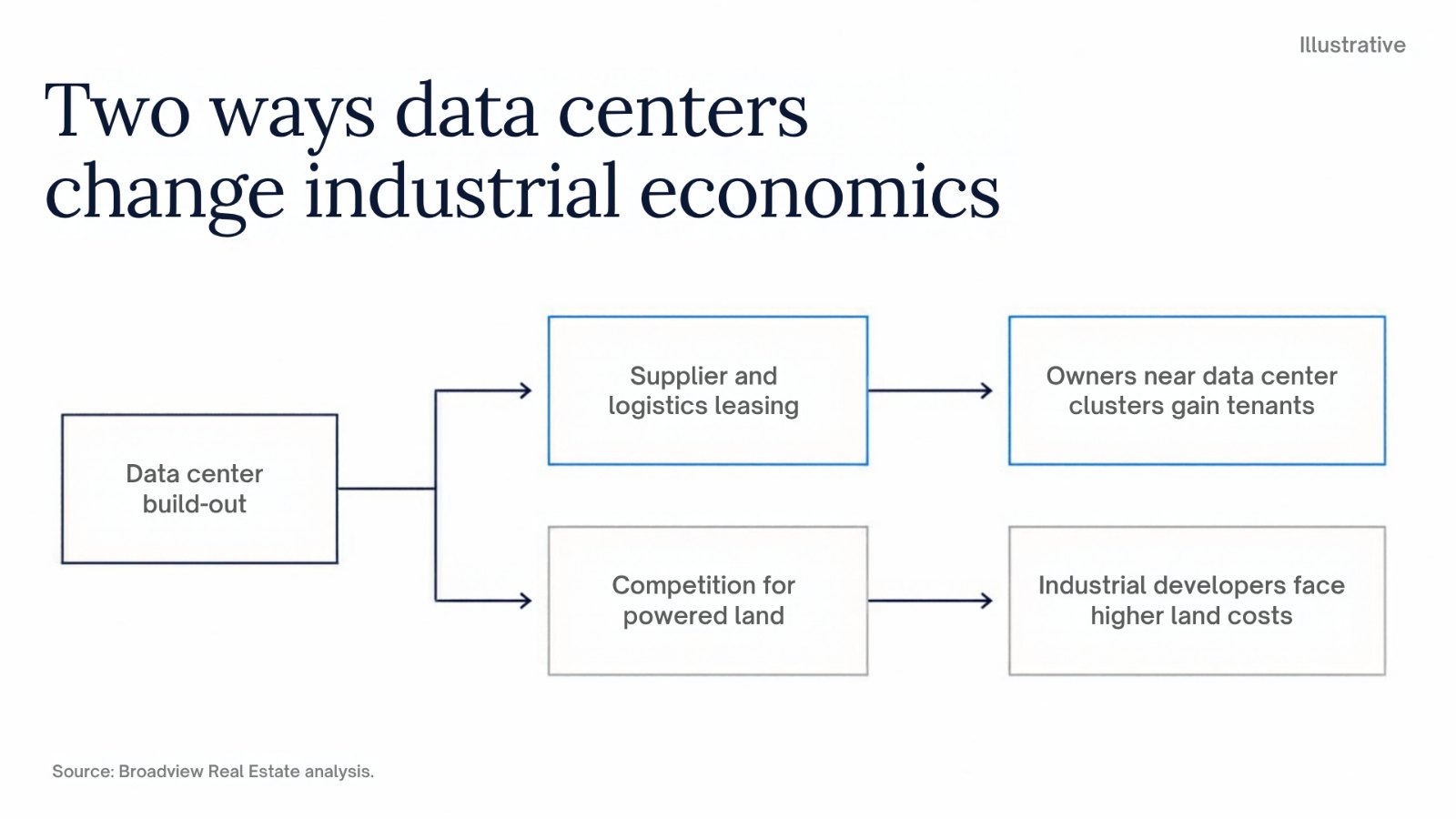
Data centers are usually discussed as their own asset class, with their own investors and their own pricing. We think the more important change for most industrial owners is that data centers now affect warehouse economics in two directions at once. They create a new group of industrial tenants, and they compete with industrial users and developers for the same land and the same electrical capacity. The result is that power, more than location or clear height alone, is becoming the variable that separates industrial assets that gain value from those that lose it.
Data centers are usually treated as a separate market
Most investors see data centers as a specialized sector served by specialized capital. The scale is consistent with that view. CBRE reported a record 7,481 megawatts of data center capacity under construction across primary U.S. markets in the first half of 2026, up 24.8% from a year earlier. The six markets in the Cushman & Wakefield study, Atlanta, Austin and San Antonio, Chicago, Dallas, Phoenix and Virginia, together have more than 11 gigawatts under construction.
On that view, the data center boom matters to a warehouse owner only indirectly, through the general strength of the economy.
Data center construction creates its own industrial demand
The leasing data shows a more direct connection. Building and running data centers requires a supply chain of equipment manufacturers, generator distributors, electrical contractors and logistics firms, and those companies lease conventional warehouses. Between 2022 and 2025, they accounted for 10.4% of new industrial leasing in the six markets Cushman & Wakefield studied, before the share reached 14.4% in 2025. In Dallas, the share was 22%, and in Virginia it averaged 13.4% over the four years.
Owners are seeing this in their own portfolios. STAG Industrial told investors in its first-quarter call that it had signed eight leases totaling 1.6 million square feet with data center-related tenants since the start of 2025, including a large third-party logistics firm serving a hyperscale data center contract and companies distributing generators.
Power-ready land is being priced as data center land
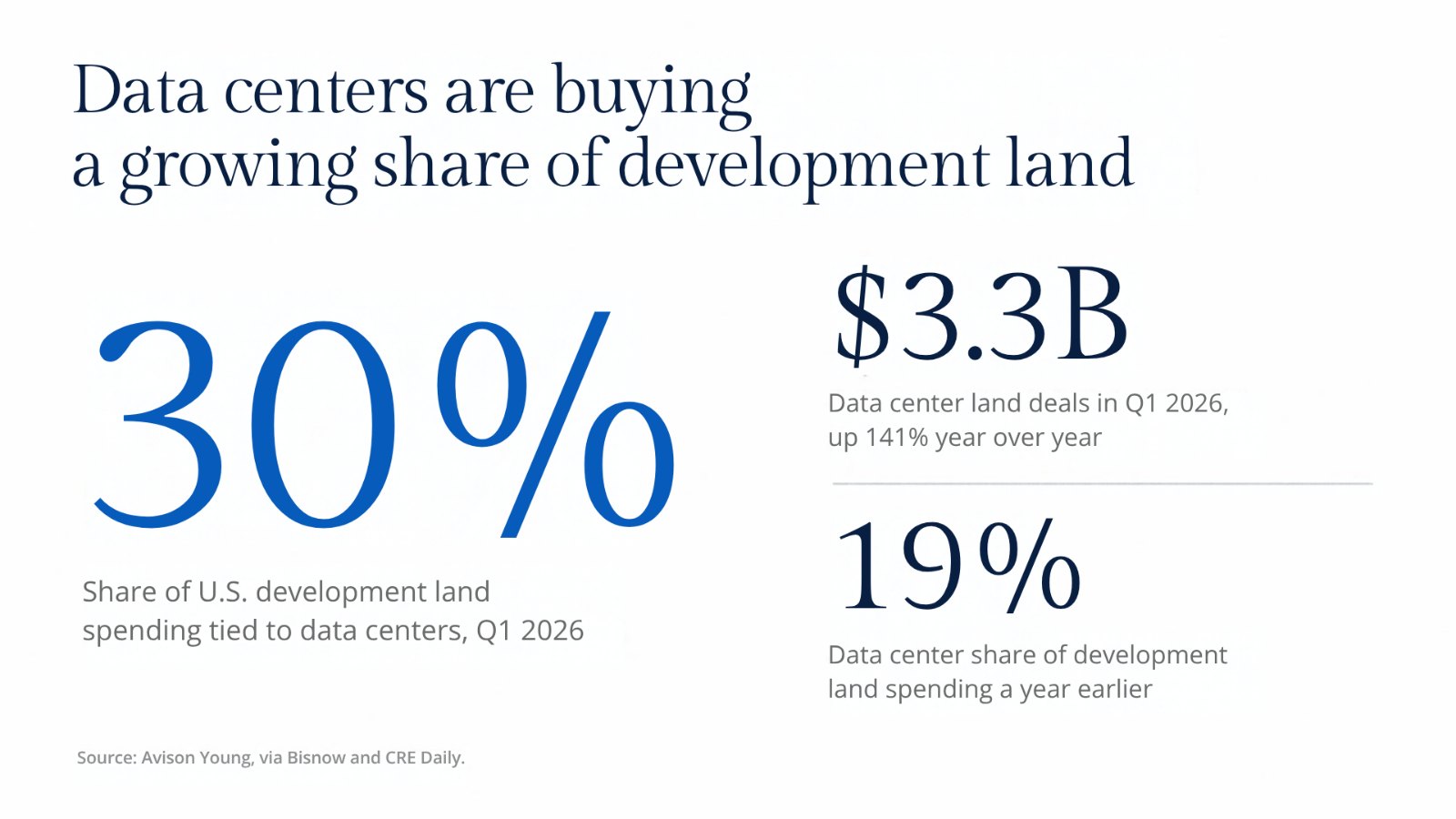
The second effect works against many industrial owners and developers. Data center buyers are paying prices for powered land that industrial uses cannot match. According to Avison Young data reported by Bisnow and CRE Daily, data center land deals totaled $3.3 billion in the first quarter of 2026, up 141% from a year earlier, and accounted for 30% of all U.S. development land spending, up from 19%. Development sales of powered sites rose 55% to $11.1 billion, and industrial land sales rose 65% as buyers paid premiums for access to power.
In Northern Virginia, data center buyers have pushed land prices beyond what industrial projects can justify. Some industrial parcels are now marketed as data center sites from the start.
Existing buildings with large power service gain an option
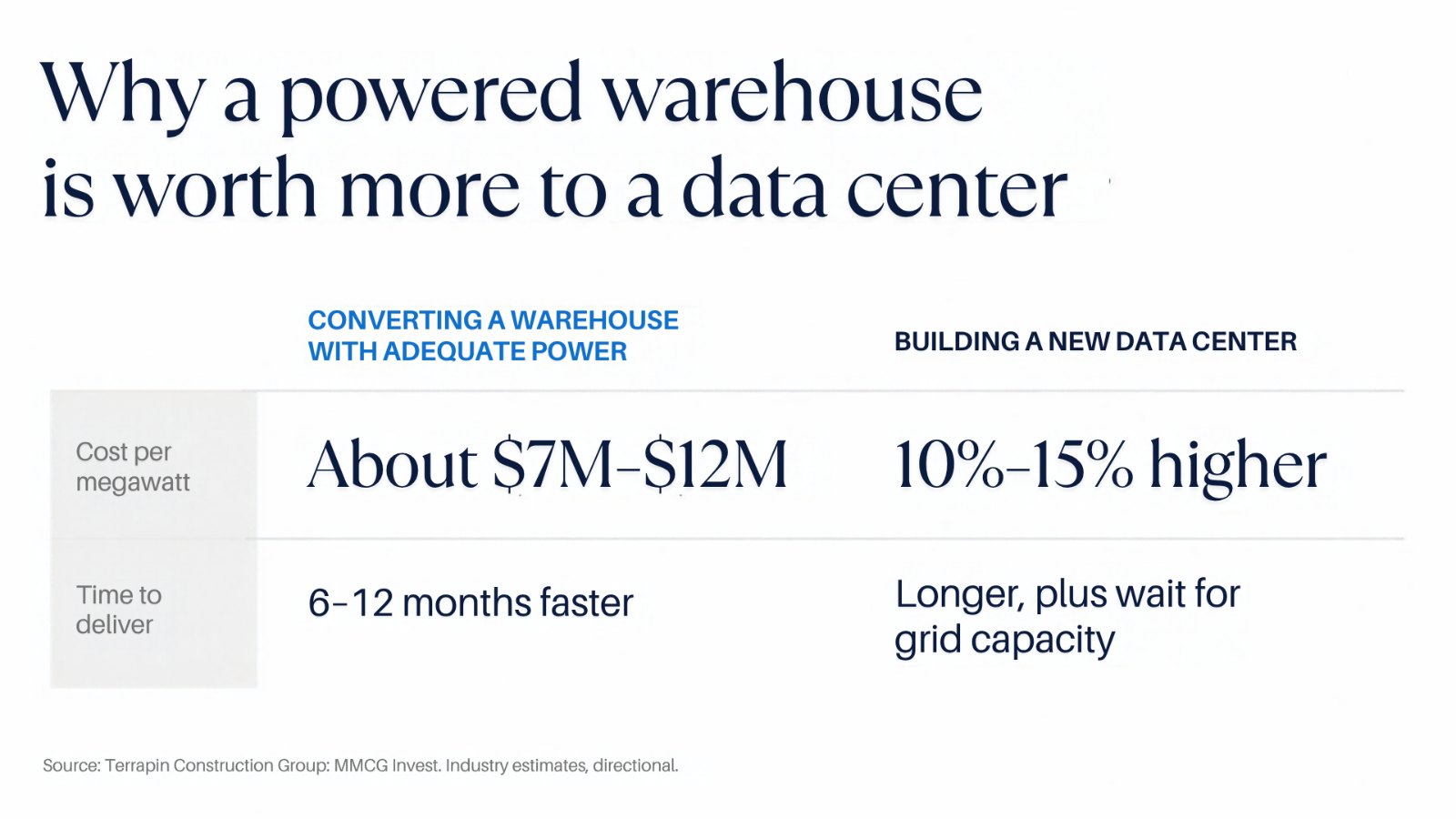
Industrial buildings with substantial electrical service now carry a value that does not appear in a standard warehouse appraisal. Industry estimates put the cost of converting an existing warehouse with adequate power into a data center at about $7 million to $12 million per megawatt, 10% to 15% below building new and six to twelve months faster. For a data center operator, the existing utility connection can be worth more than the building, because the alternative is a long wait for new grid capacity.
“For a data center operator, the existing utility connection can be worth more than the building.”
That creates two groups of winners. Owners of warehouses near data center clusters gain a new tenant base, and owners of buildings and land with large power service gain an exit to a higher-value use.
The losers are industrial developers whose land costs now compete with data center bids, and logistics tenants that need more power for automation, who must compete for the same scarce capacity. Owners of older, low-power buildings far from data center clusters see none of the benefit.
The objection is that data center demand could reverse
A reasonable objection holds that the data center pipeline depends on a small number of hyperscale buyers and on AI spending that could slow. Local opposition is also rising, and several communities have delayed or rejected projects. If construction slows, supplier leasing would fall, and land bought at data center prices could be left with only industrial value.
We take the risk seriously for land and for supplier-driven leasing in the markets most exposed to a single campus. The power constraint is more persistent. Electrical capacity in major markets takes years to add, and demand from automated logistics and manufacturing also requires more power than older warehouses provide. Even a slower data center cycle would leave power-ready industrial sites scarcer than they were five years ago.
Industrial owners should audit their power
For the industrial sector, the practical lesson is that electrical capacity now belongs in every asset review alongside location and clear height. Owners and buyers should treat each building’s electrical service, and the realistic path to more, as a separately priced component of value. Developers should secure capacity before they secure land.
The record share of industrial leasing signed by data center suppliers will be read as a sign of strong demand. Its more lasting effect is to change what a warehouse is worth, which increasingly depends on how much power reaches the site.
Sources: Cushman & Wakefield (July 2026); Commercial Real Estate Direct (September 2026); Connect CRE; STAG Industrial Q1 2026 earnings call; Avison Young via Bisnow and CRE Daily; CBRE via Brightlio; Terrapin Construction Group; MMCG Invest.