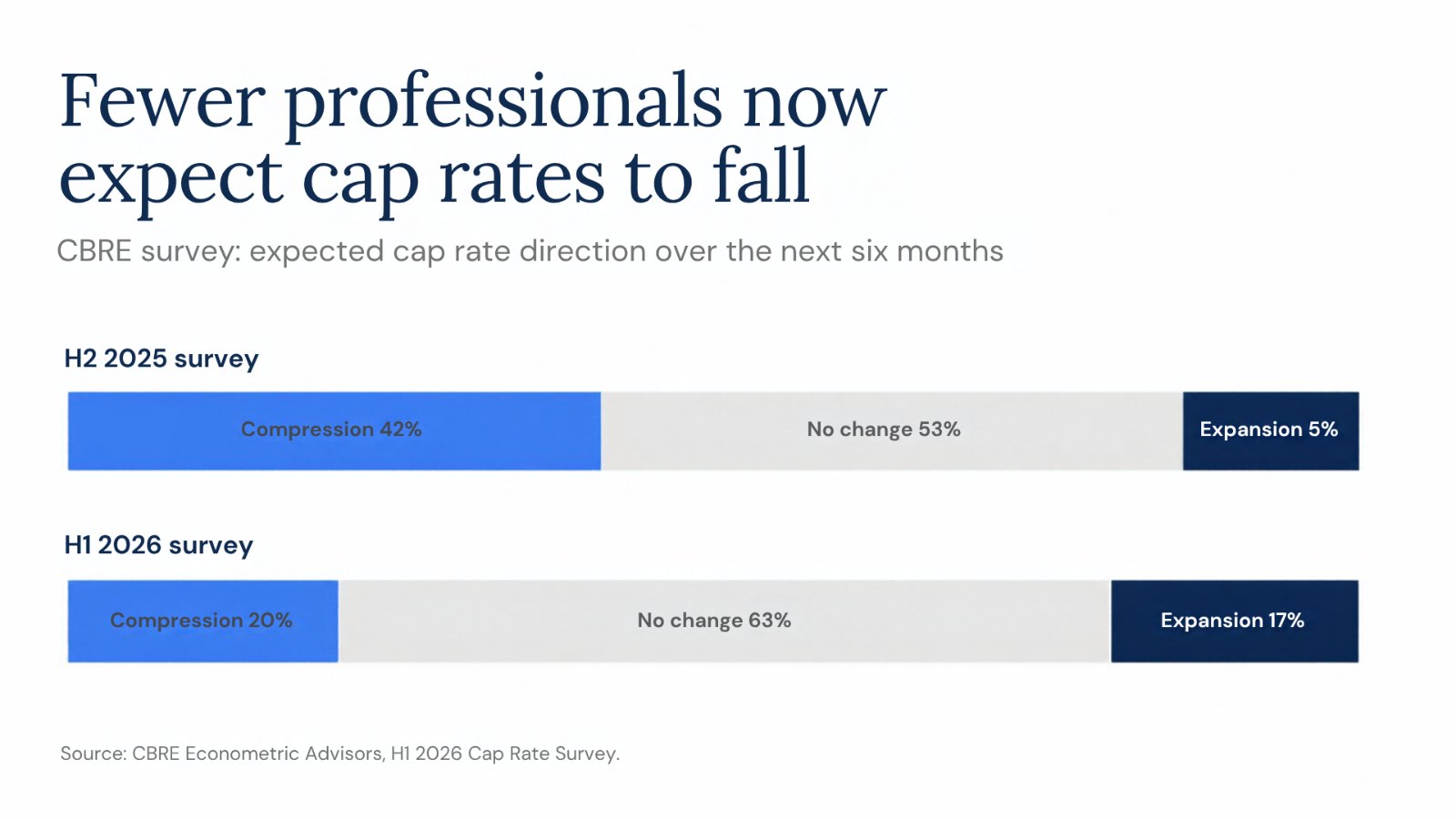
On September 23, CBRE Econometric Advisors republished the main finding of its first-half 2026 Cap Rate Survey: the share of its capital markets and valuation professionals expecting cap rates to fall over the next six months dropped from 42% to 20%, while the share expecting increases rose to 17%. Respondents gave those estimates in late June, when the 10-year Treasury yield was around 4.6%. On October 1, the yield reached 5.3%, its highest level since 2002.
For industrial real estate, that move changes the arithmetic of a purchase. Prime logistics assets have traded at some of the lowest cap rates in commercial property, and many now price at or below the yield on a government bond and below the cost of new debt. We think this means new industrial capital can no longer count on cap rates or leverage to produce returns. The return has to come from the rent roll, specifically from leases signed below today’s market rent that will reset over the next few years. Investors should buy that gap, and price everything else conservatively.
Industrial still looks like the safest place for capital
The common view is that industrial remains the sector to own. Fundamentals are improving: national vacancy fell to 6.9% in the second quarter, according to Cushman & Wakefield, and the construction pipeline is far below its 2022 peak. In CBRE’s survey, industrial was among the property types with the most cap rate compression in the first half, behind only neighborhood retail and hotels. Institutional capital continues to raise dedicated logistics funds.
On that reading, a higher Treasury yield is a temporary headwind for a sector with strong demand, and buyers should keep paying for quality.
Prime cap rates now sit below the cost of capital
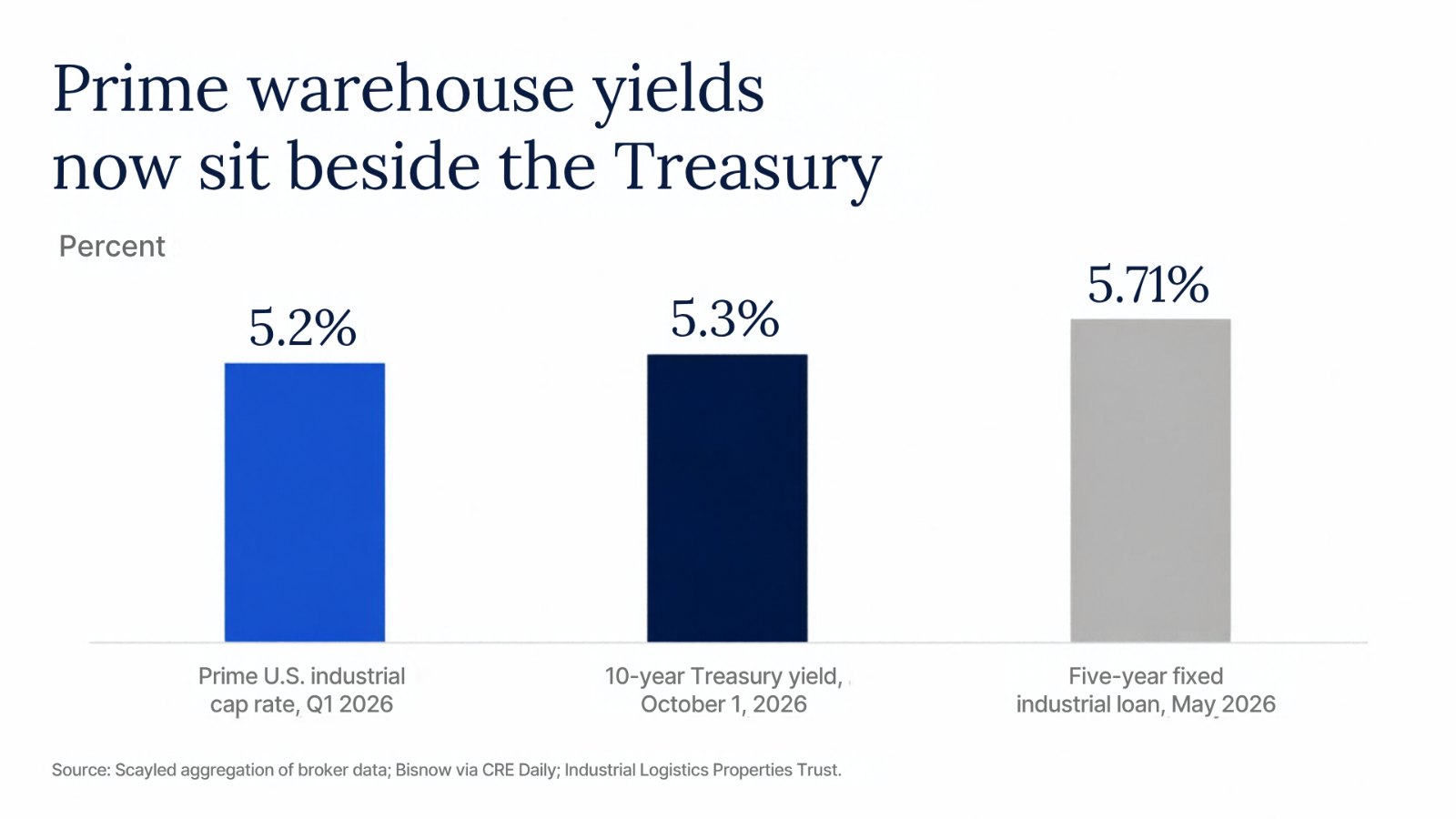
The difficulty is the spread. Aggregated broker data put the average U.S. prime industrial cap rate at about 5.2% in the first quarter of 2026, and lender guides list Class A logistics in primary markets at 4.75% to 5.50%. With the 10-year at 5.3%, the initial yield on the best warehouses is roughly equal to the risk-free rate. Fixed-rate debt costs more: Industrial Logistics Properties Trust locked in a five-year, interest-only loan at 5.71% in May, before the latest rise in yields.
When the cap rate is below the interest rate, each dollar of debt lowers the buyer’s cash yield in the early years. Underwriting that relies on leverage to reach target returns, or on selling at a lower cap rate than the purchase, has little room at today’s rates.
The return is in the gap between in-place and market rent
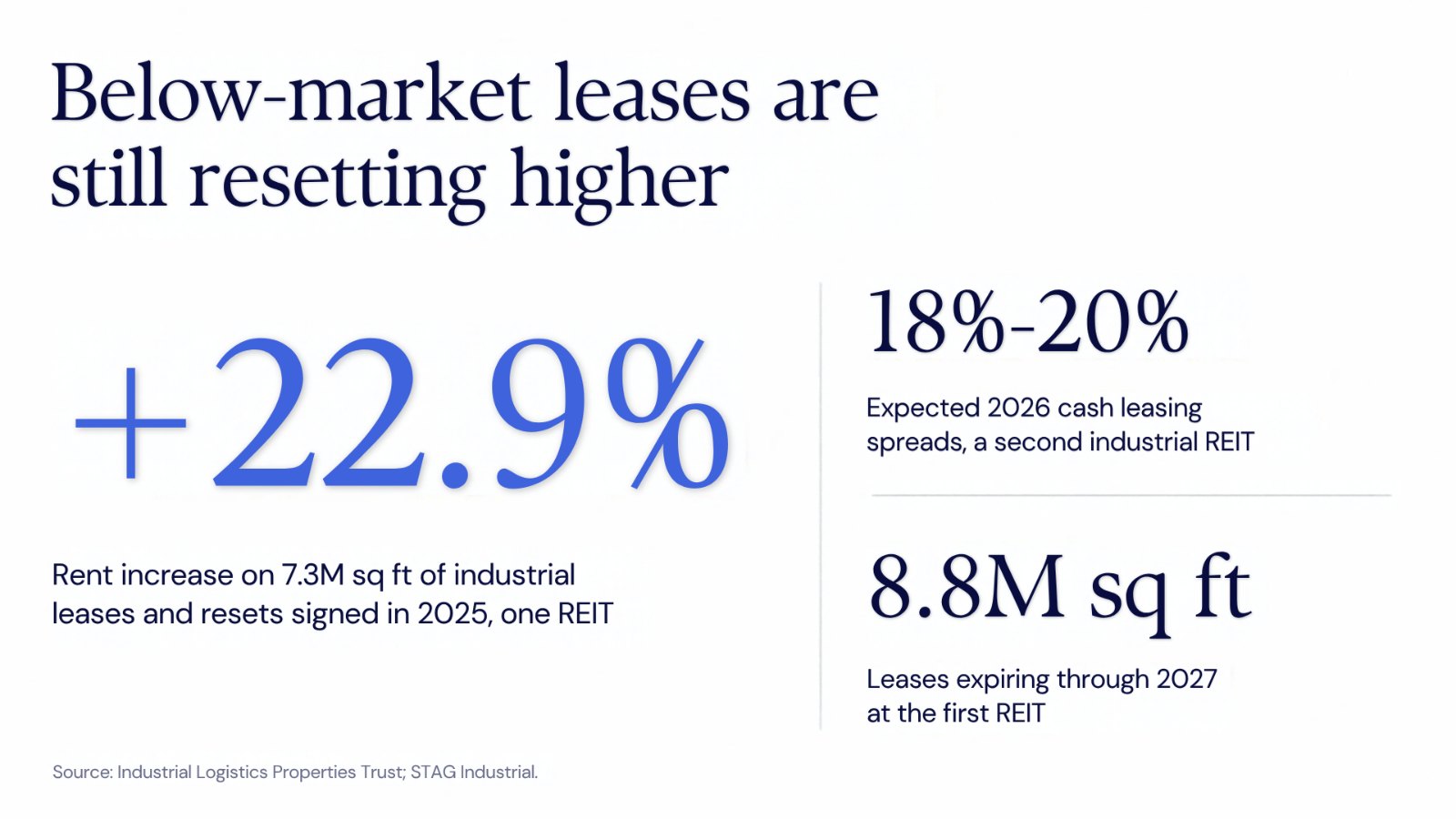
What industrial still offers is embedded rent growth. Leases signed several years ago, before the sharp rise in market rents, are still rolling over. Industrial Logistics Properties Trust reported that it signed 7.3 million square feet of new leases, renewals and rent resets in 2025 at rents 22.9% above the expiring level, and it has 8.8 million square feet expiring through 2027. STAG Industrial told investors earlier this year that it expected cash leasing spreads of 18% to 20% in 2026.
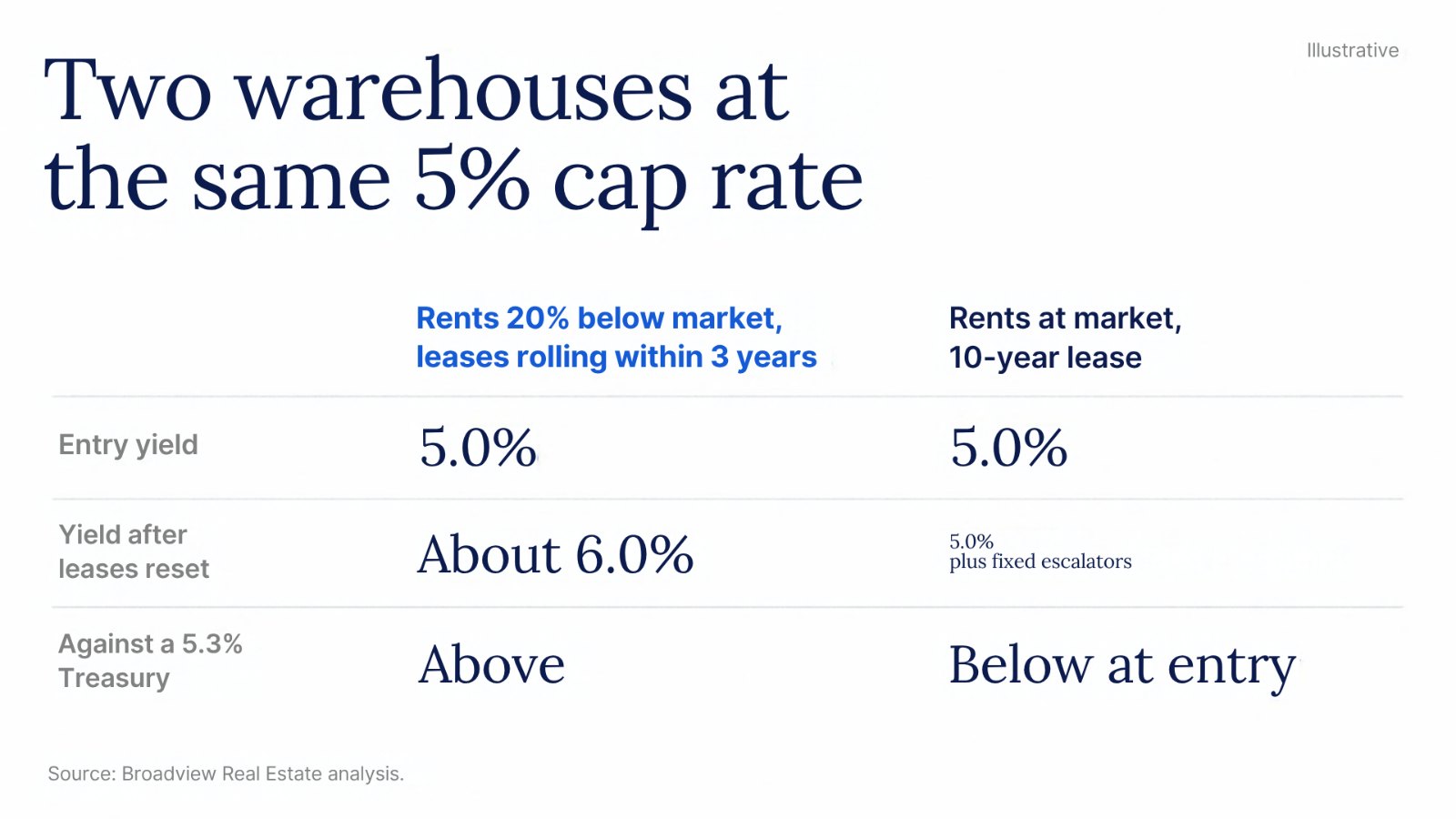
A buyer who acquires a building at a 5% cap rate with rents 20% below market and most leases expiring within three years is buying an income stream that should reach a 6% yield on cost as those leases reset, before any change in market rents. A buyer of a building at the same cap rate with a fully marked-to-market rent roll and a ten-year lease is buying a bond-like yield below the Treasury.
How we would underwrite industrial capital now
The changes are practical. Underwriting should start with a lease-by-lease comparison of in-place and market rent, using current submarket evidence instead of national averages, and should hold exit cap rates at or above entry. In markets where absorption has turned negative, such as Portland in recent quarters, the market rent assumption deserves extra scrutiny.
Structure should keep leverage low enough that negative leverage does not compress early cash returns, and any debt should be fixed or hedged for at least the period in which leases roll. On portfolio construction, we would weight new capital toward multi-tenant and shorter-lease buildings with a visible mark-to-market over the next three years, and away from long single-tenant leases priced at cap rates close to the Treasury yield.
The objection is that the rent gap is closing
A fair objection is that the gap between in-place and market rent is shrinking. Market rent growth has slowed since 2022, and every lease that rolls removes part of the embedded upside. A buyer who pays for a 20% mark-to-market today may find it is 10% by the time the leases expire, and some markets have already seen rents flatten.
We agree that the gap is finite, and that is the reason to measure it lease by lease and pay only for what can be captured within a defined period. Spreads in the high teens, which owners are still reporting in 2026, leave room for some erosion. The risk is greater for buyers who treat the national average as their own and who pay for rent growth that has already been realized by the seller.
Buy the rent roll, and price the rest conservatively
With the 10-year at 5.3%, industrial buyers are working with a narrower margin than at any time in this cycle. The sector’s fundamentals remain sound, but sound fundamentals do not make a 5% cap rate attractive when the Treasury pays the same. The industrial assets that still offer a return above the cost of capital are the ones whose leases have not yet caught up with the market, and the work of the next cycle is finding them before their rents reset.
“The industrial assets that still offer a return above the cost of capital are the ones whose leases have not yet caught up with the market.”
Sources: CBRE Econometric Advisors and CBRE U.S. Cap Rate Survey H1 2026; Bisnow via CRE Daily; Scayled; CLS CRE; Industrial Logistics Properties Trust SEC filings; STAG Industrial Q1 2026 earnings call; Cushman & Wakefield; WareCRE.