On September 22, Millrose Properties, the land-banking REIT that Lennar spun off in 2025, announced plans to sell $1 billion of senior notes and draw $500 million on a term loan to fund lot acquisitions. HousingWire reported that the capacity is tied to land needs arising from the merger of Dream Finders Homes and Beazer Homes. A month earlier, Millrose amended its agreements with Lennar to allow investment in single-family homes held as rentals and to raise up to $2 billion of new capital outside Lennar’s priority rights.
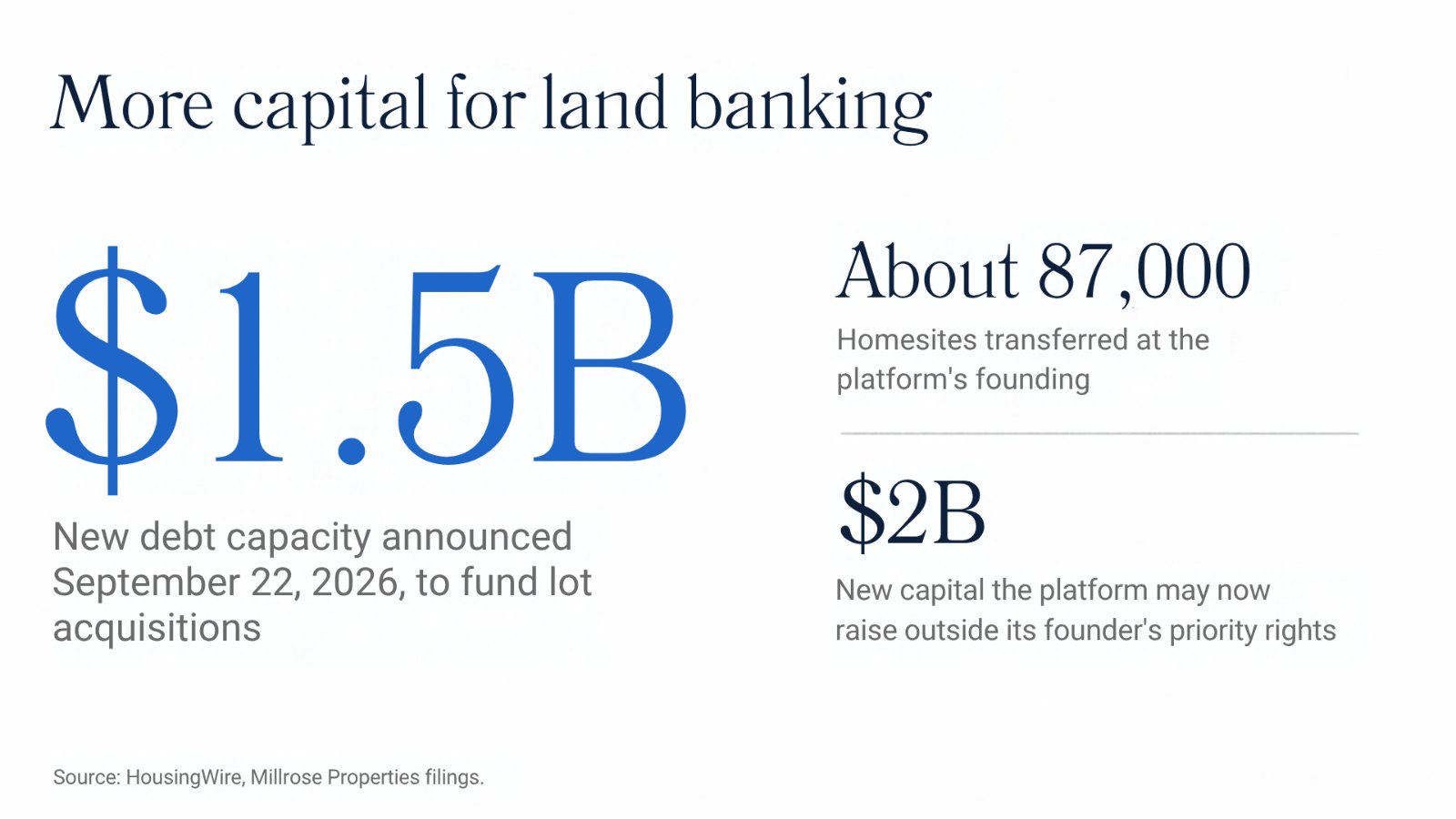
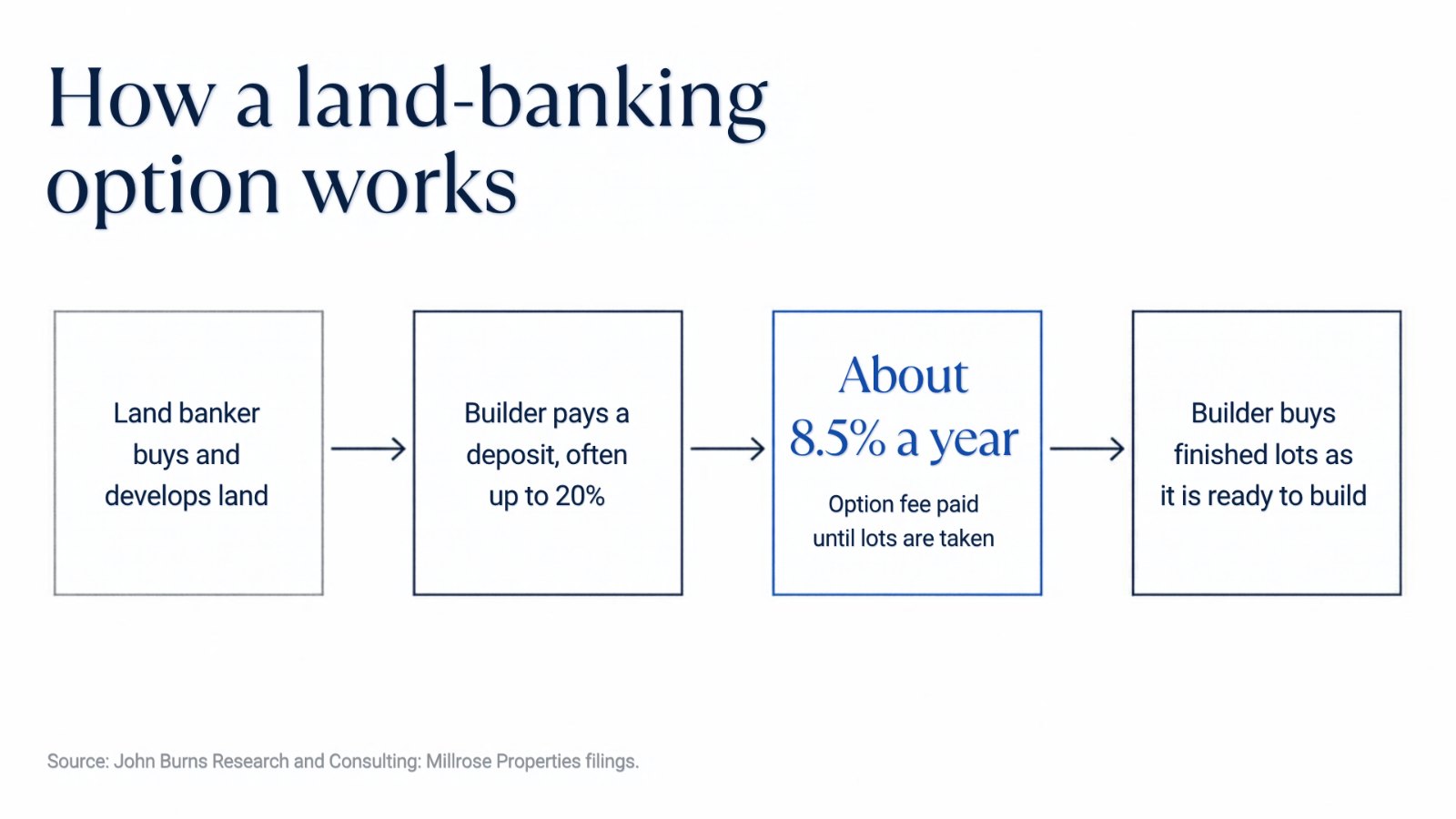
Millrose describes itself as a homesite option platform. It buys and develops land, then sells finished lots to builders as they are ready to build, while the builder pays an option fee for the right to buy. At its founding, Lennar transferred about $5.5 billion of land, roughly 87,000 homesites, and $1 billion of cash into the company. The September financing shows that institutional capital is still flowing into this model. We think its growth is changing the economics of master-planned communities, because it turns the cost of holding land into a fixed monthly charge on builders, and that charge now weighs on every decision about which lots to take and when.
Land banking is usually seen as a way to make builders lighter
The standard view treats land banking as a balance sheet tool. Builders that own less land carry less risk and earn higher returns on equity, and investors reward that model. John Burns Research and Consulting has found that public builders have been owning fewer lots and optioning more, especially through land bankers. Under a typical arrangement, the builder puts down a non-refundable deposit, often up to 20% of the cost of the developed lots, and buys finished homesites over time at a price that covers the land banker’s costs and return.
On that view, land banking reduces risk for everyone. Builders stay light and earn higher returns, while master-planned community developers gain a reliable buyer for finished lots.
The option fee is a fixed cost in a slowing market
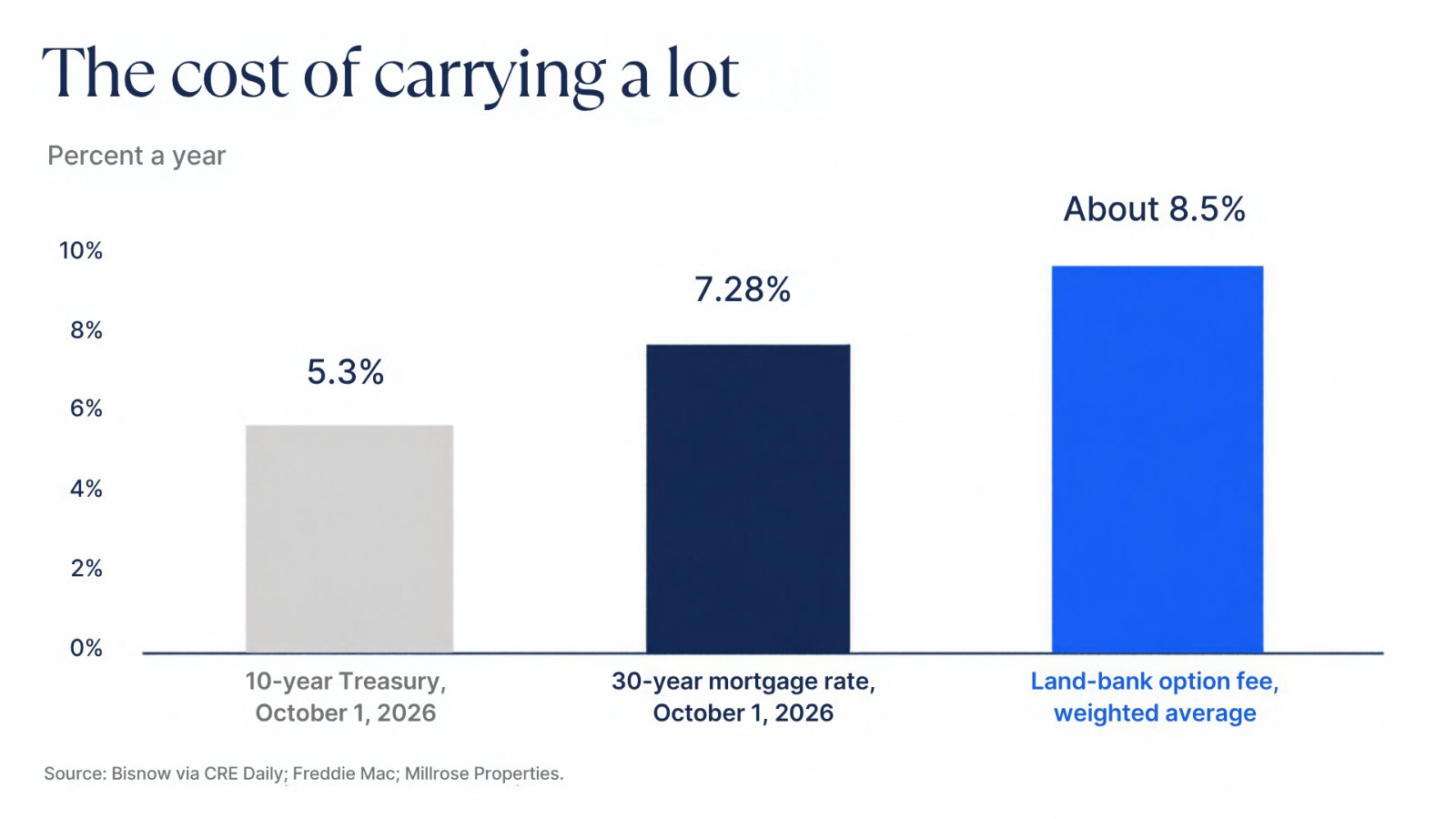
The arrangement looks different when sales slow. Millrose’s main agreement with Lennar carries option fees at a weighted average of about 8.5% a year, paid monthly on the value of finished land, and the company has said its agreements with other builders earn more. Those fees are owed whether or not homes sell. With the 30-year mortgage rate at 7.28% on October 1 and two-thirds of builders using sales incentives in September, according to NAHB, the fee has become a significant cost of carrying unsold lots.
A builder facing that cost has a clear incentive. It will take down lots first in communities where homes sell fastest, so that each lot turns into a closed sale before fees accumulate, and it will slow takedowns where sales are weak.
Who gains and who loses
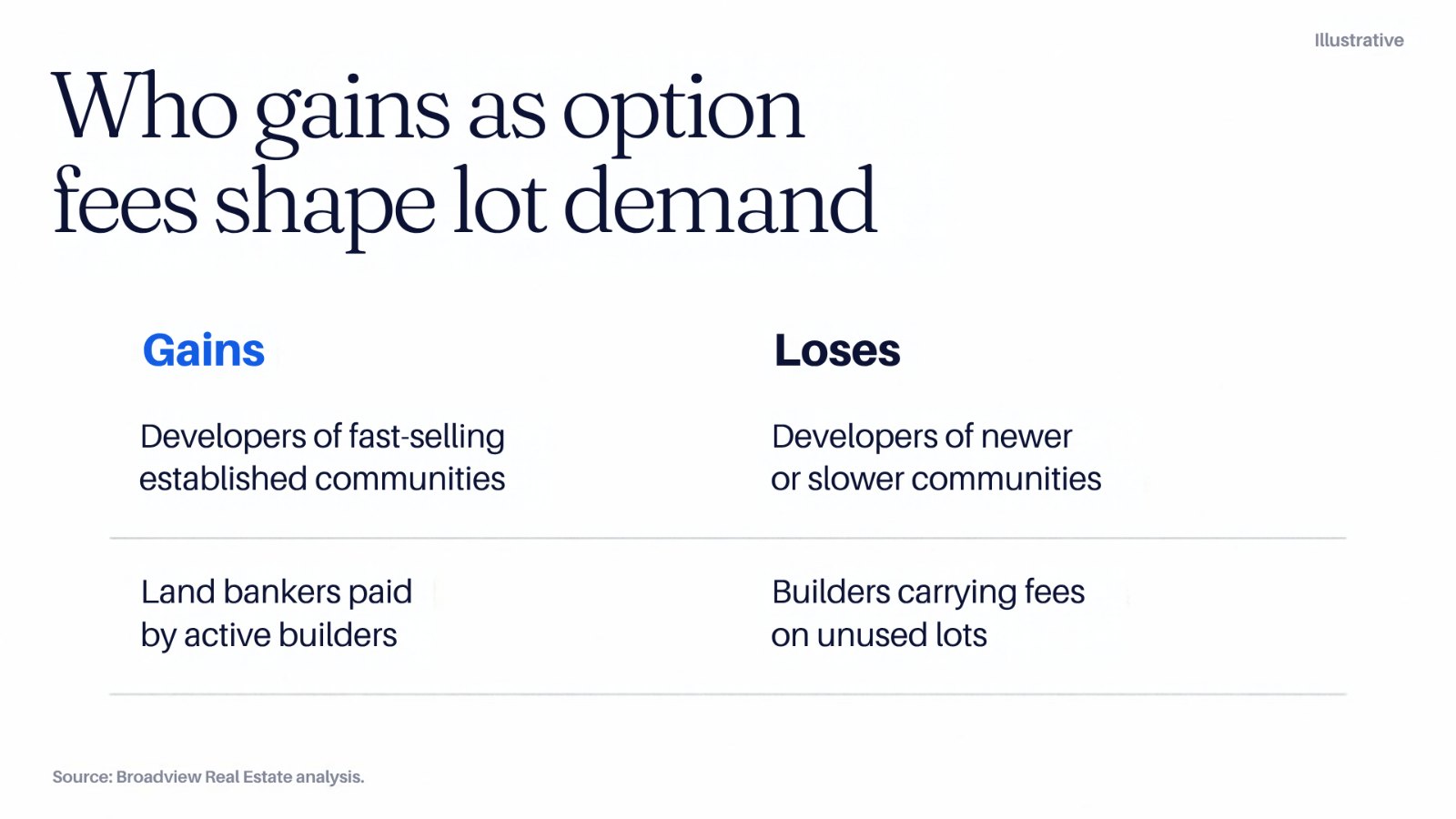
That behavior sorts master-planned communities into winners and losers. Developers of established communities with strong sales velocity gain, because builders want their lots even at higher prices and will take them on schedule. Land bankers gain a return of 8.5% or more on finished land, well above the 5.3% 10-year Treasury yield, as long as their builder clients keep buying.
The losers are developers of newer or slower communities, whose lot takedowns are the first to be deferred, and builders whose option fees accumulate on lots they cannot yet use. Land bankers concentrated in a single builder or a weak region carry the risk that takedowns stop altogether.
The last cycle shows how option structures behave under stress
The land market of 2007 to 2009 offers a warning. When home sales fell sharply, many builders walked away from optioned land and forfeited their deposits, leaving land owners with lots and no buyer. The structures have since changed. Millrose’s agreement with Lennar uses cross-termination pooling, which prevents the builder from abandoning a weak community in one area without triggering forfeitures across a wider pool. That makes walkaways more costly for the builder and more predictable for the land banker.
The objection is that land banking spreads risk well
A reasonable objection holds that land banking is a sound allocation of risk. Builders put deposits at risk, and land bankers are paid for holding land until it is needed. Millrose’s expansion into built-for-rent homes also gives it another way to use land if for-sale demand weakens.
We accept that the model allocates risk more clearly than the land ownership of the last cycle. It also concentrates the cost of slow sales on the builder through fees, and that concentration shapes where builders choose to build. In a slowing market, the communities that sell fastest will receive a growing share of lot demand, and the rest will wait longer for theirs.
The fee decides which lots get taken
For the master-planned community sector, the growth of land banking means that sales velocity now has a direct, measurable value to builders. Every month a lot sits unused carries a fee. Developers whose communities sell quickly will find builders and land bankers eager to work with them, and developers with slower communities will need lower prices or longer timelines. The September financing will add more capital to the land banking model, and that capital will flow first to the places where lots turn into homes the fastest.
“Every month a lot sits unused carries a fee.”
Sources: Millrose Properties (via HousingWire, MiniChart and Hunterbrook, August to October 2026); John Burns Research and Consulting; NAHB; Freddie Mac; Bisnow via CRE Daily.