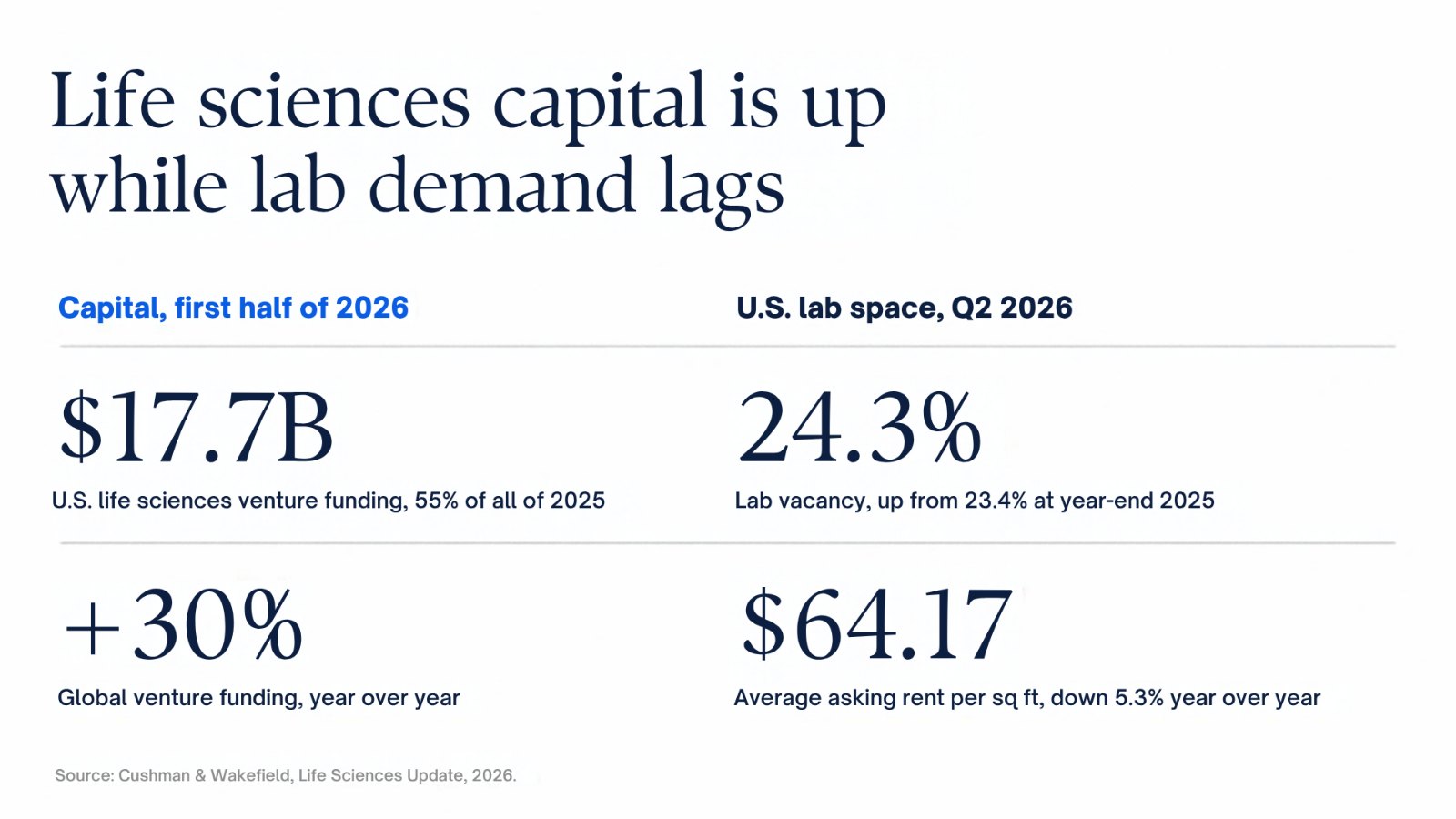
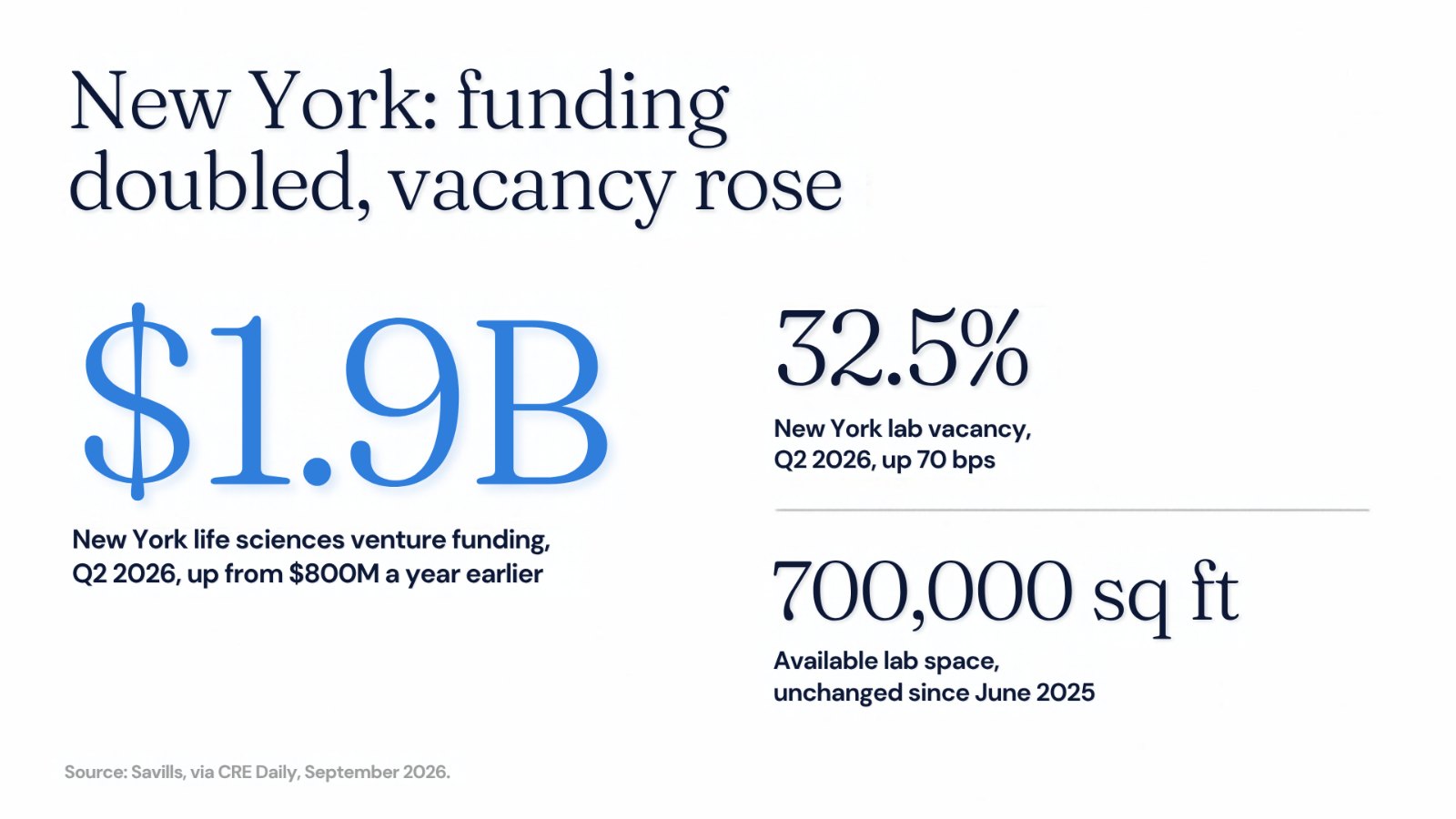
In late September, Savills reported that life sciences venture funding in New York more than doubled in the second quarter, to $1.9 billion from $800 million a year earlier. In the same quarter, the city’s lab vacancy rate rose 70 basis points to 32.5%, and available lab space has held at about 700,000 square feet since June 2025. The national picture follows the same pattern. Cushman & Wakefield reports that U.S. life sciences venture funding passed $17.7 billion in the first half of 2026, equal to 55% of the whole of 2025, while national lab vacancy rose to 24.3% and asking rents fell 5.3% over the year to $64.17 per square foot.
The usual explanation is a time lag: companies raise money first and lease space later. We think the lag is real, but it explains less than it used to. The capital returning to life sciences is going to fewer, larger companies at later stages of development, many of them using AI to do more of their early work in software. Each dollar of funding is likely to produce less lab demand than in the last cycle. Vacancy will fall more slowly than the funding recovery suggests, and the recovery will be uneven by market and building.
Funding usually leads lab demand
The standard reading has a long record behind it. Life sciences companies raise capital, hire scientists and then lease space, so funding has typically led leasing by several quarters. On that view, the current figures are an early signal. Global venture funding reached $29.9 billion in the first half of 2026, up 30% and the strongest first half since 2022, according to Cushman & Wakefield. IPO volume nearly tripled to $6.8 billion, and life sciences mergers and acquisitions reached $97.2 billion, close to three times the prior year.
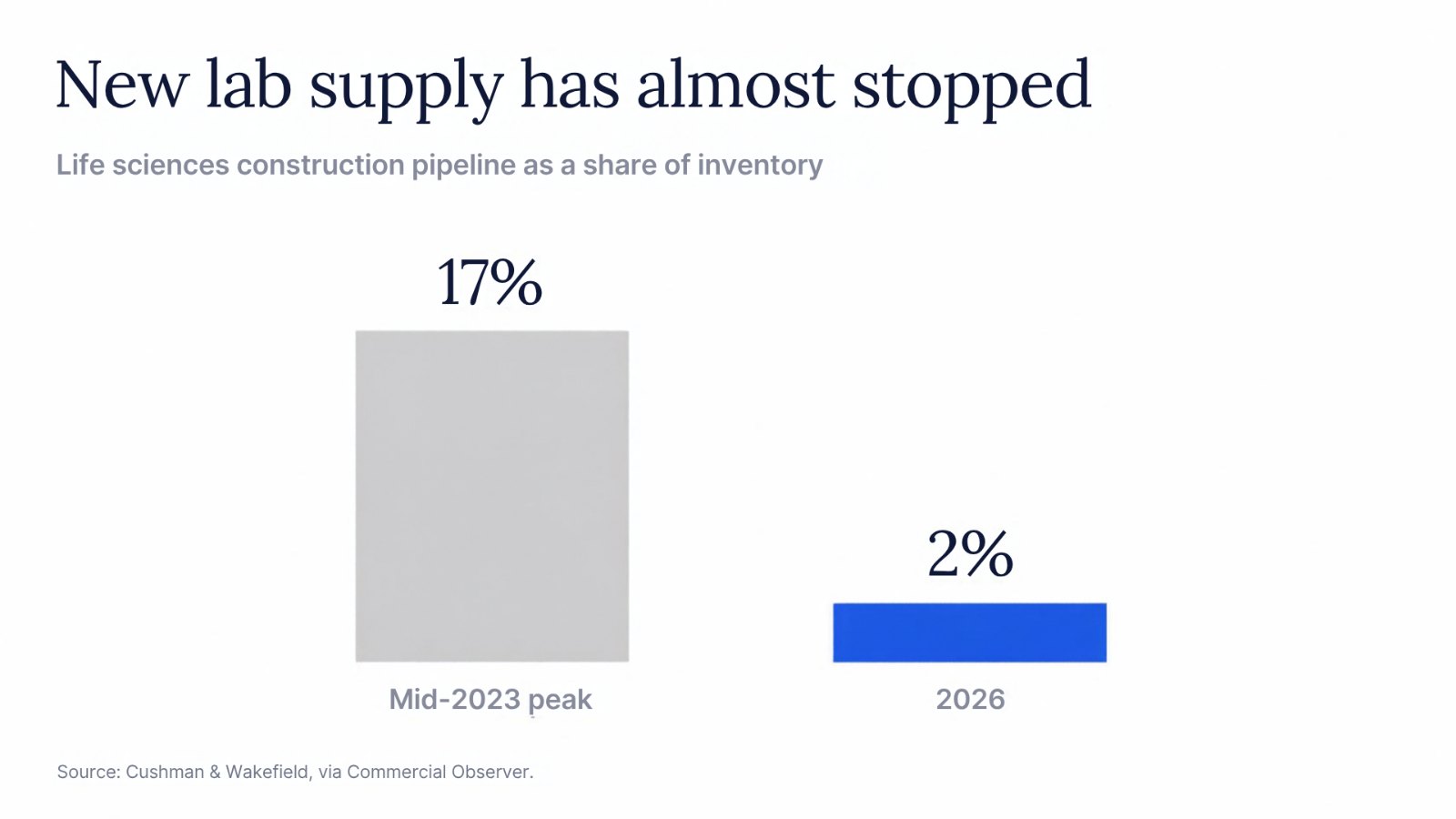
Supply is no longer adding to the problem. The construction pipeline equals about 2% of inventory, down from 17% at its mid-2023 peak. CBRE reported the first quarterly decline in national lab vacancy since 2022 at the end of last year, to 23%.
The 2021 cycle turned funding into space almost directly
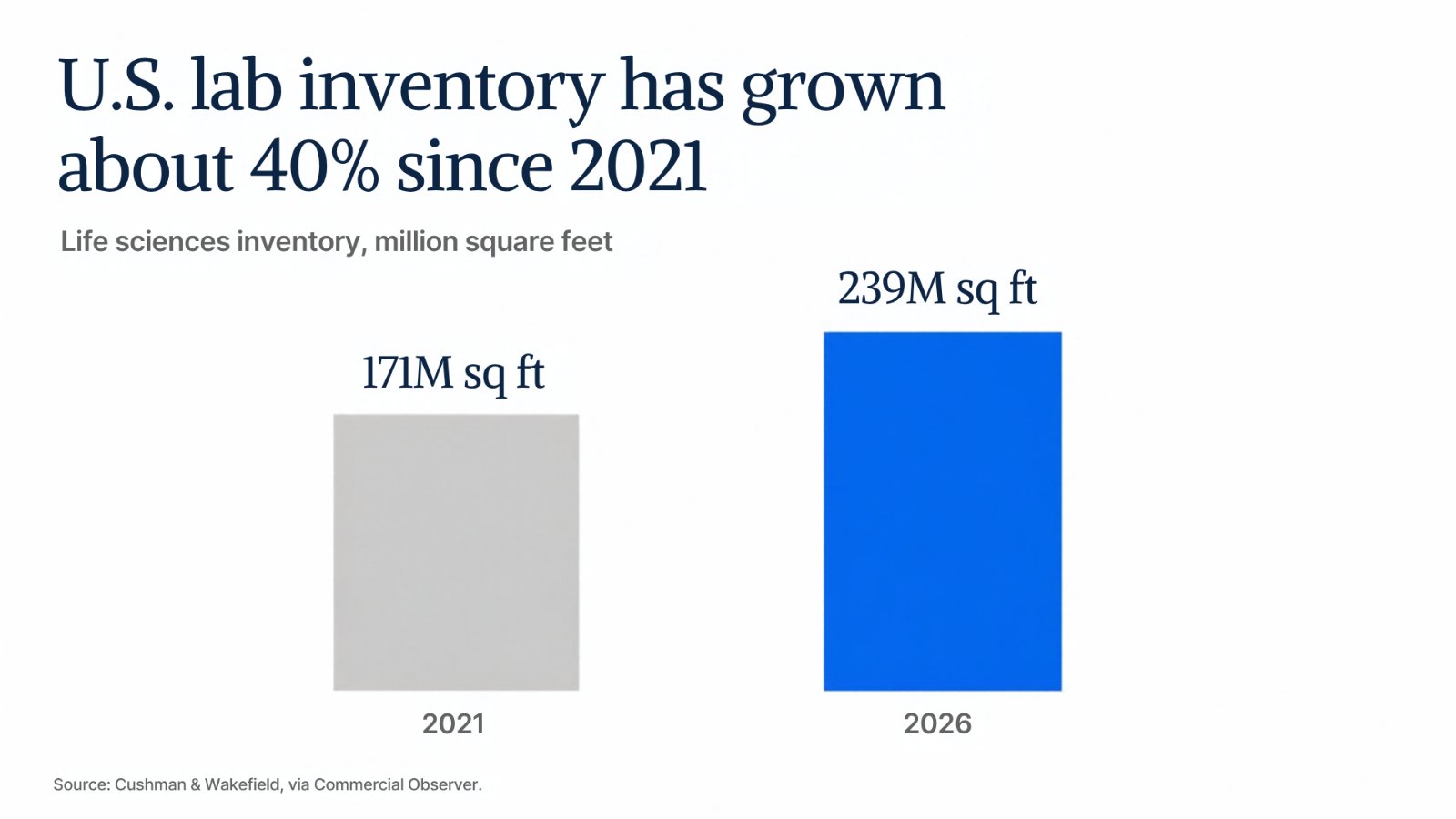
The last cycle shows how close the link once was. In 2020 and 2021, record venture funding went to a wide range of early-stage companies, each of which needed its own lab. Developers responded, and life sciences inventory grew from 171 million square feet in 2021 to 239 million square feet today, an increase of about 40%. Much of that space was planned while the funding surge was at its height and delivered after it had passed.
That experience shapes how investors read today’s numbers. If funding is back, the reasoning goes, the leasing that followed funding in 2021 should follow it again.
This cycle’s capital needs less space per dollar
The composition of the funding has changed. Cushman & Wakefield reports that the average life sciences venture deal in the first half of 2026 was 33% larger than the 2025 average, which means capital is concentrating in fewer companies. Much of it is going to later-stage programs, where spending shifts toward clinical trials and away from bench research. Some of the largest rounds have gone to AI-driven drug discovery companies, which do more of their early work computationally and need smaller wet labs relative to the capital they raise.
The New York numbers illustrate the result. Funding more than doubled, yet the largest leases of the quarter were 46,000, 42,741 and 41,000 square feet, according to Savills. Demand is real, but it arrives in smaller units than the funding totals suggest.
“Demand is real, but it arrives in smaller units than the funding totals suggest.”
Where the market is likely to go
We expect national lab vacancy to stay in the low-to-mid 20s through 2027 and to begin falling only gradually, with sublease space, now 3.4% according to Cushman & Wakefield, shrinking first. Rents should stabilize before they recover, as landlords trade concessions for occupancy. The improvement will be uneven. Chicago and Raleigh-Durham recorded meaningful declines in vacancy in the second quarter, while New York remains above 30%.
Within each market, newer buildings with flexible floor plates and shared amenities should lease first, because they suit the smaller requirements this cycle produces. Older single-tenant conversions face a longer wait.
Hiring could close the gap faster than we expect
A fair objection is that it is too early to judge. Funding that arrived in the first half of 2026 may not show up in leasing until 2027, and job postings, which Cushman & Wakefield reports rose 8% in the first half, often lead space decisions. If hiring continues and M&A creates well-funded acquirers, demand could recover faster than we expect.
We agree that leasing will improve from here. Our view concerns its pace, which depends on how much space each funded company needs. Larger rounds to fewer companies, and more computational work per program, point to lower lab demand per dollar than in 2021. Even a full recovery in funding would not fill an inventory that grew about 40% in five years at the old ratio.
The signal to watch is space per dollar raised
For investors, the main implication is to underwrite life sciences assets on the specific tenants that can lease them, more than on national funding totals. The figures released this autumn show a sector whose capital has recovered. They also show that capital and space have separated, and the useful measure for the next two years is how much lab each dollar of funding actually leases.
Sources: Savills via CRE Daily (September 2026); Cushman & Wakefield Life Sciences Update 2026 (via Webull and Commercial Observer); CBRE via Connect CRE; Xtalks.