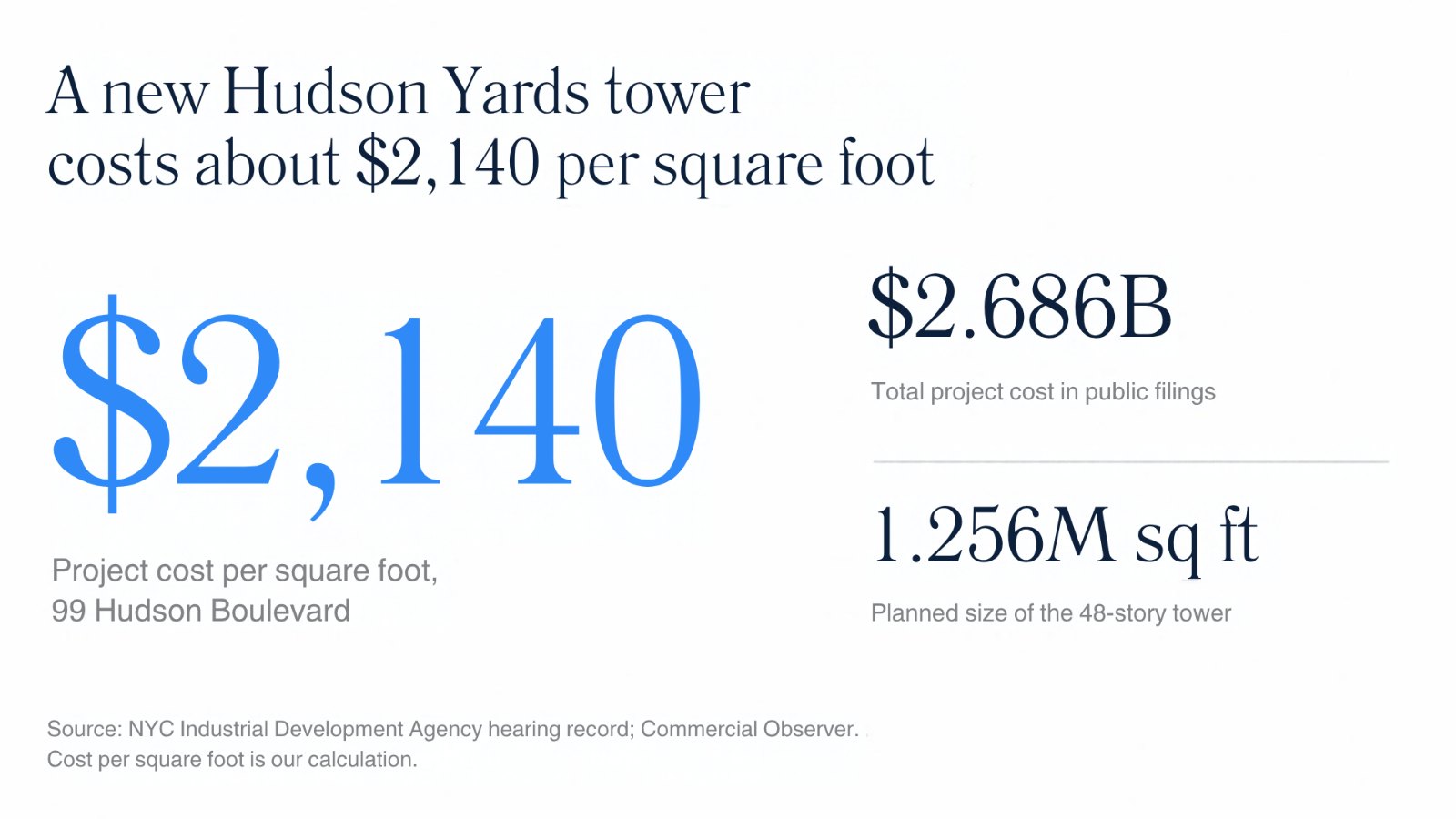
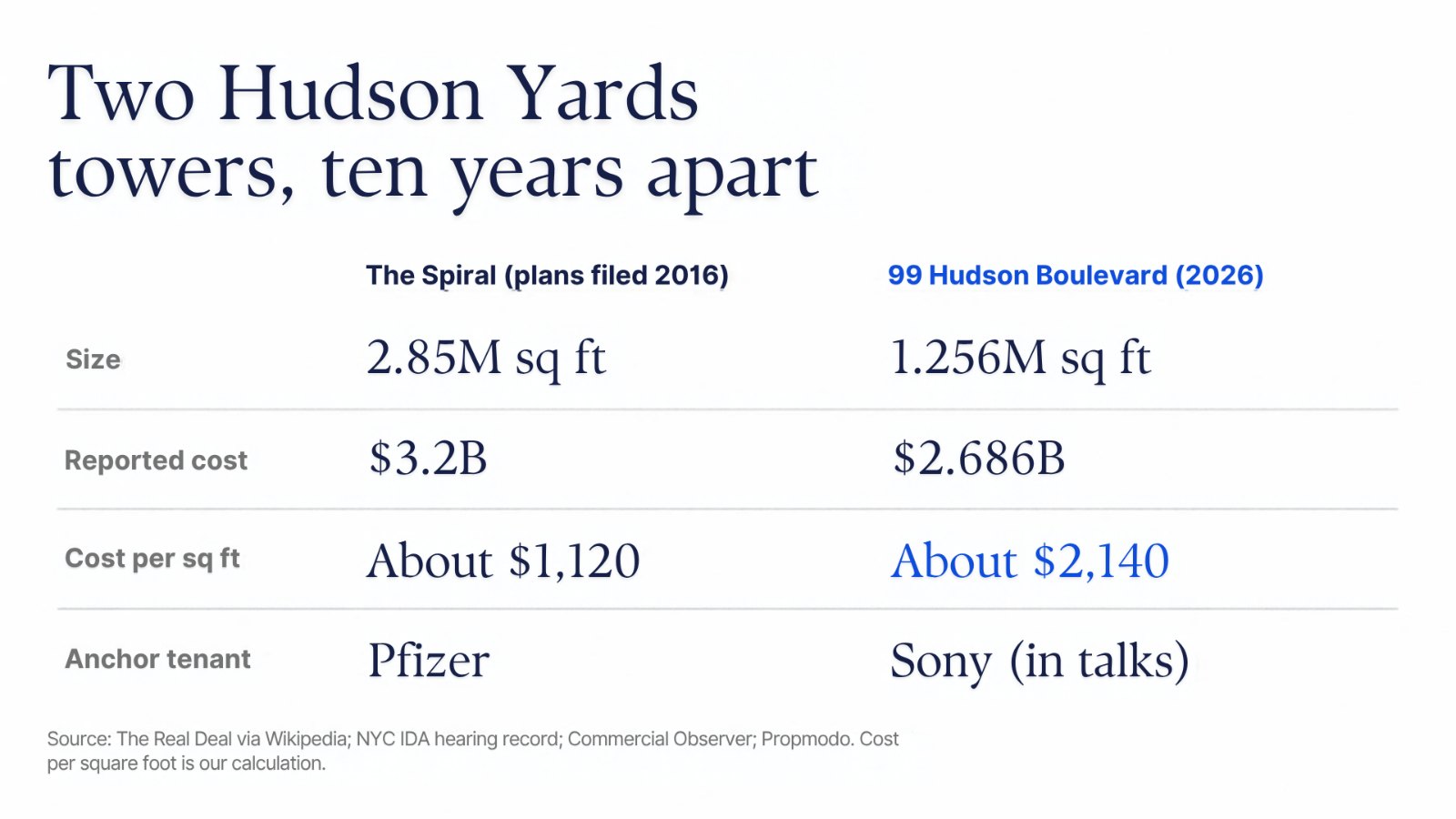
On October 2, Commercial Observer reported that Sony is negotiating to anchor 99 Hudson Boulevard, a planned 48-story, 1.256 million-square-foot office tower that Tishman Speyer intends to build in Hudson Yards. Public filings put the project’s cost at $2.686 billion, funded with a $1.477 billion loan and about $1.2 billion of equity. That works out to roughly $2,140 per square foot. Two weeks earlier, New York City’s Industrial Development Agency postponed its vote on $92.2 million of tax relief for the project and moved it to November 17.
Most coverage reads the project as a sign that Manhattan office development is back. We think the more useful reading concerns cost. At about $2,140 per square foot, a new tower only works with a large anchor tenant committed years ahead of delivery and with public tax relief, and very few sites in the city can assemble both. That constraint will keep new office supply thin through the end of the decade, and it decides who gains and who loses in the sector over that period.
The return of cranes looks like the end of scarcity
The common reading follows a familiar cycle. Manhattan availability fell to 12.4% in the third quarter, according to Colliers, and Midtown has returned to its pre-pandemic availability. Average asking rents reached $85.08 per square foot, the highest since July 2020. When rents rise and space runs short, developers build, and new supply eventually caps rents. On that view, 99 Hudson Boulevard and a handful of other anchored projects mark the start of a normal construction cycle.
The national figures show how far that cycle has to run. Cushman & Wakefield counts 19.7 million square feet of office space under construction across the U.S., about 0.4% of inventory. Only five markets, Midtown Manhattan among them, have more than 1 million square feet underway.
The arithmetic of a new tower limits how many get built
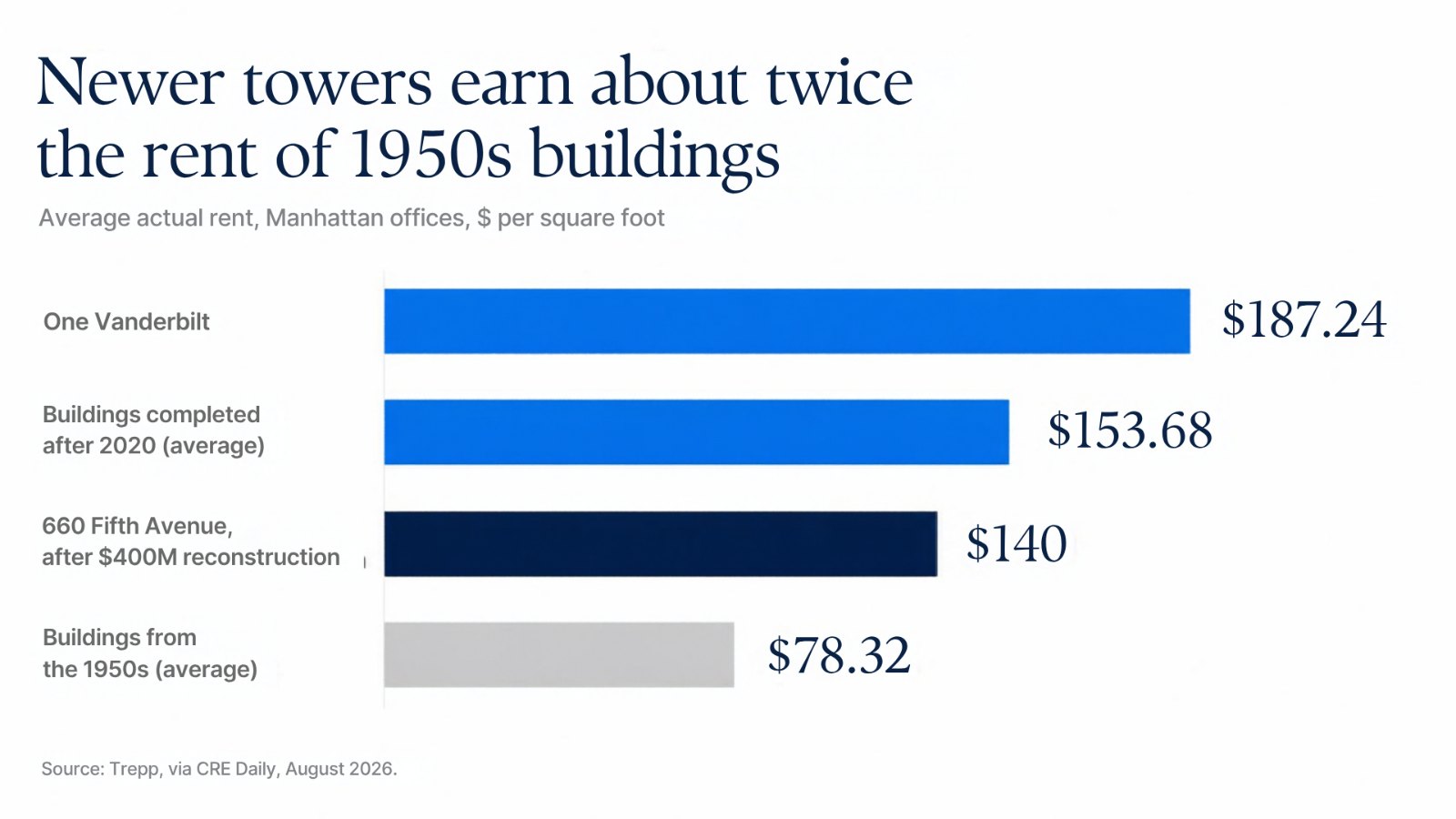
New construction now costs far more than most of the market pays in rent. Trepp data reported by CRE Daily in August shows Manhattan offices built after 2020 achieving average actual rents of $153.68 per square foot. Buildings from the 1950s average $78.32, and pre-1930s buildings average less than $60. Cushman & Wakefield put the Midtown average asking rent at $76.98 in mid-2026.
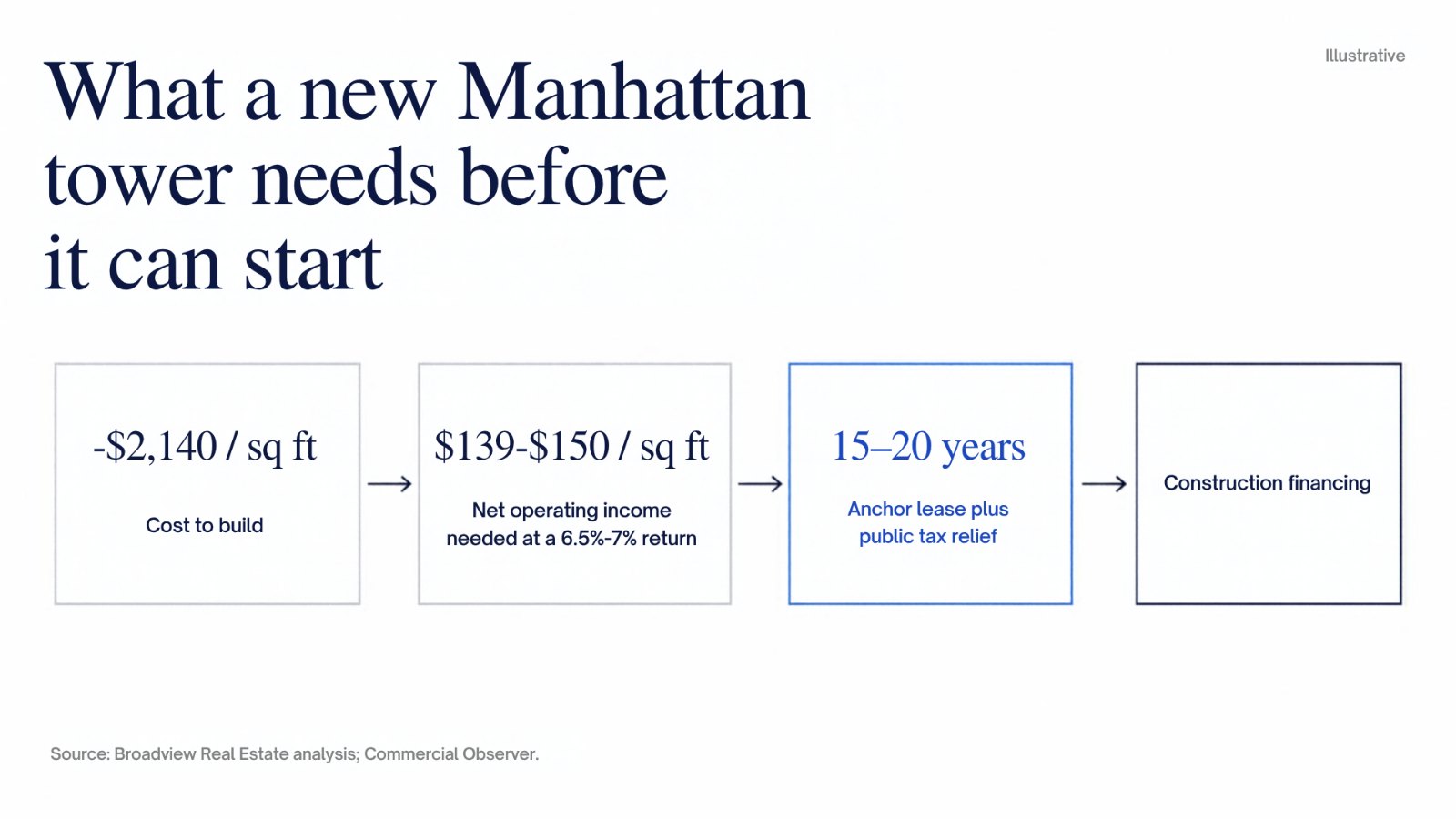
On our estimate, a developer seeking a 6.5% to 7% return on a cost of $2,140 per square foot needs net operating income of roughly $139 to $150 per square foot. Gross rents must sit above that to cover operating expenses and real estate taxes, which is why tax relief carries so much weight in the underwriting. Only the newest towers earn rents in that range today. Lenders also want income secured before they fund a building of this size: Commercial Observer has reported that anchor leases on new Manhattan towers often run 15 to 20 years so that developers can obtain construction financing.
A decade ago the same developer built at roughly half the cost per foot
Tishman Speyer’s own history offers a close comparison. When the firm filed plans in 2016 for The Spiral, a 2.85 million-square-foot tower a few blocks south, the reported project cost was $3.2 billion, or about $1,120 per square foot. The building was roughly half leased when it topped out in 2021 and opened in 2023 with Pfizer’s headquarters as its anchor. On those figures, the cost of a comparable Hudson Yards tower has risen by about 90% per square foot in ten years. The rent premium for new space has to absorb that increase, which is why the projects that proceed today are the ones with a committed anchor.
Owners of new towers gain, and the buildings anchors leave carry the risk
The first group to gain is the owners of towers completed since 2020. Trepp found these buildings command premiums of 30% to 50% over earlier Class A properties, and few of them have space to offer. With little new supply arriving before about 2030, that premium has little to erode it. One Vanderbilt achieves $187.24 per square foot in actual rent, while 660 Fifth Avenue, after a $400 million reconstruction, achieves about $140.
The second group is developers holding entitled sites in districts with an established tax-relief framework. In Hudson Yards, the 2006 Uniform Tax Exemption Policy gives commercial projects a path to payments in lieu of taxes, and those payments service the bonds that financed the 7-train extension. A site without that framework carries the full tax load on top of the full construction cost.
Two groups are worse off. Large tenants that need contiguous space before 2030 will pay record rents or wait, since Newmark reports that Class A large-block space in Manhattan has fallen 51.4% since 2021. Owners of the buildings that anchors leave carry a less visible risk. Sony occupies 568,000 square feet at 11 Madison Avenue, according to Commercial Observer, and a move would return a large block of older space to the market at the end of the decade. Each anchored tower shifts demand into new product and leaves the backfill problem with the building it empties.
“Each anchored tower shifts demand into new product and leaves the backfill problem with the building it empties.”
The strongest objection is that new supply will arrive faster than we expect
The fair counterargument is that rising rents will draw in more developers, and that several towers delivering around 2030 could compress the new-building premium just as they open. In October 2025, Commercial Observer listed a group of large anchored projects in Manhattan, including BXP’s 3 Hudson Boulevard, RXR and TF Cornerstone’s 175 Park Avenue, and Related’s 625 Madison Avenue. If several of them deliver within a few years of each other, the premium for new space could narrow in specific submarkets.
We accept that risk for those submarkets, and we think it is limited for the sector. Anchored projects deliver much of their space to tenants who have already committed, so their effect on available supply is smaller than their size suggests. The political cost of tax relief is also rising. The 99 Hudson vote was deferred, and the public hearing drew written opposition questioning the jobs estimate and the use of the resulting payments. Any project that needs public assistance now faces a longer and less certain approval path, which slows the response of supply to rents.
Construction cost is now the reference price for the top of the market
For the office sector, the practical effect is that the cost of building has become the benchmark for the best space. Rents in new towers will need to stay near the level that justifies building them, and older buildings will be priced at a discount to that level that widens with age. Renovation can narrow the gap, but the Trepp figures for 660 Fifth Avenue suggest it rarely closes it.
The IDA’s November 17 vote concerns $92.2 million of tax relief. Its practical result will be one of the few inputs that decide how much new office space Manhattan has in 2030, and the price against which every older building in the market will be measured.
Sources: Commercial Observer (Sony talks; Colliers Q3 2026; anchor tenants, October 2025); NYC Industrial Development Agency hearing record; Bloomberg via Audacy; Propmodo; Crain’s New York Business; Trepp via CRE Daily; Cushman & Wakefield Q2 2026 U.S. Office MarketBeat; Newmark; The Real Deal via Wikipedia.