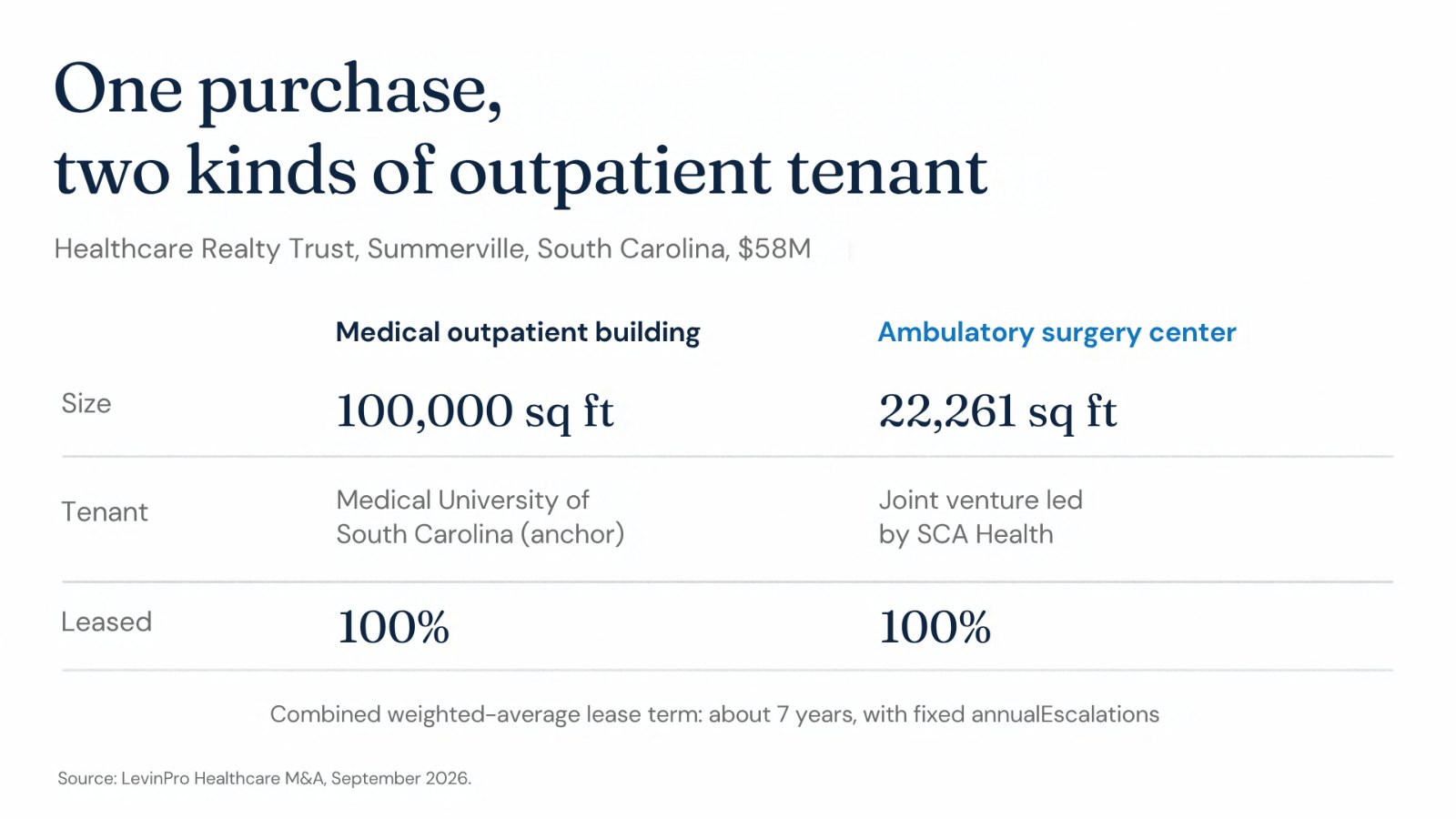
On September 16, Healthcare Realty Trust announced a $58 million purchase of two properties in Summerville, South Carolina, which LevinPro described as the company’s first announced deal of the year. The package pairs a 100,000-square-foot medical outpatient building anchored by the Medical University of South Carolina with a 22,261-square-foot surgery center fully leased to a joint venture led by SCA Health. Both assets are 100% leased, with a weighted-average lease term of about seven years and fixed annual escalations.
The deal is small, but its composition is telling. The largest pure-play owner of medical outpatient buildings in the country chose to announce a health-system building and an ambulatory surgery center in one transaction. We read that as a response to Medicare policy that is moving the economic value of outpatient care, and with it the value of outpatient real estate, away from hospital-billed space and toward surgery centers and physician-run settings. The change will separate medical buildings that looked alike a few years ago.
The usual view treats all outpatient space as one trade
Most investors still describe medical outpatient buildings as a single, steady sector. The aggregate fundamentals are consistent with that view. Cushman & Wakefield reported that medical outpatient absorption reached 3.8 million square feet in the first quarter of 2026, up 71% from a year earlier, and occupancy across the top 50 markets reached 92.5%. Investors have long treated a lease to a hospital system as the safest income in the sector, because health systems carry strong credit and rarely leave a building once they have fitted it out.
That reading looks at demand for space. It gives less attention to how the tenants in that space are paid, and Medicare is changing that quickly.
Medicare is narrowing the premium for hospital-billed outpatient care
The Centers for Medicare & Medicaid Services released its proposed 2027 outpatient payment rule on July 2, and a final rule is expected later this year. It would extend site-neutral payment to imaging without contrast, such as CT and MRI, performed in excepted off-campus hospital outpatient departments. Those departments would be paid at 40% of the hospital outpatient rate, the same approach CMS already applies to clinic visits and drug administration in those settings.
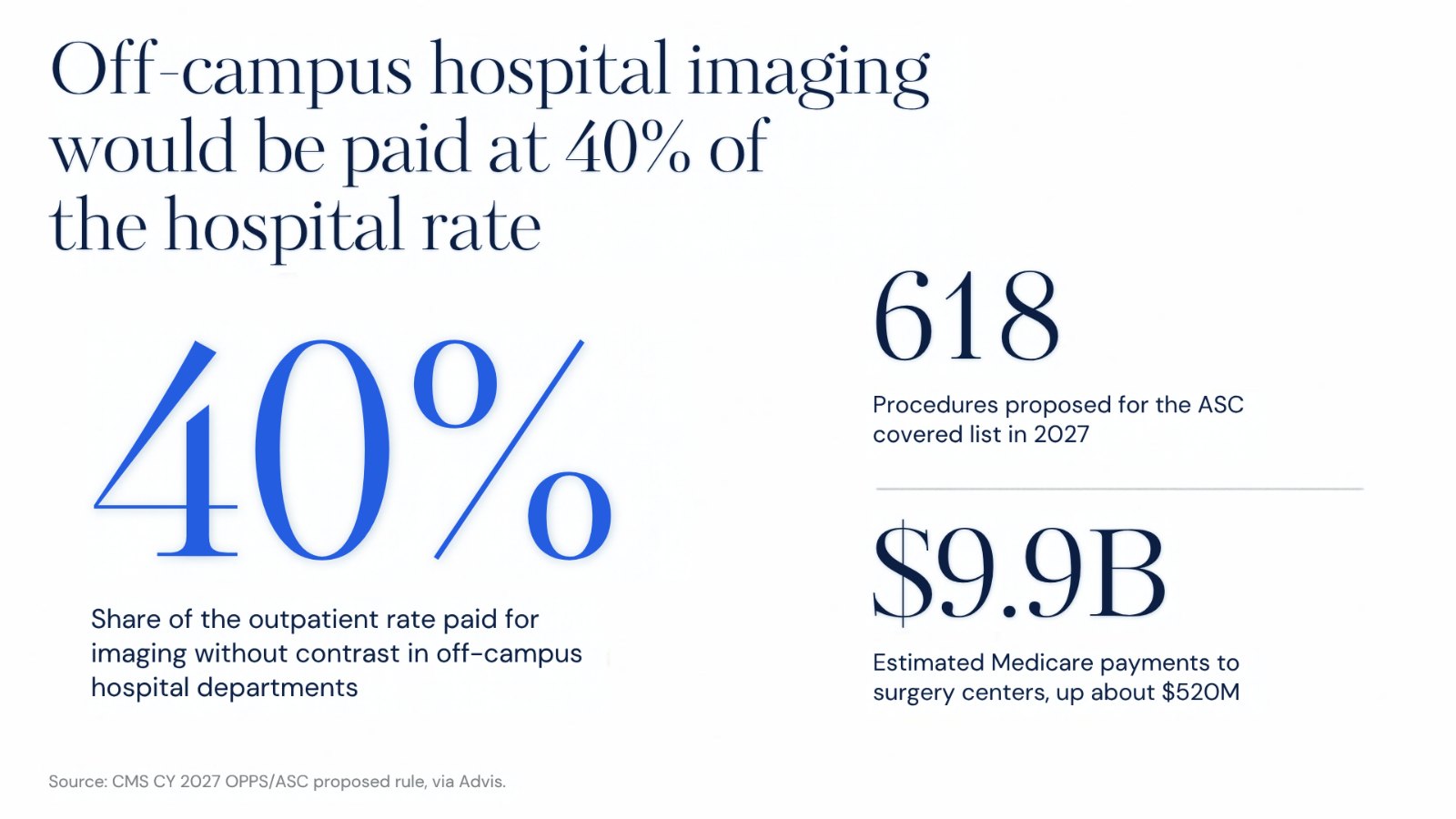
The rule also continues the three-year phase-out of the inpatient-only list. CMS proposes to remove 637 procedures from the list for 2027 and to add 618 codes to the list of procedures Medicare will pay for in an ambulatory surgery center. A separate provision, required by Congress, would make payment to each off-campus hospital department conditional on its own billing number and a provider-based attestation from January 2028.
The policy redistributes revenue among tenants
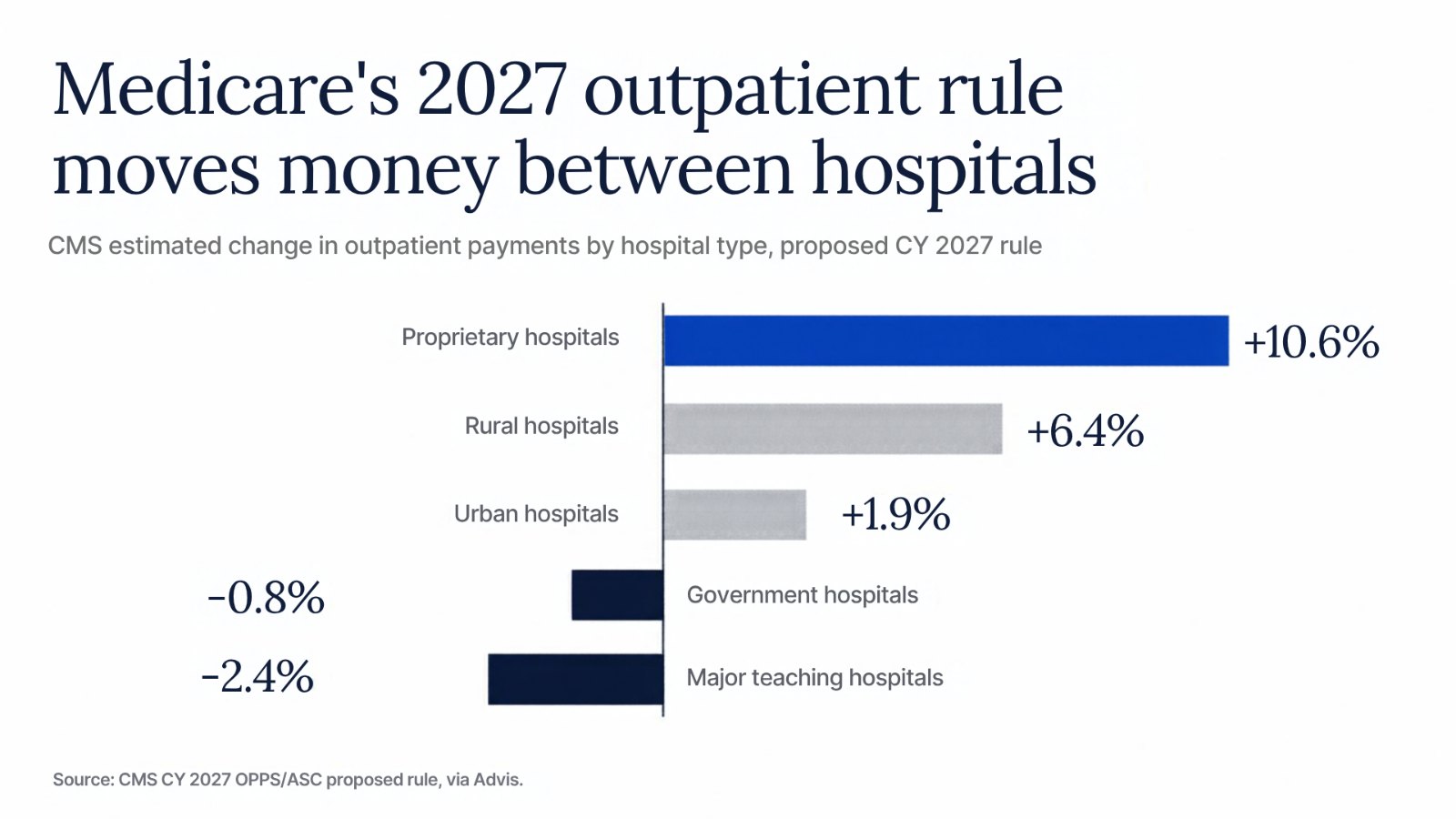
The payment estimates show how uneven the effect is. CMS projects that major teaching hospitals would see payments fall 2.4% and government hospitals 0.8%, while proprietary hospitals would gain 10.6%, according to a summary by the consulting firm Advis. A proposed cut to payments for drugs bought under the 340B program, worth about $4.55 billion, falls mainly on safety-net and teaching systems. Total Medicare payments to surgery centers would rise to about $9.9 billion, roughly $520 million more than in 2026.
For landlords, the question is what these changes do to each tenant’s ability to pay rent and grow. A hospital system that bills imaging in an off-campus department loses much of the payment premium that justified the space. A surgery center joint venture gains access to hundreds of procedures it could not perform for Medicare patients before. Both may sit in the same building type, under similar leases, with similar credit ratings on paper.
Site-neutral policy has moved in one direction for a decade
The current rule extends a long sequence. Medicare created the inpatient-only list in 2000. The Bipartisan Budget Act of 2015 limited higher hospital rates for off-campus departments opened after that year, and CMS has since applied site-neutral rates to clinic visits, then to drug administration in the 2026 rule, and now proposes imaging. Courts have checked some policies, including the 340B cuts CMS imposed from 2018 to 2022, which the Supreme Court overturned. The site-neutral direction itself has survived changes of administration and of Congress.
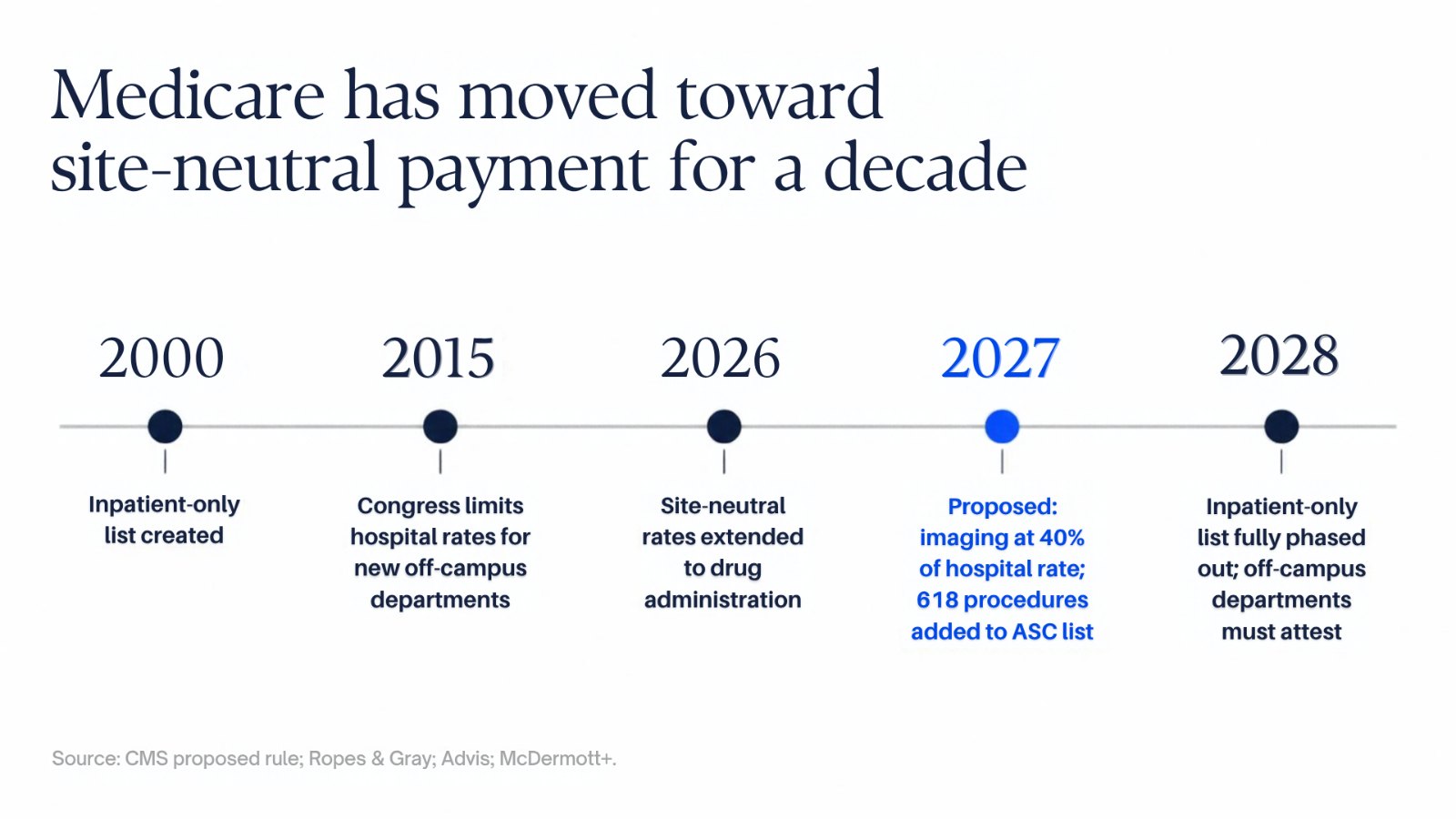
For a sector where medical leases often run seven to ten years, that consistency matters more than any single rule. A building leased today will spend most of its term under a payment system that favors lower-cost settings more than the current one does.
Surgery center space and physician-run space gain the most
The first group to benefit is owners of buildings that can house ambulatory surgery centers. These buildings need heavier structure and specialized air handling, which raises fit-out costs above the $412 per square foot JLL cites for a basic medical outpatient fit-out and makes tenants slow to move once installed. Owners of space leased to physician groups that perform imaging and procedures outside the hospital billing system are the second group. Their tenants’ Medicare rates do not fall under the new rule.
The groups under pressure are owners of off-campus space whose income depends on hospital departments billing imaging or clinic services at hospital rates, and landlords concentrated in teaching and safety-net systems facing 340B and site-neutral cuts at the same time. Their leases will continue, but renewals and expansion plans will reflect the lower revenue the space now produces.
Most procedures will stay in hospitals for now, and that limits the shift
The main objection comes from the surgery center industry itself. The Ambulatory Surgery Center Association said the proposal would reduce payments for the most common procedures ASCs perform, and that most of the newly eligible procedures will still be done in hospitals for the foreseeable future. Proposed rules also change before they are final, and 340B policy in particular has a record of reversal in court.
We agree that the shift will be gradual, and we expect hospital outpatient demand to remain substantial. For real estate, the effect shows up in where health systems and physician groups choose to add space over the next lease cycle and in which tenants can afford higher rents at renewal. A slow migration of volume is enough to move both. On both counts the payment rules now point toward surgery centers and physician-run settings.
Underwriting the tenant’s payment mix
The sector’s high occupancy will continue to lift the whole category. Inside it, the useful distinction is between space whose tenants are paid at hospital rates for services Medicare is moving to site-neutral payment, and space whose tenants gain from the change. Healthcare Realty’s Summerville purchase pairs a health-system building with a surgery center, which gives it a position on each side of that line. Investors evaluating medical outpatient buildings will increasingly need to read a tenant’s Medicare payment mix with the same care they give its credit rating.
“Investors evaluating medical outpatient buildings will increasingly need to read a tenant’s Medicare payment mix with the same care they give its credit rating.”
Sources: LevinPro Healthcare M&A (September 2026); Centers for Medicare & Medicaid Services, CY 2027 OPPS/ASC proposed rule, with summaries by Advis, McDermott+, Ropes & Gray and J. Taylor; Cushman & Wakefield 2026 Vital Signs; JLL via Facilities Dive.