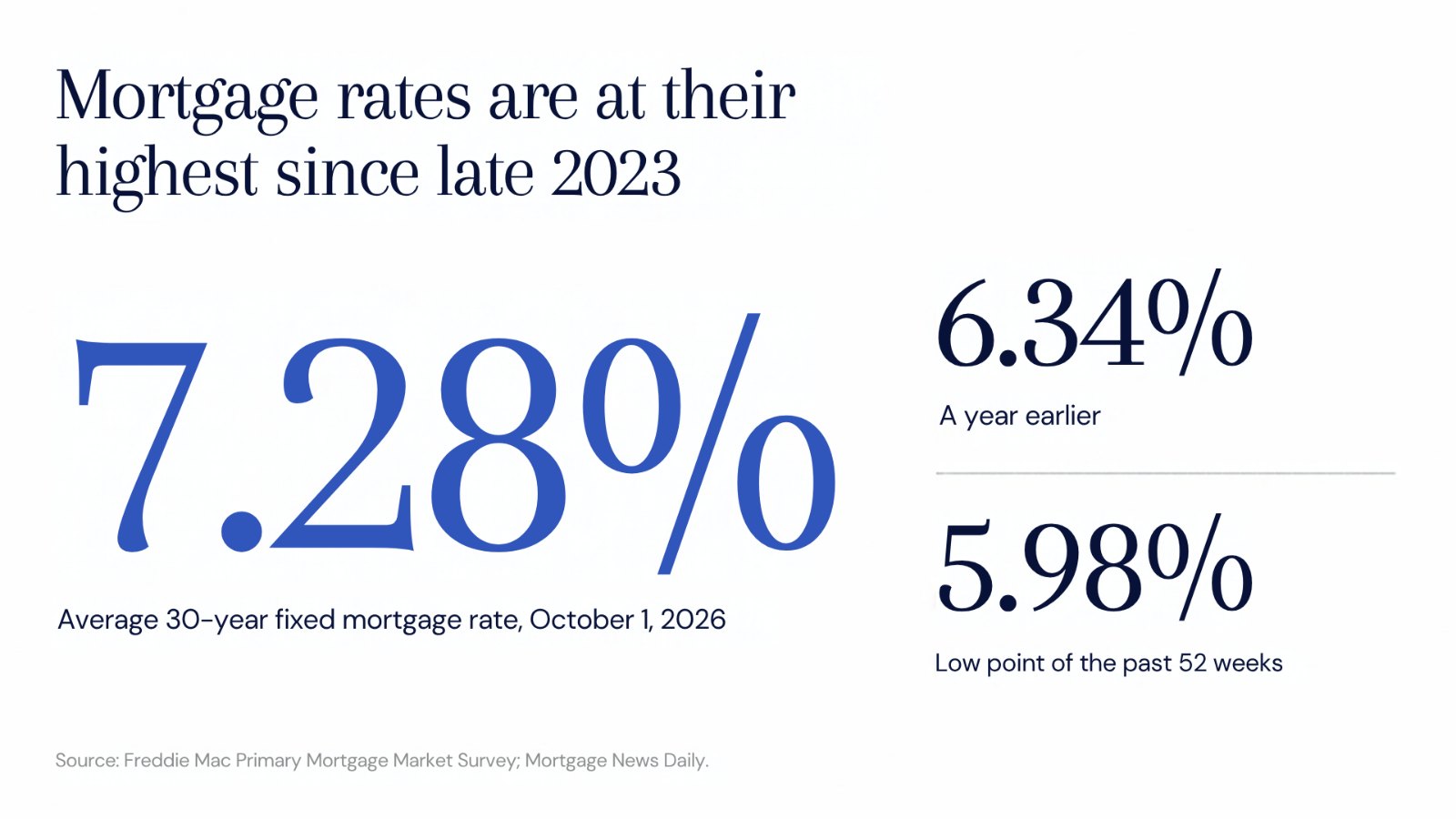
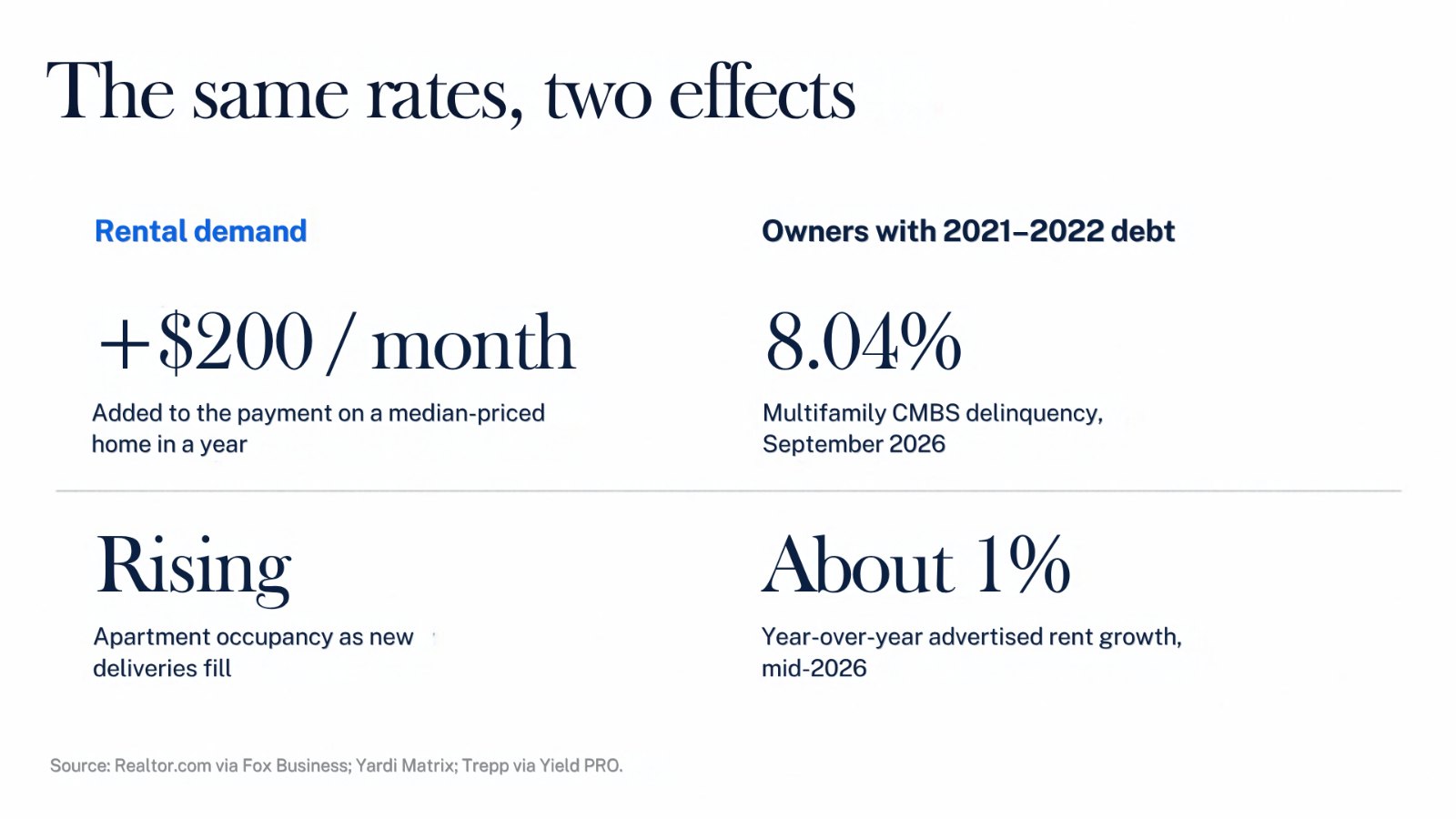
On October 1, Freddie Mac reported that the average 30-year fixed mortgage rate rose to 7.28%, up from 7.03% a week earlier and 6.34% a year ago. It was the highest reading since late 2023. The rate had been as low as 5.98% within the past year. A Realtor.com economist said the increase of nearly a full percentage point over twelve months had added more than $200 to the monthly principal and interest payment on a median-priced home, even though the median price itself had fallen.
The usual reading is that higher mortgage rates are good news for apartment owners, because households that cannot afford to buy keep renting. We think that is correct about demand and too quick about rents. The rate move will lengthen the time households spend as renters and lift occupancy, but national rent growth is still held down by the apartments delivered over the past three years. The likely result over the next year is fuller buildings with modest rent growth, while the same interest rates add pressure to owners who financed apartments at the top of the last cycle.
Higher mortgage rates are expected to lift apartment rents
The case for rental strength is straightforward. When the cost of owning rises, fewer renters move into homeownership, and demand for rented housing grows. The monthly payment on a median-priced home has risen even as prices have softened, which widens the gap between the cost of owning and the cost of renting. On that view, owners of apartments and single-family rentals should be able to raise rents as the renter pool expands.
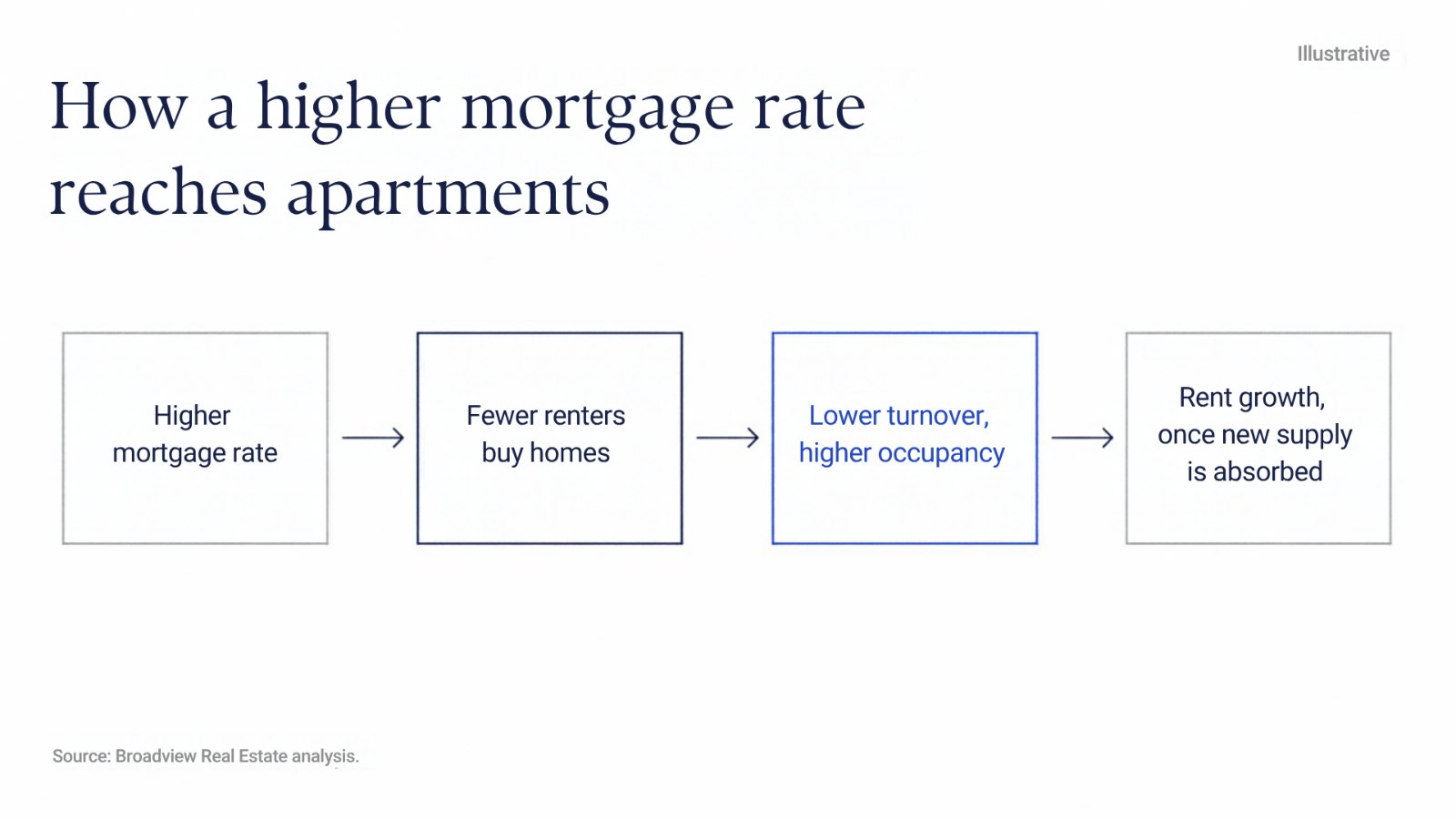
There is evidence of firmer demand. Yardi Matrix reported in its September national report that occupancy has risen in recent months as new deliveries are filled, and that third-quarter performance is showing signs of improvement.
Rents are still being held down by supply
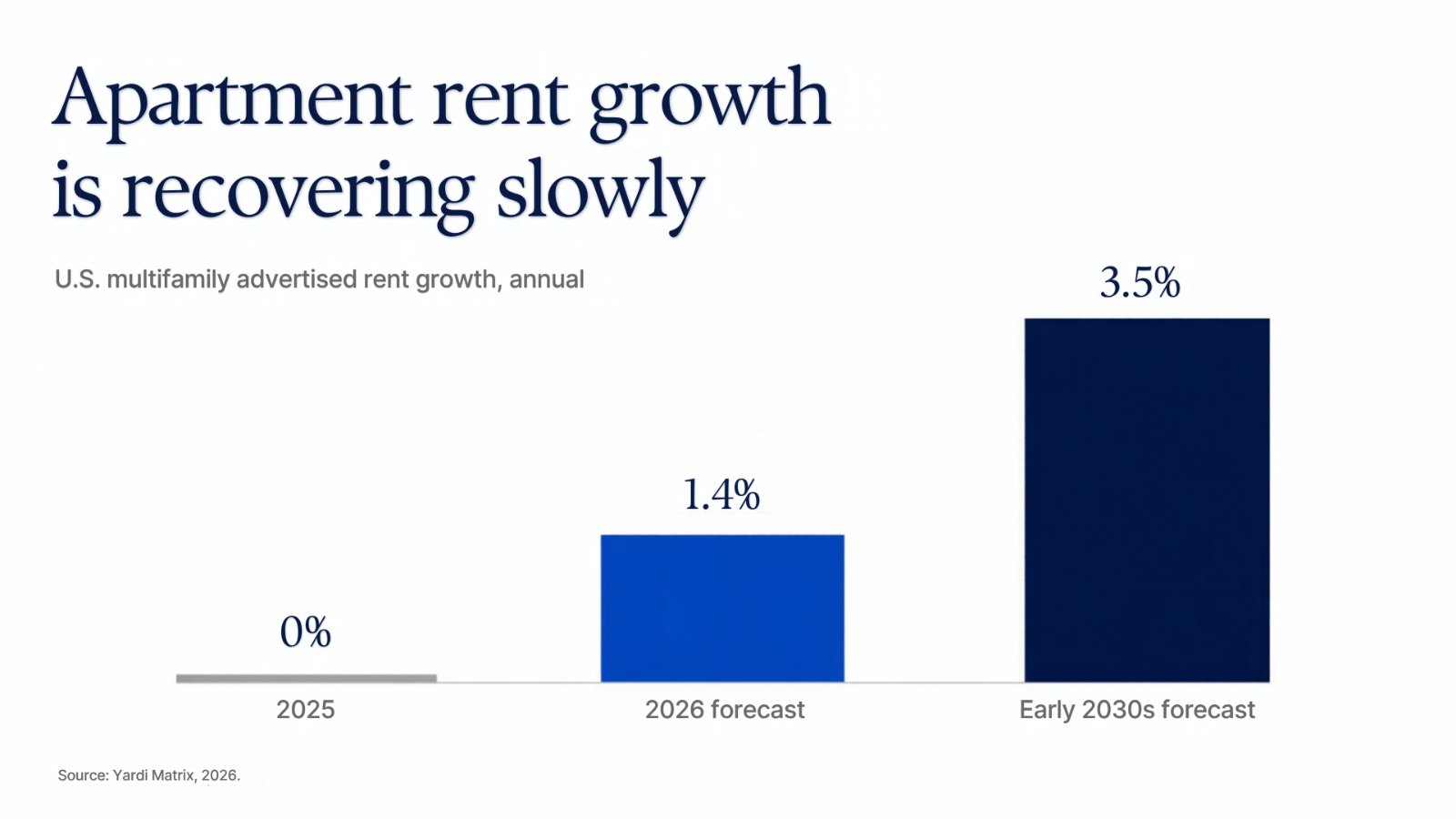
The rent data has not followed. Yardi Matrix recorded national advertised rent growth of about 1% year over year through mid-2026 and forecasts 1.4% for the full year. Advertised rents fell slightly in September. In 2025, national advertised rents did not rise at all for the first time since 2020. In markets that absorbed the largest wave of new construction, such as Austin and Phoenix, Yardi expects rents to decline this year.
The reason is the volume of new apartments still being leased. Concessions remain common in high-supply metros, and RealPage has described concession use narrowing in recent months while discounts on the units that still carry them have deepened. Owners are choosing occupancy over rent, which is the right response while new buildings compete for the same tenants.
The 2023 rate peak offers a useful comparison
The last time mortgage rates were this high, in late 2023, the apartment market was entering the peak of its delivery cycle. Higher rates then kept many renters from buying, but rents still flattened because a record number of new units arrived at the same time. The current period differs in one important way. RealPage reported in September that multifamily development momentum has stalled. Demand pressure from high mortgage rates is now arriving as supply is starting to recede.
That combination points to occupancy gains first, with rent growth following as the remaining new supply is absorbed. Yardi Matrix projects annual rent growth recovering toward 3.5% in the early 2030s, and the rate move strengthens the case for that path.
The same rates create stress for some owners
The rental demand story is not the only effect of higher rates. Multifamily loans in commercial mortgage-backed securities became delinquent at a rate of 8.04% in September, according to Trepp, the first time since the pandemic that the multifamily rate exceeded the overall CMBS rate. Many of those loans were written in 2021 and 2022, at low interest rates and at values that assumed strong rent growth. Fuller buildings with flat rents do not produce the income needed to refinance them at today’s rates.
A fair objection is that renters cannot afford more
A reasonable objection holds that rental demand is limited by renters’ incomes, whatever happens to mortgage rates. Yardi Matrix has noted that it may be difficult to raise rents if the people renting workforce apartments do not see steadily rising incomes, and the labor market has softened. Higher rates may keep households renting without giving them more to spend on rent.
We think this objection explains the modest pace of rent growth. It does less to change the outlook for occupancy. Households that delay a purchase still need a place to live, and their demand shows up first as lower turnover and higher occupancy. Pricing power returns more slowly, and it will return first in markets with limited new supply, such as the gateway and Midwestern markets that have led rent growth this year.
Occupancy first, rent later
Through 2027, we expect apartment occupancy to keep rising while national rent growth stays in low single digits. Distress will concentrate in properties financed in 2021 and 2022. For investors, the useful distinction is between buildings whose income will benefit from a larger renter pool and loans that cannot wait for that income to arrive.
A 7.28% mortgage rate will be read as good news for landlords. For the next year, its clearest effect will be on who stays a renter, and only later on what those renters pay.
“For the next year, its clearest effect will be on who stays a renter, and only later on what those renters pay.”
Sources: Freddie Mac Primary Mortgage Market Survey (October 1, 2026); Realtor.com via Fox Business; Mortgage News Daily; Yardi Matrix (2026 reports); RealPage Analytics; Trepp via Yield PRO.