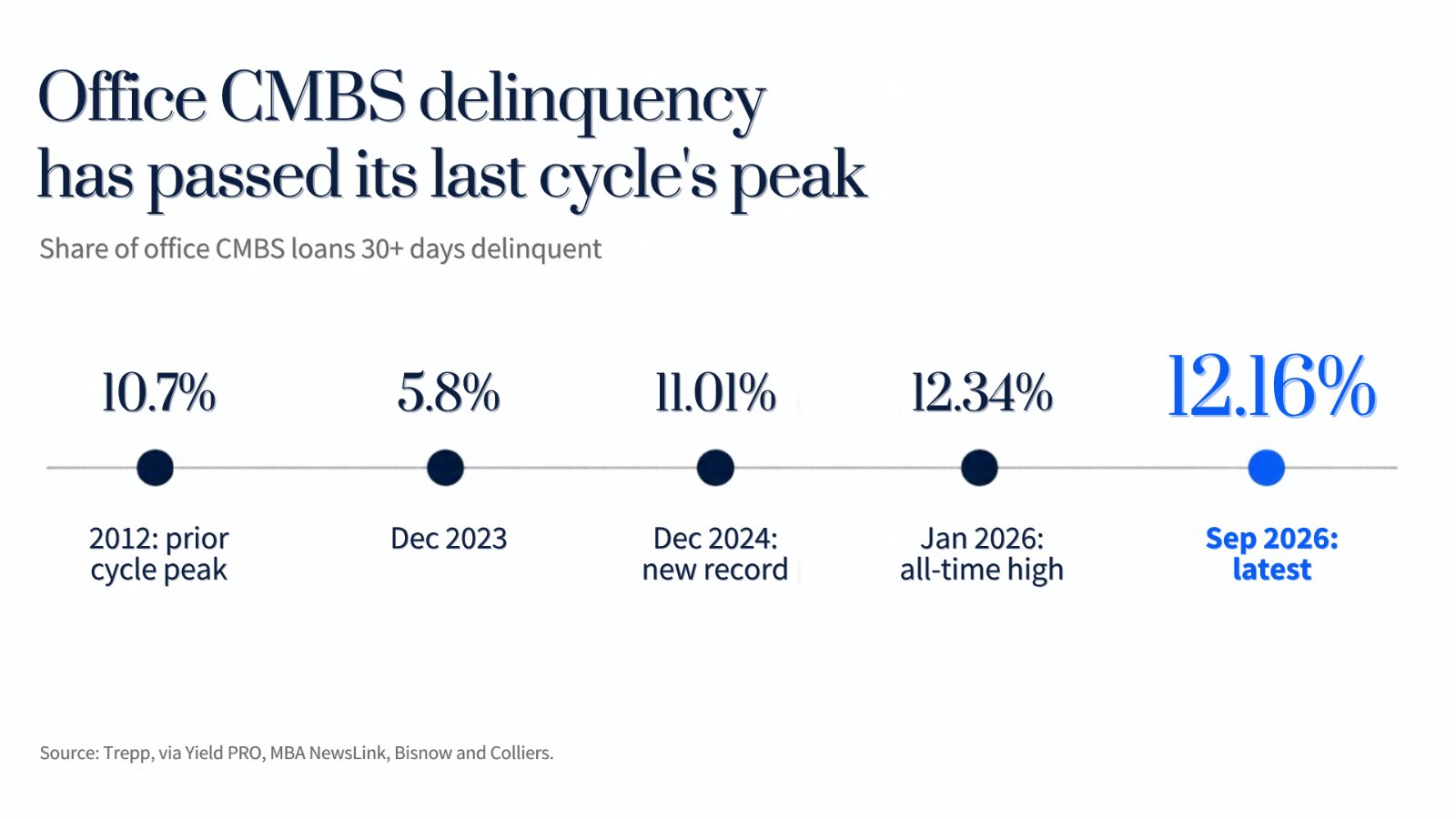
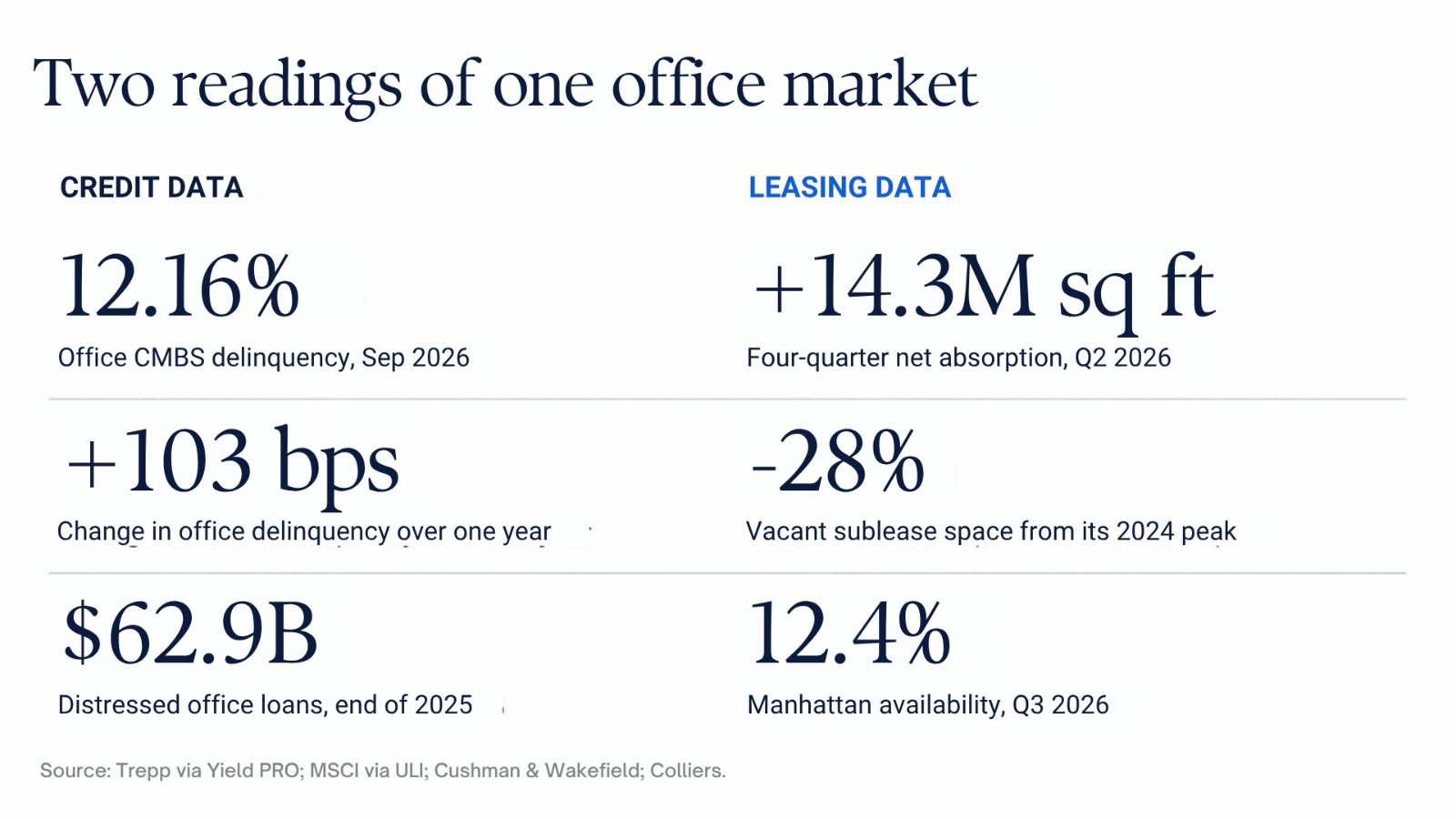
The share of office loans in commercial mortgage-backed securities that are 30 or more days delinquent rose 16 basis points in September to 12.16%, according to Trepp data reported on October 4. The rate is 103 basis points higher than a year ago and sits just below the record of 12.34% set in January. Three days earlier, Colliers reported that Manhattan’s office availability rate fell to 12.4% in the third quarter, its 10th straight quarter of tightening and the longest such run since 2007.
Read side by side, the two releases seem to conflict. We read them as one market measured at two points in its history. Leasing data records what tenants are deciding now. Delinquency data records what lenders decided five to ten years ago, and it will keep reporting those decisions until the last loans written at pre-2022 rates and values have matured. For the next 18 months, we expect office credit and office leasing to move in opposite directions, and we think investors should treat that gap as the expected shape of this stage of the cycle.
Each new delinquency figure is read as proof that the recovery is weak
The usual interpretation of a rising delinquency rate is simple: if more office borrowers are failing, the sector cannot be recovering. That reading has evidence behind it. Office accounted for $62.9 billion of distressed loans at the end of 2025, nearly half of the U.S. total, according to MSCI data cited by ULI. National vacancy, at 20.1% in Cushman & Wakefield’s second-quarter count, has been largely flat for eight straight quarters.
The leasing data has moved further than that reading allows. Cushman & Wakefield’s four-quarter net absorption reached 14.3 million square feet in the second quarter, the strongest level since 2020 and the seventh consecutive quarter of improvement. Class A buildings absorbed 24.5 million square feet over the same four quarters, the highest national total since mid-2020. Vacant sublease space fell 15.4% over the year to 95.6 million square feet, 28% below its early-2024 peak. In Manhattan, tenants signed more than 10 million square feet in each of the last four quarters, which Colliers says last happened in 2002, and average asking rents reached $85.08 per square foot, the highest since July 2020.
A refinancing default describes the loan more than the building
A CMBS loan becomes delinquent in one of two ways. The property can lose income and miss payments, or the loan can reach maturity without a refinancing. The second cause now dominates the office numbers. Colliers’ research team, citing Trepp, describes current office distress as driven mainly by refinancing pressure, with operating failure a smaller factor. Trepp also reports that if loans past maturity but still paying interest were counted, the overall CMBS delinquency rate would be 9.66%, against a headline rate of 8.02%.
A default at maturity says little about whether a building is leasing well today. It says the loan was sized against a value and an interest rate that no longer hold. A building can sign new tenants and still be unable to refinance a loan written in 2016 at a lower cap rate and a lower coupon. In that case the delinquency resolves the capital structure, and the space market carries on as before.
“A building can sign new tenants and still be unable to refinance a loan written in 2016 at a lower cap rate and a lower coupon.”
The last cycle shows how far credit can trail the economy
The years after the global financial crisis offer a close comparison. Office CMBS delinquencies built slowly and did not peak until 2011 and 2012, as loans matured into tighter credit and lower values. Trepp attributed that peak to five-year loans written in 2006 and 2007, the weakest underwriting years, coming due. The office rate reached about 10.7% in 2012, well after the economy had returned to growth.
The current cycle has moved faster. Office delinquency was 5.8% in December 2023, reached 11.01% a year later, and has held between 11.57% and 12.34% in every month of 2026. The pattern matches 2012 closely: credit data peaks on the maturity schedule of the debt, and the leasing market keeps its own timetable.
The maturity calendar will keep the rate near its high through 2027
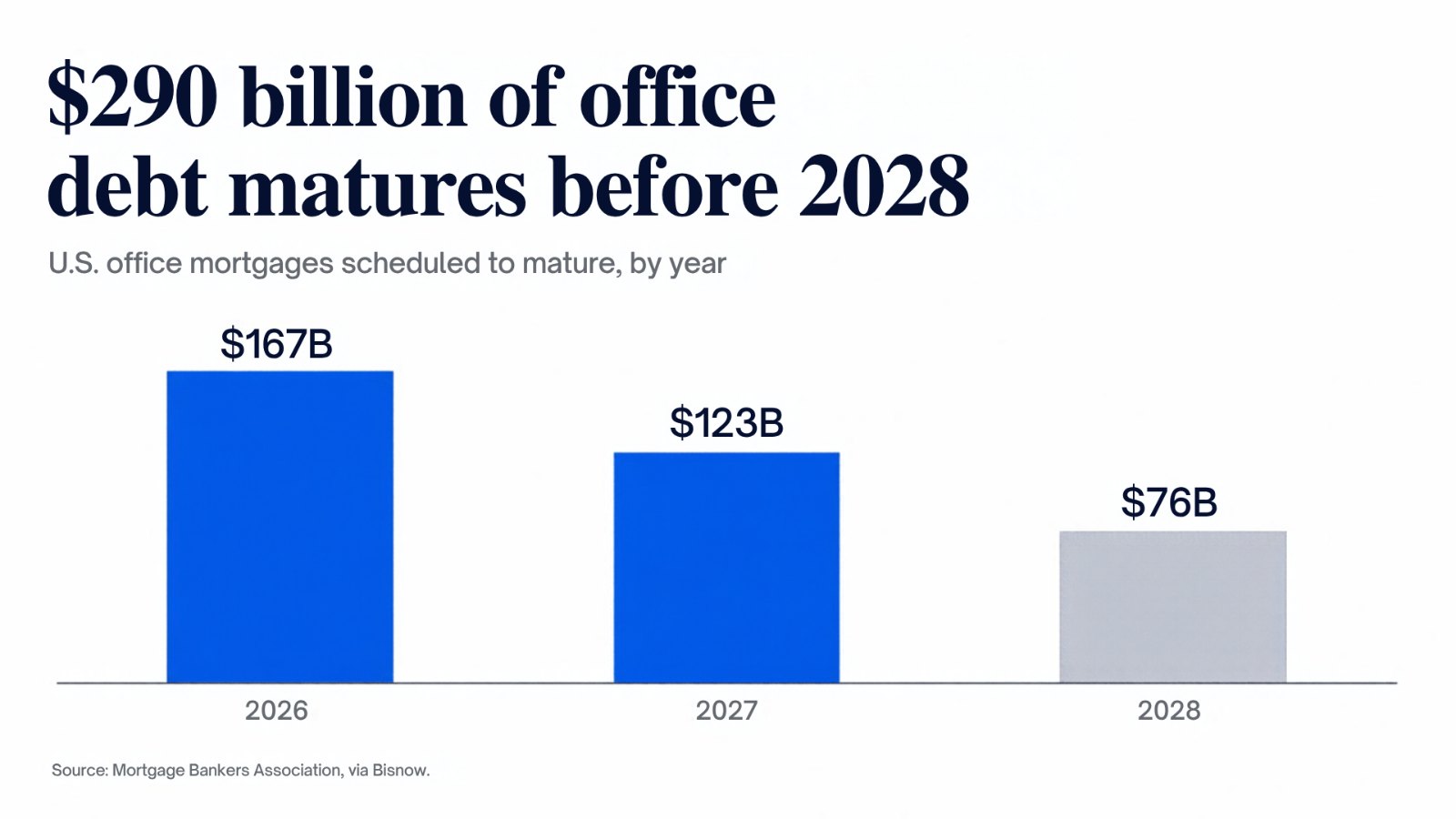
The Mortgage Bankers Association estimates that $167 billion of office mortgages mature in 2026 and another $123 billion in 2027, before the figure drops to $76 billion in 2028. The MBA also notes that commercial mortgage rates remain well above their pandemic-era lows, so many of these loans cannot refinance at their current size. We expect a meaningful share to be extended or handed back to lenders, which means the delinquency rate is likely to stay close to record levels well into 2027 even if leasing keeps improving.
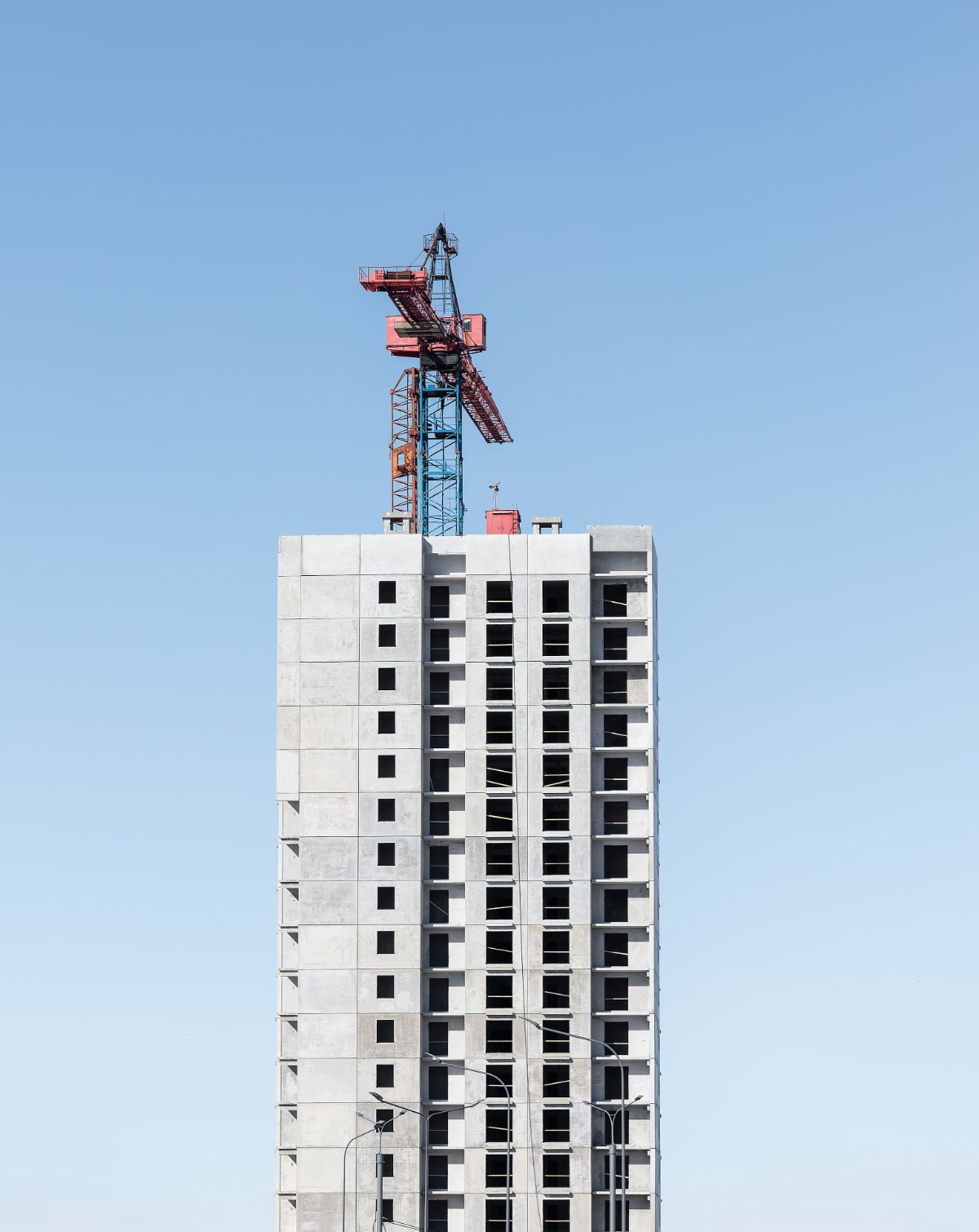
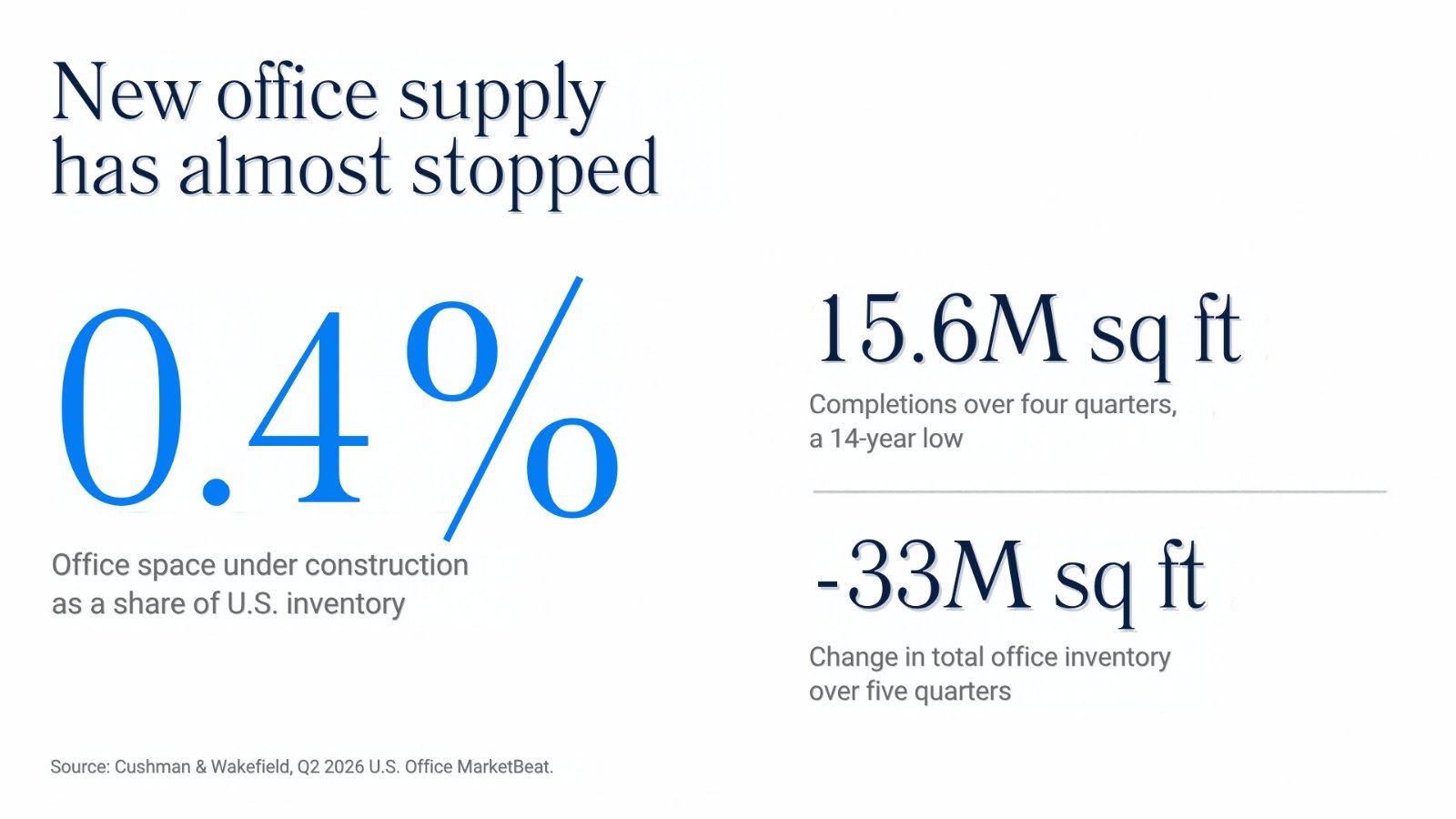
The supply side points the other way. Office completions over the four quarters to June totaled 15.6 million square feet, a 14-year low, and the national construction pipeline equals about 0.4% of inventory. Total office inventory has shrunk by 33 million square feet over five quarters as owners convert or demolish older buildings. CBRE noted that 2025 was the first year since it began tracking in 1988 in which removals exceeded new completions.
The strongest objection is that forced sales will reprice good buildings too
The fair counterargument is that credit stress rarely stays inside the loans that caused it. Lenders that take losses tighten terms for every borrower, and forced sales create comparable transactions that appraisers then apply to stronger assets. If enough older buildings trade at deep discounts, the value of the whole sector resets lower, and a leasing recovery in the best buildings does little to prevent it.
We accept this objection for appraisals over the next few quarters. Its effect on the direction of the market is smaller, for two reasons. Forced sales are concentrated in older, commodity buildings, and many of those leave the office market through conversion, which reduces competing supply for the better stock. Credit is also returning: the MBA forecast $805 billion of commercial mortgage originations for 2026, 27% more than in 2025. Discounted comparables from commodity assets will weigh on valuations, while the occupancy data that drives income in better buildings continues to improve.
What the signal says about the next six quarters
We expect the next four to six quarters to produce two sets of headlines at once: office delinquency at or near record levels, and tightening availability in the markets and buildings tenants prefer. Midtown Manhattan has already returned to its pre-pandemic availability, according to Colliers, and CBRE expects national prime vacancy to reach pre-pandemic levels by the end of 2027. For investors, the practical point is that the maturity calendar will release assets at a reset basis through 2027, and leasing will decide which of those assets can be stabilized. Underwriting needs both measures, each read for what it actually records.
Trepp will publish the October figure in a few weeks, and it may rise again. When it does, it will tell the market how much debt from an earlier cycle is still waiting to be cleared. Investors who wait for the credit data to confirm the office recovery will be waiting on the one measure that, by its construction, reports last.
Sources: Trepp (via Yield PRO, MBA NewsLink, Bisnow, Multi-Housing News and Multifamily Dive); Colliers (via Commercial Observer and Colliers Knowledge Leader); Cushman & Wakefield Q2 2026 U.S. Office MarketBeat; Mortgage Bankers Association (via Bisnow and MBA); MSCI (via ULI Urban Land); CBRE U.S. Real Estate Market Outlook 2026.