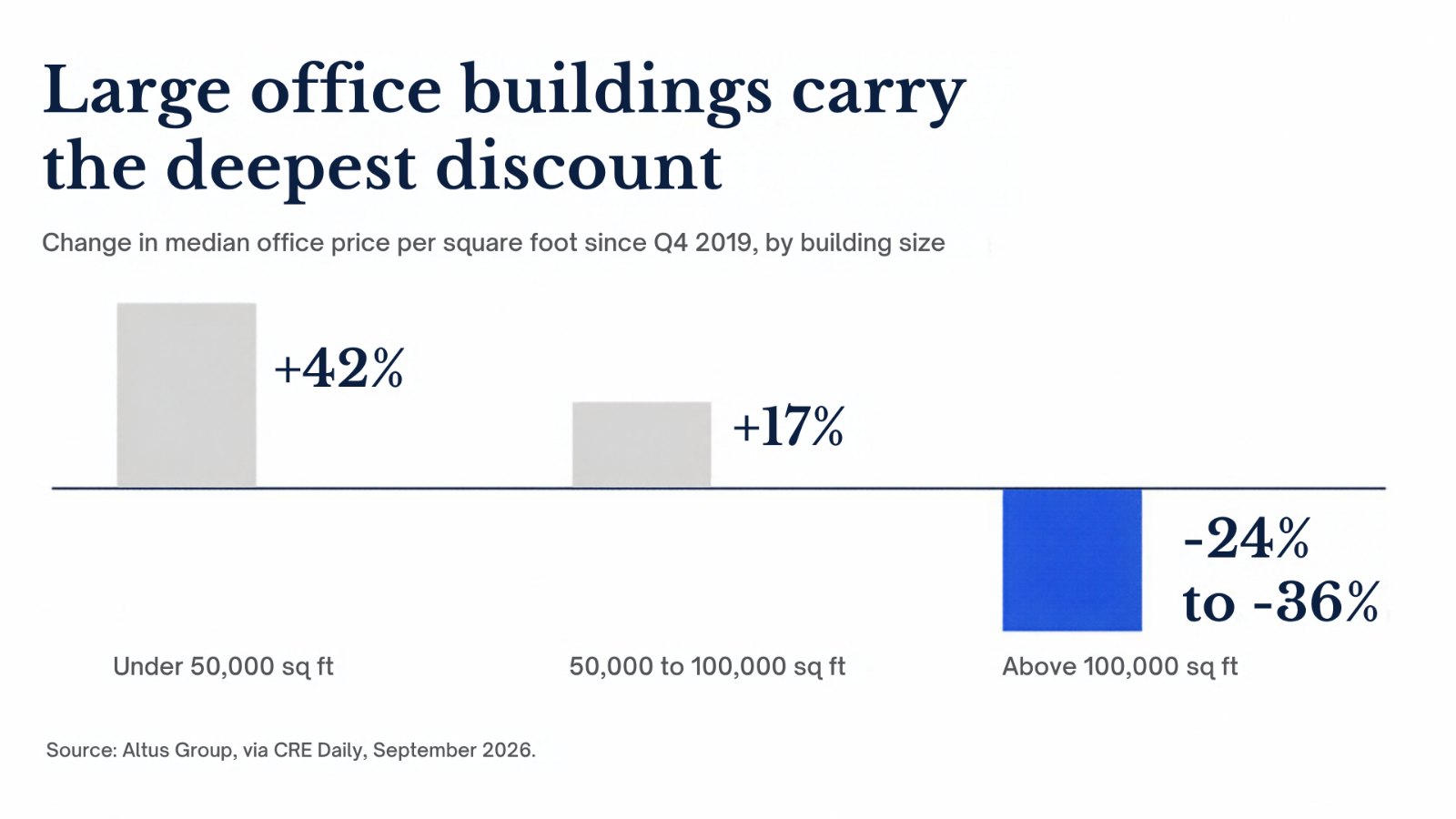
The 10-year Treasury yield reached 5.3% on October 1, its highest level since 2002, according to Bisnow reporting summarized by CRE Daily. The move capped the largest quarterly increase since 1994. At Bisnow’s commercial real estate finance event the same week, lenders said they expect lower leverage and fewer loan extensions, and one AEW Capital Management executive said a 75-basis-point rise in 30 days had chilled the market.
The common reaction is to wait until rates settle before buying offices. We think the rate shock does the opposite for investors who can deploy with little debt. It removes cap-rate compression as a source of return for the foreseeable future, so office returns will now come almost entirely from leasing. At the same time, it forces sales of large buildings at prices well below their pre-pandemic levels. Capital that underwrites lease-up at a reset basis, with modest leverage and conservative exit assumptions, is better placed today than it was in the summer.
The rate shock looks like a reason to wait
The case for patience is easy to make. Higher Treasury yields raise borrowing costs and put upward pressure on cap rates, and office cap rates had already seen the most upward pressure of any sector, reaching 7.5% in MSCI’s spring data. Panelists at the Bisnow event said appraisals have not yet caught up with the move in rates. If values are about to fall, a buyer who waits a few quarters should pay less.
That reasoning assumes the price falls evenly across the market and that the discount will still be available later. The data on recent office trades suggests otherwise on both points.
Higher rates are forcing the sales that reset basis
Lenders spent most of the past three years extending maturities in the hope of lower rates. The same panel said that period is ending. One special-servicing head described borrowers paying off loans once they were warned rates could keep rising, and banks are asking for more equity in exchange for modifications. A borrower who cannot add equity has to sell, and a sale at today’s rate sets a new, lower basis for the next owner.
Competing capital is thinner than it was. SitusAMC data cited by CRE Daily puts commercial real estate dry powder at 46% of transaction volume in 2026, down from a peak of 97% in 2023 and below the 10-year average of 56%. Fewer bidders with ready equity means the buyers who do show up have more say over price and terms.
Large buildings carry the deepest discount
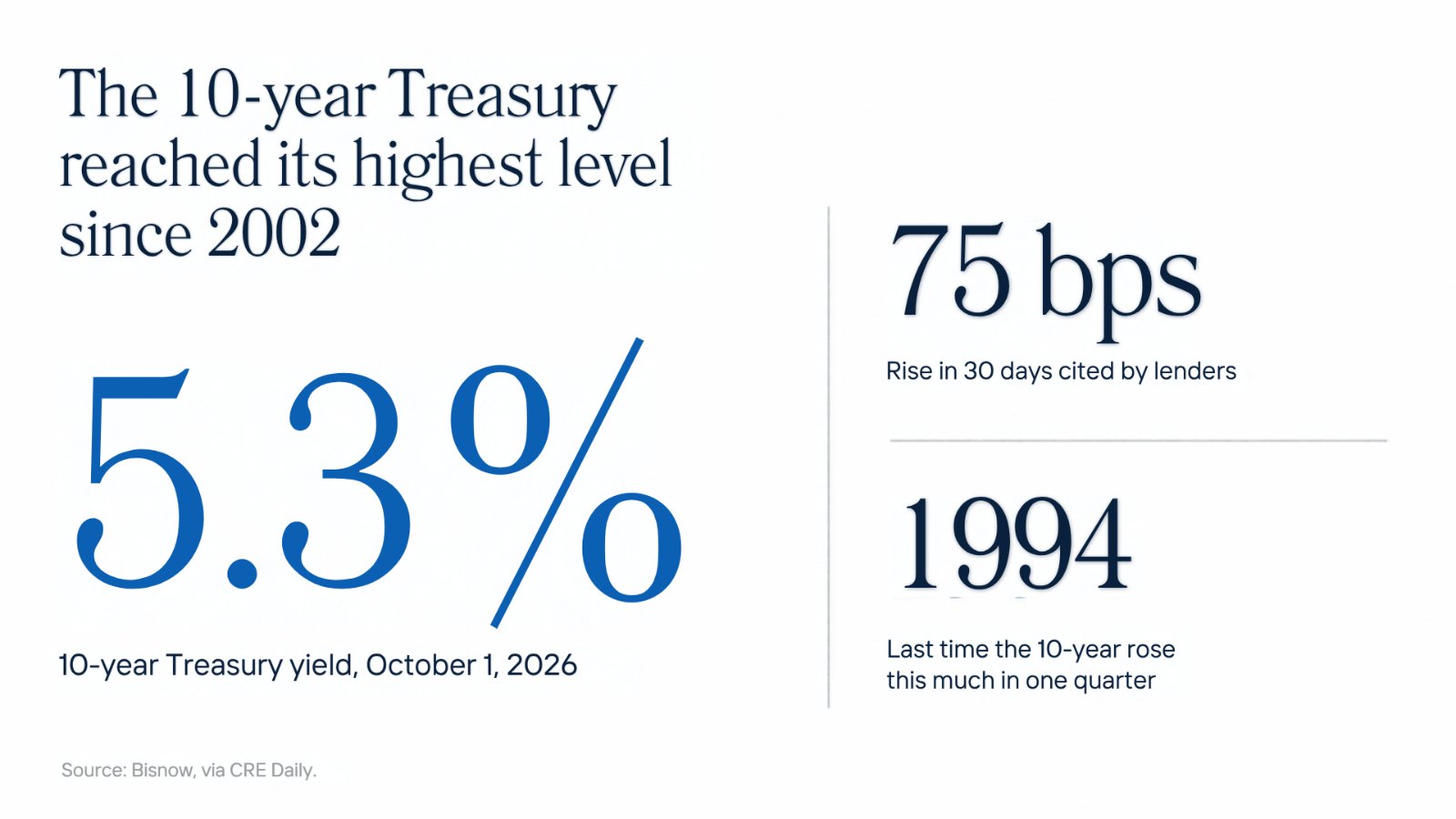
The reset is uneven. Altus Group data reported by CRE Daily on September 16 shows that since the fourth quarter of 2019, median pricing per square foot has risen 42% for office buildings under 50,000 square feet and 17% for buildings between 50,000 and 100,000 square feet. Buildings above 100,000 square feet have fallen 24% to 36% over the same period. The gap between average and median office pricing, which reflects the premium larger assets used to command, narrowed from $72 per square foot to $15.
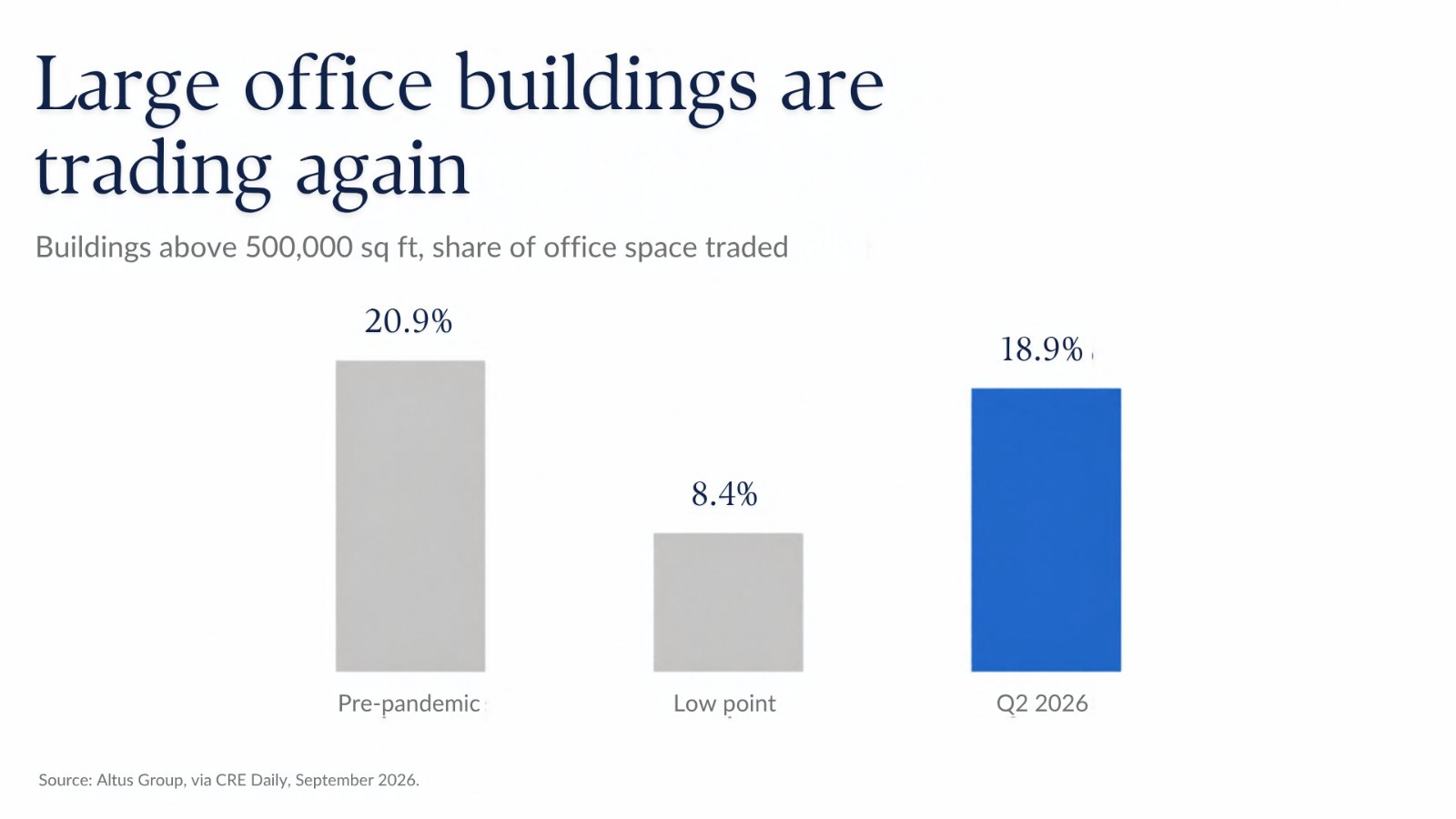
Large buildings are also trading again. Properties above 500,000 square feet accounted for 18.9% of office space traded in the second quarter, up from a low of 8.4% and close to their pre-pandemic share of 20.9%. Liquidity has returned at the scale where pricing has fallen most, which is the combination an investor whose equity can wait out a lease-up should look for.
A Ballston round trip shows where the return came from
A recent Northern Virginia sale illustrates the strategy. In September, Piedmont Realty Trust bought 4075 Wilson Boulevard, a 189,000-square-foot office building in Ballston, for $52.7 million in cash. The sellers had acquired it in 2024 for $27.6 million in cash, less than 30% of its 2019 sale price, when it was 52% leased. Over two years they invested $6 million, signed 10 leases and raised occupancy to 83%, according to Bisnow and Piedmont’s SEC filing.
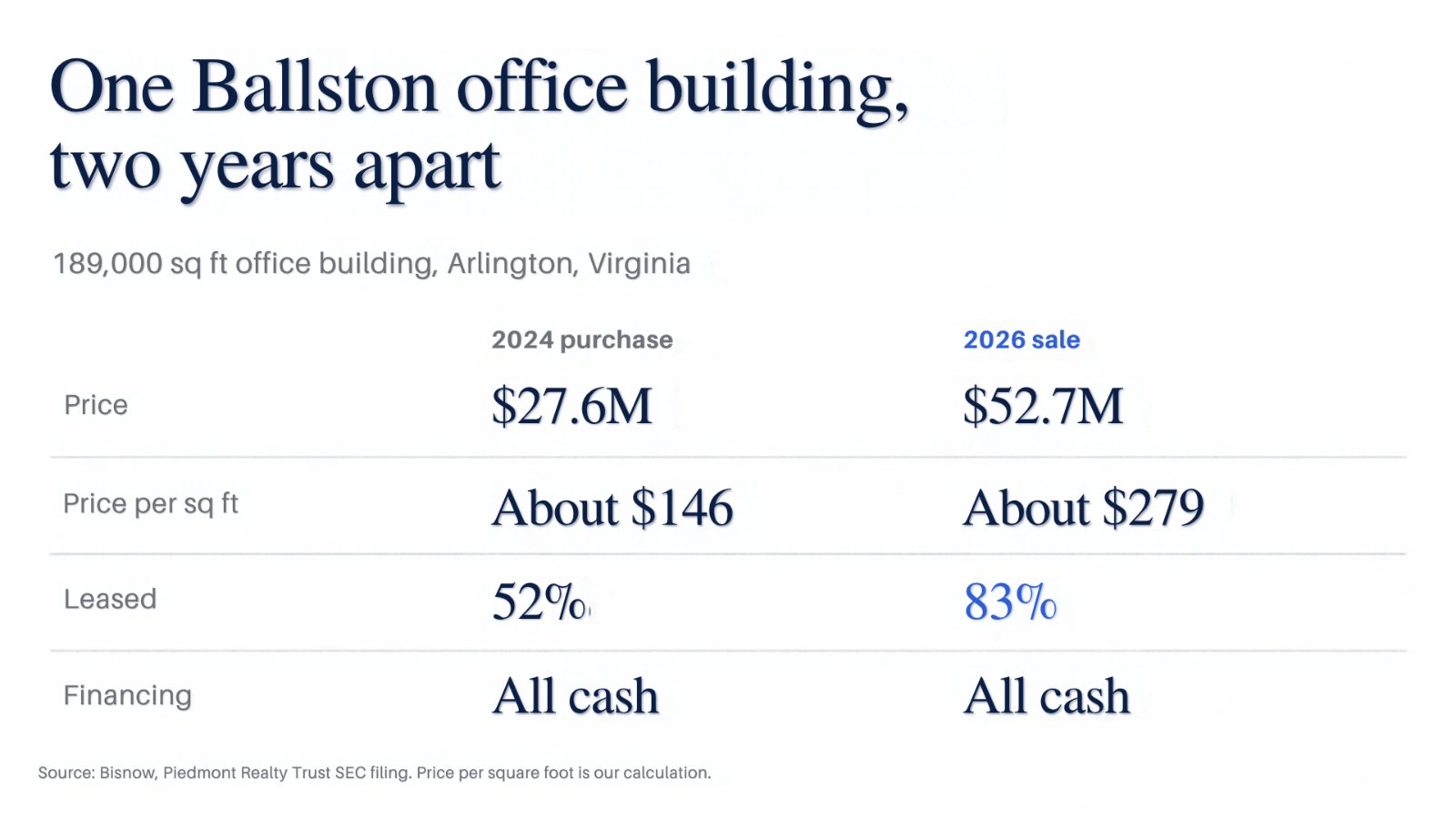
On those figures, the sellers’ gross proceeds were about 1.6 times their purchase price plus capital spending. None of that gain depended on lower interest rates or on debt. It came from buying at a basis set by distress and then filling the building. We expect that pattern, more than any recovery in pricing multiples, to define successful office investments over the next several years.
“None of that gain depended on lower interest rates or on debt. It came from buying at a basis set by distress and then filling the building.”
How we would underwrite office capital now
The practical changes are specific. Underwriting should hold the exit cap rate at or above the entry cap rate and treat lease-up as the main driver of value, with realistic downtime and tenant improvement budgets for each vacant suite. Leverage should be low enough that the business plan survives a further rise in rates, with interest reserves sized for the full lease-up period, an approach Brookfield’s Nailah Flake told the Bisnow panel she expects lenders to bring back.
Diligence should focus on what a reset basis cannot fix: floor plates, building systems, transit access and the competitive set within a few blocks. A low price per square foot does not help a building that tenants will not lease. In portfolio terms, we would weight new office capital toward buildings above 100,000 square feet in submarkets with positive absorption, where the pricing discount is largest and the leasing path is visible.
Waiting for lower marks is the main alternative, and it has a cost
The serious case against buying now is that rates may keep rising and that appraisals have not yet reflected the move to 5.3%. If marks fall another 10% or 15% next year, an investor who buys now will show losses on paper, and the same building could be bought more cheaply later.
We take that risk seriously, and it shapes how we would structure an investment more than whether we would make one. A low-leverage buyer who underwrites to income can carry a lower appraisal without a forced sale. The discount on large buildings is also partly a function of how few bidders exist today. When credit eases and dry powder rebuilds, the gap between distressed and stabilized pricing is likely to narrow before marks finish adjusting, and late buyers will compete for the same assets with more capital around them.
Basis is the one variable an investor still controls
With the 10-year at its highest level in 24 years, investors cannot count on rates or cap rates to lift office values. They can control the basis they buy at and the debt they carry. The Ballston sale shows what those two choices, followed by steady leasing, can produce in two years. The current rate environment narrows the field of buyers able to make both, and for now that favors the capital that can.
Sources: Bisnow, via CRE Daily (10-year Treasury and lender panel, October 2026); Altus Group and SitusAMC, via CRE Daily (September 2026); Bisnow and Piedmont Realty Trust SEC filing (Ballston sale); MSCI Real Estate Client Roundtable, Spring 2026.