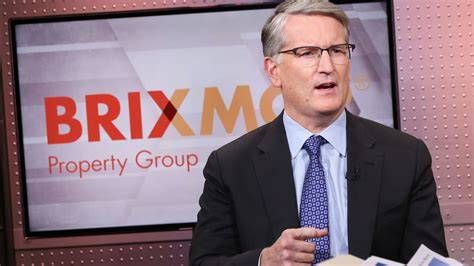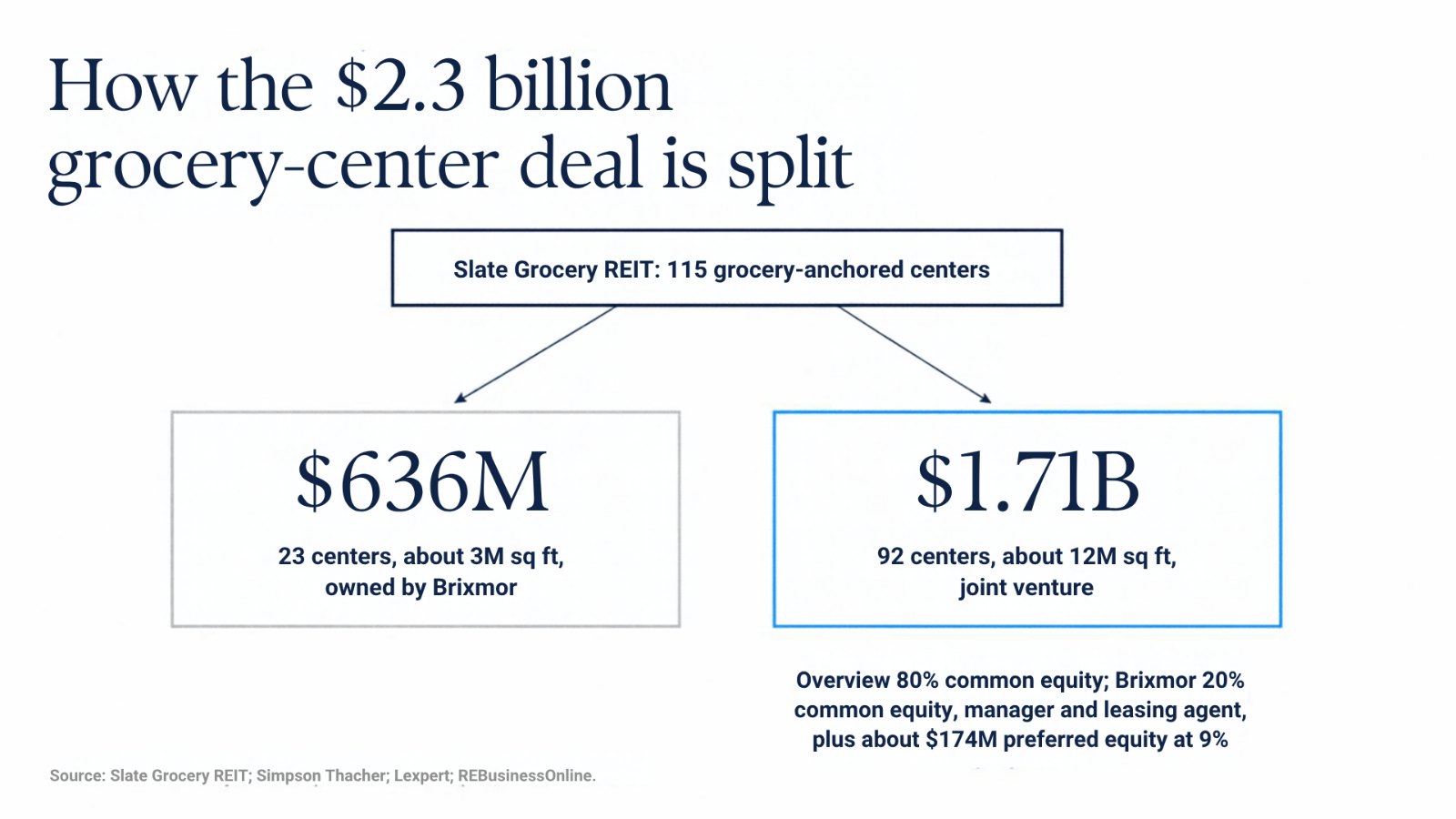
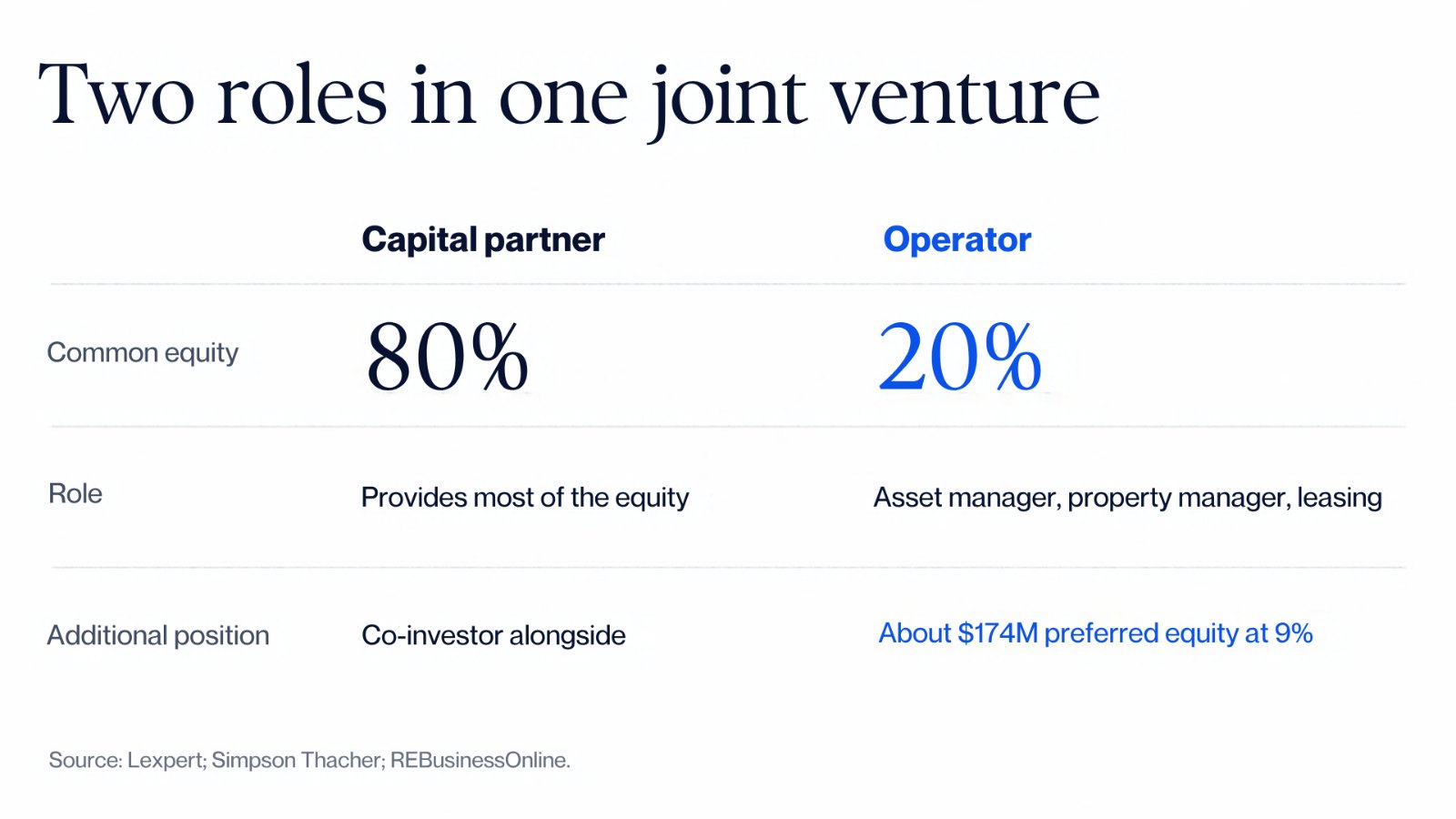
On September 28, Slate Grocery REIT agreed to be taken private by Brixmor Property Group and affiliates of Everview Partners for $13 per unit in cash, an enterprise value of about $2.3 billion. The Toronto-listed trust owns 115 grocery-anchored shopping centers across the United States. Brixmor will buy 23 of them outright, about 3 million square feet mainly in Florida, Georgia and the Carolinas, for $636 million. A new joint venture will buy the remaining 92 centers, about 12 million square feet, for about $1.71 billion. Everview will hold 80% of that venture’s common equity and Brixmor 20%, and a subsidiary of the Abu Dhabi Investment Authority will invest alongside Everview.
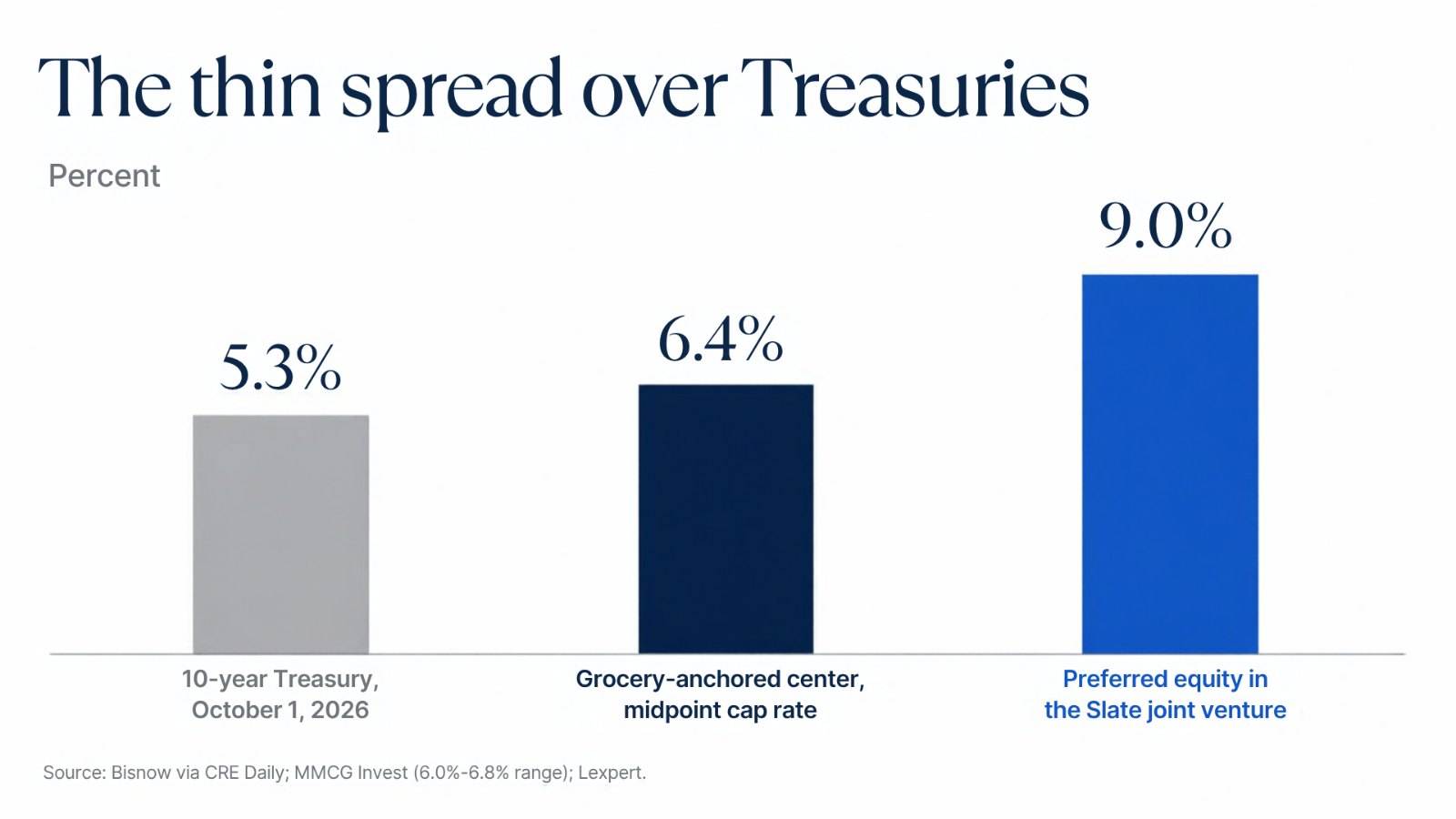
The headline will be read as another sign of investor demand for grocery-anchored retail. We think the more useful lesson is in the structure. Brixmor will manage and lease the joint venture’s centers and invest about $174 million of preferred equity carrying a 9% dividend. That arrangement is a practical answer to how capital should enter open-air retail with the 10-year Treasury at 5.3%. Capital should buy through the public-market discount, alongside an operator that controls leasing, and some of it can take a layer of the capital structure priced well above the risk-free rate.
Demand for grocery-anchored retail is well known
The case for the property type is familiar. Open-air retail benefits from very little new construction, and the space vacated by recent store closures has largely been re-leased. Grocery anchors bring repeat traffic to the smaller shops around them. Investors have responded: an industry report found that grocery-anchored centers trade at cap rates of roughly 6.0% to 6.8%, below unanchored strip centers at 7% to 8%. On that reading, the only question is how much to pay.
Price is the difficulty at a 5.3% Treasury
The spread between those cap rates and the risk-free rate is now narrow. A grocery-anchored center bought at 6.25% earns less than one percentage point above a 10-year Treasury yielding 5.3%, before the costs of leasing and capital spending. Buying individual centers at private-market prices leaves little margin for the work needed to raise income.
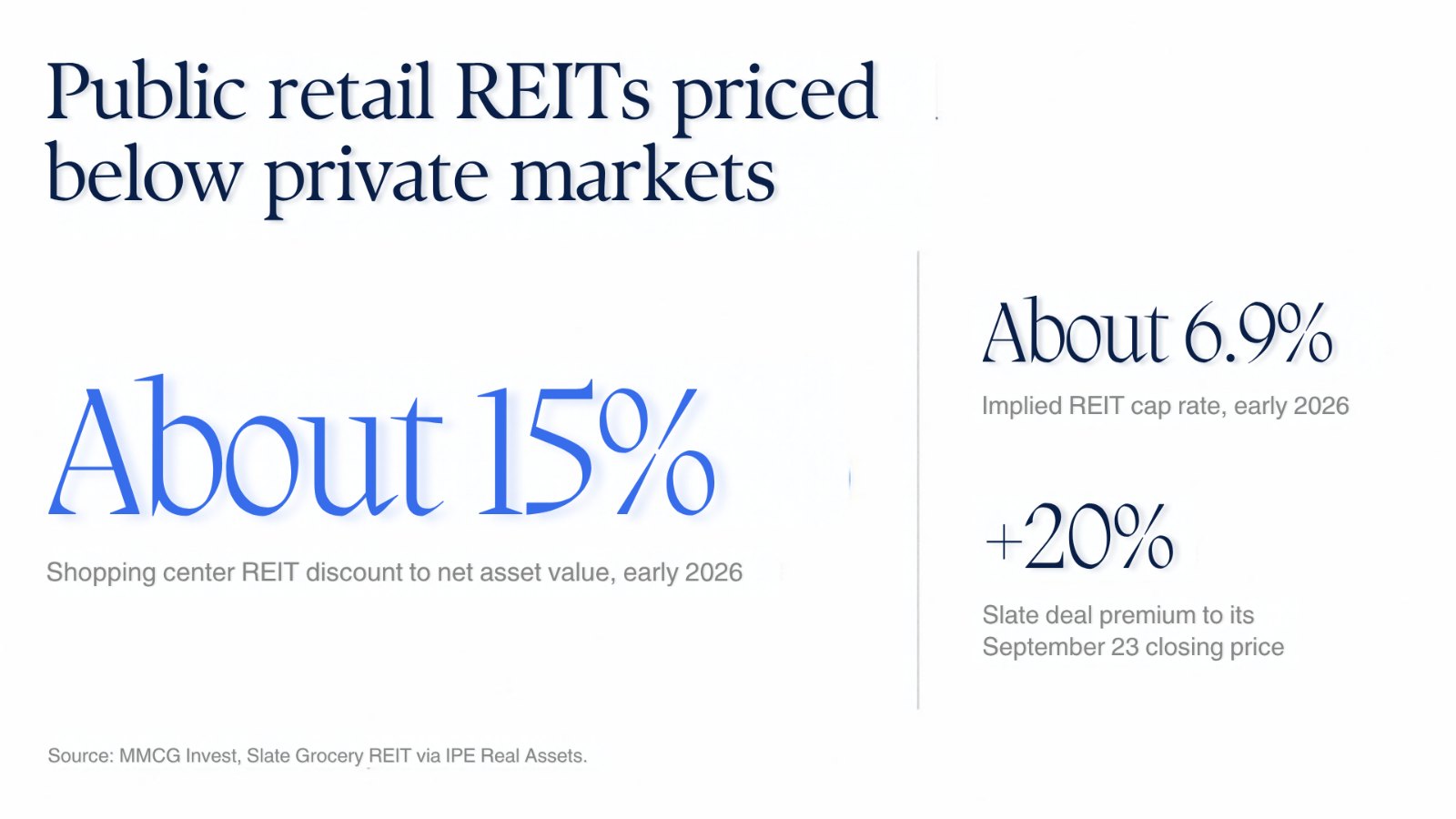
The public market has offered a different entry price. Shopping center REITs traded at an implied cap rate of about 6.9% and a discount of roughly 15% to net asset value at the start of 2026, according to the same report, which is why several have been taken private this year, including Whitestone REIT by Ares Management in July. The Slate price was a 20% premium to the trust’s closing price on September 23, the day before it suspended distributions, and a 13% premium to its price before the strategic review began in May. Even with that premium, buyers acquired a 115-center portfolio in one transaction, without bidding asset by asset.
The structure aligns the operator with the capital
The joint venture separates two roles that are often combined. Everview and its partner provide most of the equity. Brixmor, which already owns 346 centers totaling about 63 million square feet, provides management and leasing. It earns a fixed 9% return on its preferred investment, which sits ahead of the common equity, while its 20% common interest rewards it for raising income.
For a capital partner, that structure solves the main risk in open-air retail, which is execution. Value in these centers comes from re-leasing small shop space at current market rents and replacing weaker tenants with stronger ones. An operator with a national leasing platform and its own capital at stake is better placed to do that than a financial buyer on its own.
How we would put capital into open-air retail now
Entry should come through public-market discounts and portfolio transactions where possible, since individual high-quality centers trade near the cost of capital. Underwriting should focus on the gap between in-place and market rents in shop space, tested against the depth of tenant demand in each trade area. Structure should pair capital with an operator that controls leasing and has its own money in the deal, and capital that needs a defined return can take a preferred position like Brixmor’s at a yield well above Treasuries.
The objection is that buyers are paying a premium for a crowded trade
A reasonable objection holds that grocery-anchored retail has become a consensus trade, and that paying a premium in a competitive auction leaves little room for error if consumer spending slows or rates rise further.
We accept that individual centers are fully priced. The Slate transaction is different in two ways. It buys a large portfolio at a price set partly by a depressed public market, and it divides the capital structure so that each investor holds the risk it is best able to carry. Those features make the return less dependent on further cap rate compression and more dependent on leasing, which the operator controls.
Structure is where the return is in open-air retail
For investors deploying capital in retail at today’s rates, the property type matters less than how it is bought and who runs it. The Slate deal pairs a public-market entry price with an operator-led structure that includes a preferred layer priced at 9%, and both elements can be applied elsewhere. The grocery anchor brings the traffic, and the structure of the investment decides how much of the resulting income reaches each investor.
“The grocery anchor brings the traffic, and the structure of the investment decides how much of the resulting income reaches each investor.”
Sources: Slate Grocery REIT, Brixmor and Everview (via Lexpert, Simpson Thacher, REBusinessOnline, IPE Real Assets and BNN Bloomberg, September 2026); MMCG Invest; Bisnow via CRE Daily.