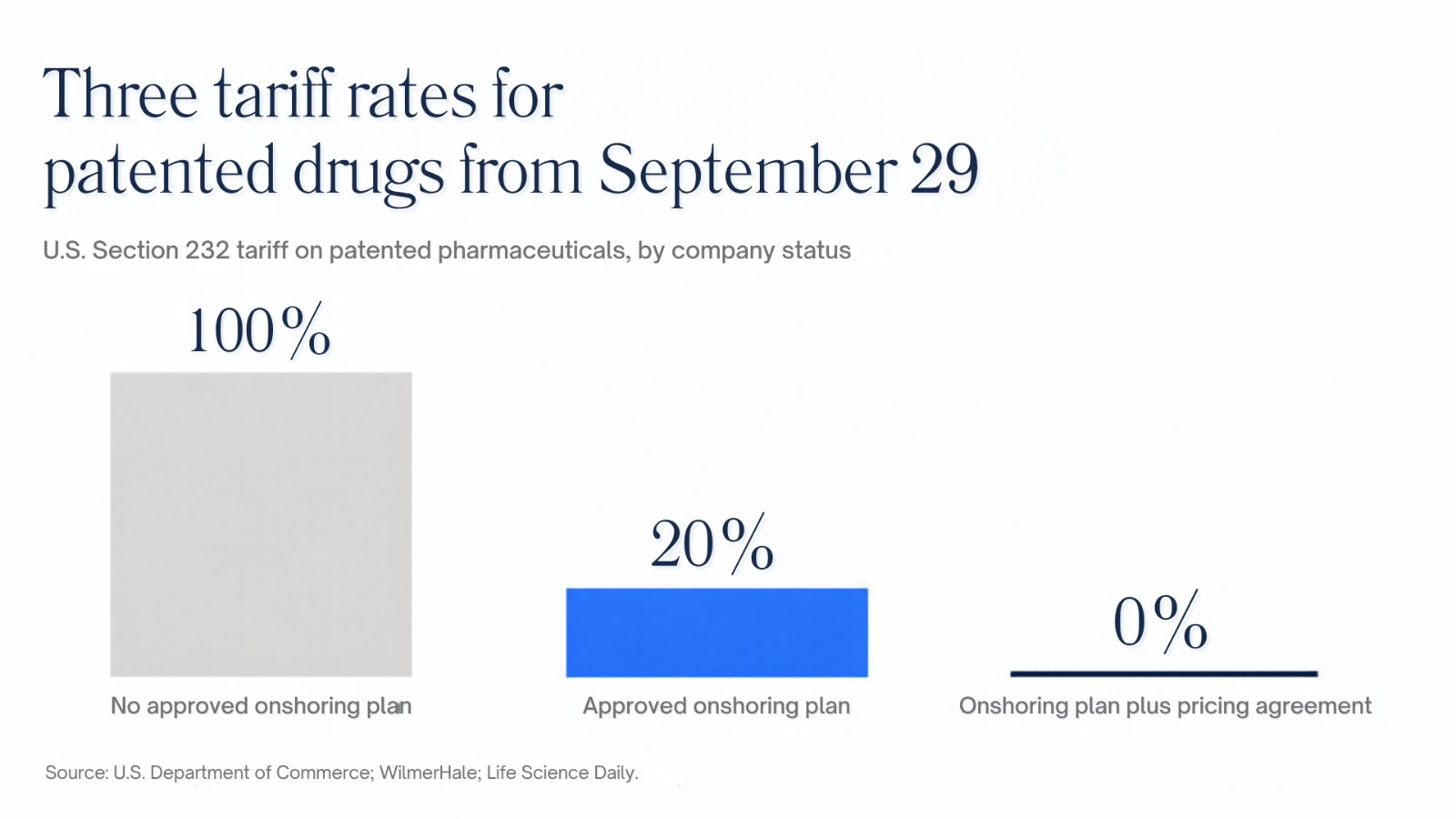
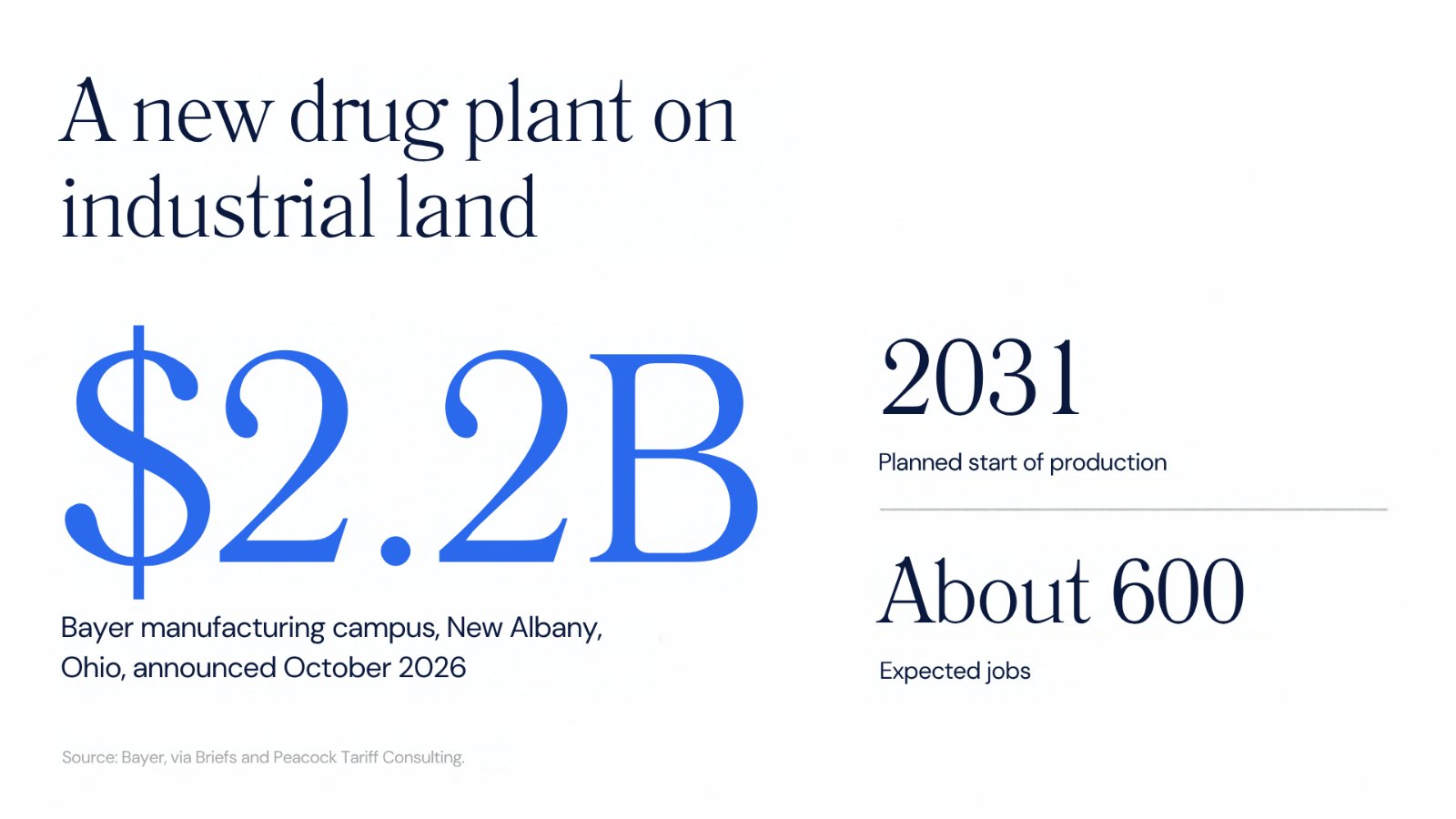
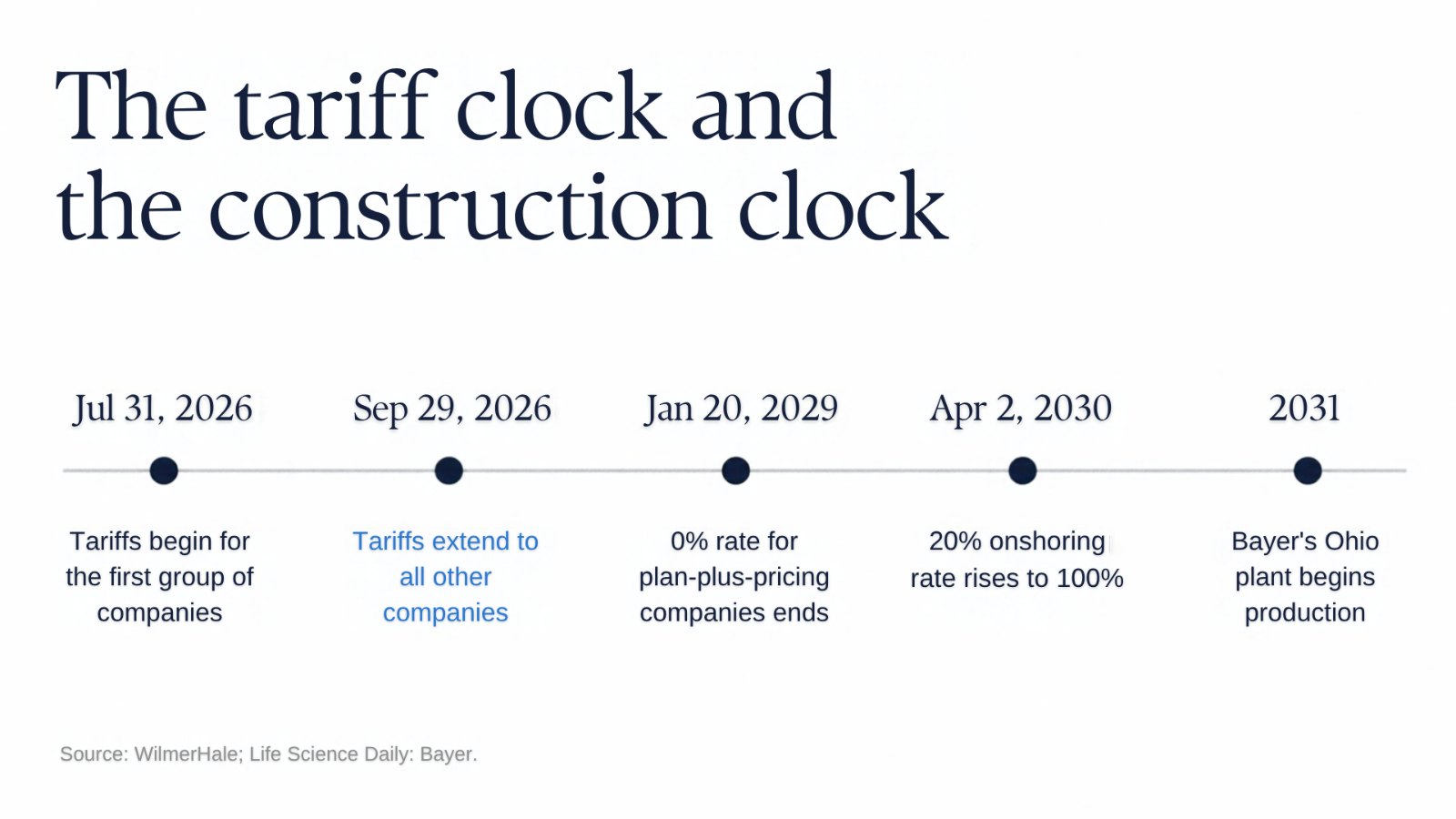
On September 29, U.S. Section 232 tariffs on patented pharmaceuticals and their ingredients extended to every company not covered by the first tranche in July. Companies without an approved plan to move production to the United States face a 100% tariff. Those with a Commerce-approved onshoring plan pay 20%, and those that also sign a most-favored-nation pricing agreement pay nothing until January 2029. Three days later, Bayer announced a $2.2 billion manufacturing plant in New Albany, Ohio, outside Columbus, scheduled to begin production in 2031 with about 600 jobs.
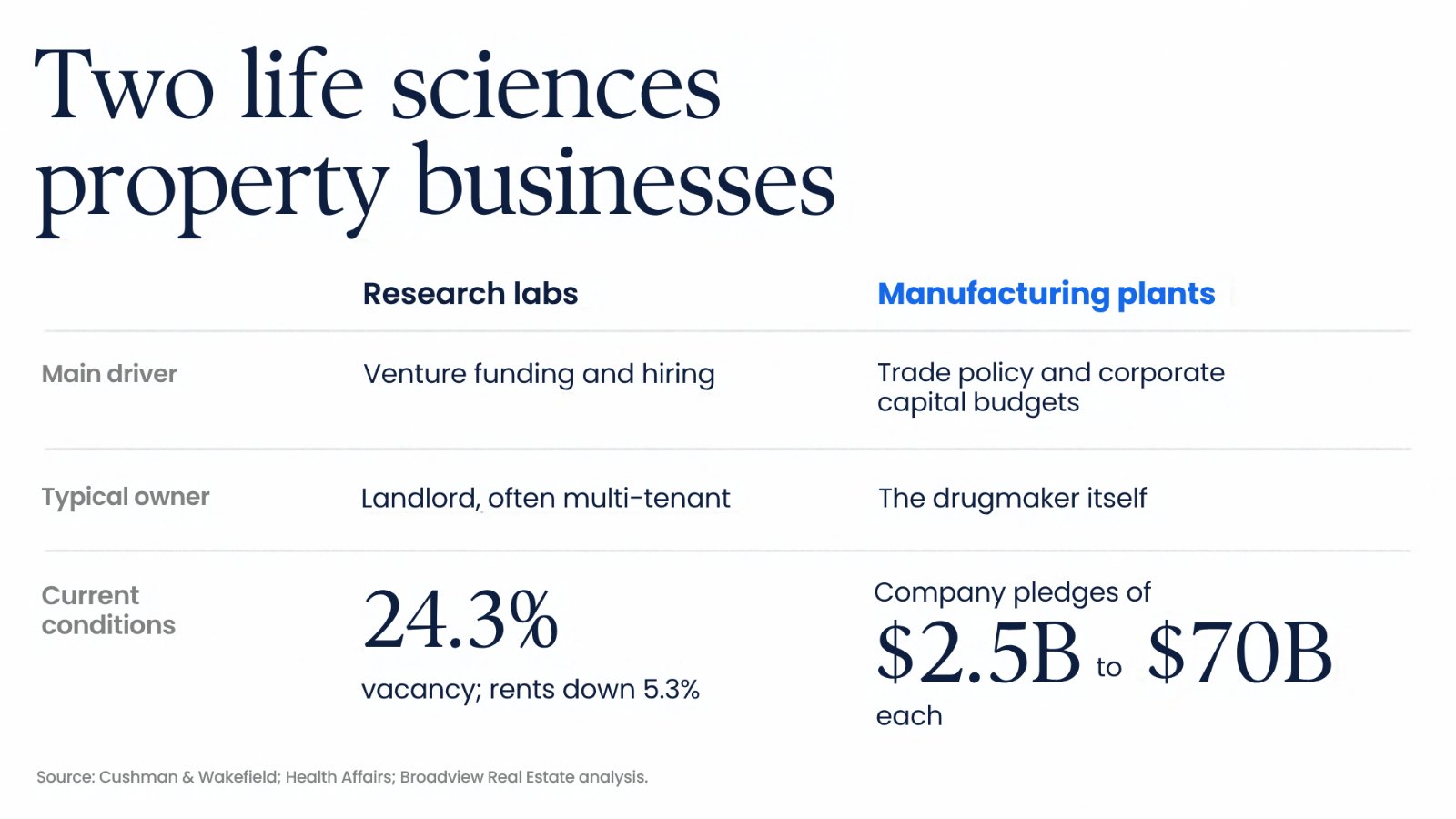
Bayer’s plant joins a long list of pledges. Health Affairs counted individual company commitments ranging from $2.5 billion to $70 billion, and Pfizer alone committed $70 billion to U.S. research and manufacturing. Much of the commentary has assumed that this wave of capital will help the life sciences real estate market recover. We think it will help a different part of that market from the one that needs help. The onshoring money is flowing into owner-built manufacturing campuses on industrial land, while the oversupply sits in research labs in a handful of coastal clusters. The policy changes who wins in life sciences real estate more than it changes the sector’s vacancy rate.
Onshoring is read as good news for every lab owner
The appeal of the common reading is easy to see. Lab landlords have endured a difficult period. Cushman & Wakefield reports national lab vacancy of 24.3% in the second quarter, up from 23.4% at the end of 2025, with asking rents down 5.3% over the year. A policy that pushes drugmakers to invest hundreds of billions of dollars in the United States looks like the demand those buildings have been waiting for. CBRE’s life sciences leader noted at the start of the year that multinationals were already reshoring and consolidating.
The question for owners is what kind of space that money will buy, and where.
The capital is going to plants, and plants are built to order
Drug manufacturing facilities are specialized buildings. They require heavy structure, high clear heights, large power and water capacity, and clean-room environments that meet good manufacturing practice standards. Most large manufacturers build them on their own land to their own specifications and own them for the life of the facility. Bayer’s Ohio plant is a greenfield project in the New Albany International Business Park, the same advanced manufacturing district that has drawn other large industrial investments in recent years.
The disclosed projects follow that pattern. Recent commitments include Roche’s roughly $2 billion expansion of its manufacturing site in Holly Springs, North Carolina, and a $1 billion biologics plant in Delaware. These are campus-scale industrial projects. Few of them will lease space in a multi-tenant lab building in Cambridge or South San Francisco.
Puerto Rico shows how policy can move a whole industry
The closest precedent is the Section 936 tax incentive, which for about 30 years drew a large share of U.S. pharmaceutical manufacturing to Puerto Rico before its phase-out was completed in 2006. The incentive did not create demand for research space in the island’s cities. It produced dedicated plants, built by the companies that used them and located where the policy made production cheapest. When the incentive ended, many of those plants closed or changed hands.
The current tariff regime works in a similar way. It rewards production on U.S. soil, and the real estate it creates is the real estate production needs.
Industrial landowners and manufacturing corridors gain
The clearest winners are owners of large, power-ready industrial sites in regions that already host pharmaceutical manufacturing and have the workforce and permitting experience that production requires. Central Ohio and the Research Triangle are two examples. Contract manufacturers, which produce drugs for companies that prefer not to build their own plants, are a second source of demand, and they lease or buy flexible industrial buildings that can be fitted out for production.
The groups that gain little are owners of research labs in markets where vacancy is highest. A tariff on imported medicines does not increase demand for early-stage research space, and much of the oversupply in those markets is in buildings designed for small and mid-sized biotech tenants. Owners of conventional warehouses near new plants may see modest gains from suppliers and logistics firms, as data center suppliers have produced in other markets.
The objection is that some labs can be converted to production
A reasonable objection holds that the line between lab and manufacturing space is not fixed. Cushman & Wakefield publishes fit-out costs for current good manufacturing practice space alongside lab types, and some newer lab buildings have the floor-to-floor heights and structural capacity for small-scale production, particularly for cell and gene therapies. Smaller drugmakers that cannot build their own plants may lease that space.
We agree that a share of the newest lab inventory can serve that demand, and owners of those buildings should market them for it. The volume involved is small relative to the pledged investment, though, and most production space will still be built new. The tariff regime also has a timeline: the 20% rate for companies with onshoring plans rises to 100% in April 2030, and plants like Bayer’s will not produce until 2031. Leasing demand from onshoring will arrive slowly and in specific locations.
Reading the onshoring numbers by building type
For investors, the practical step is to separate life sciences real estate into two businesses with different drivers. Research labs depend on venture funding and hiring, and they will recover slowly. Manufacturing space depends on trade policy and corporate capital budgets, and it is entering a period of strong demand concentrated in a few industrial regions. The onshoring announcements will continue, and each will be described as good news for life sciences property. The useful question to ask of each one is what kind of building it pays for, and who will own it.
“The useful question to ask of each one is what kind of building it pays for, and who will own it.”
Sources: U.S. Department of Commerce, via WilmerHale and Life Science Daily; Bayer, via Briefs and Peacock Tariff Consulting; Health Affairs; Reuters factbox via Yahoo Finance; Cushman & Wakefield; CBRE via Connect CRE.