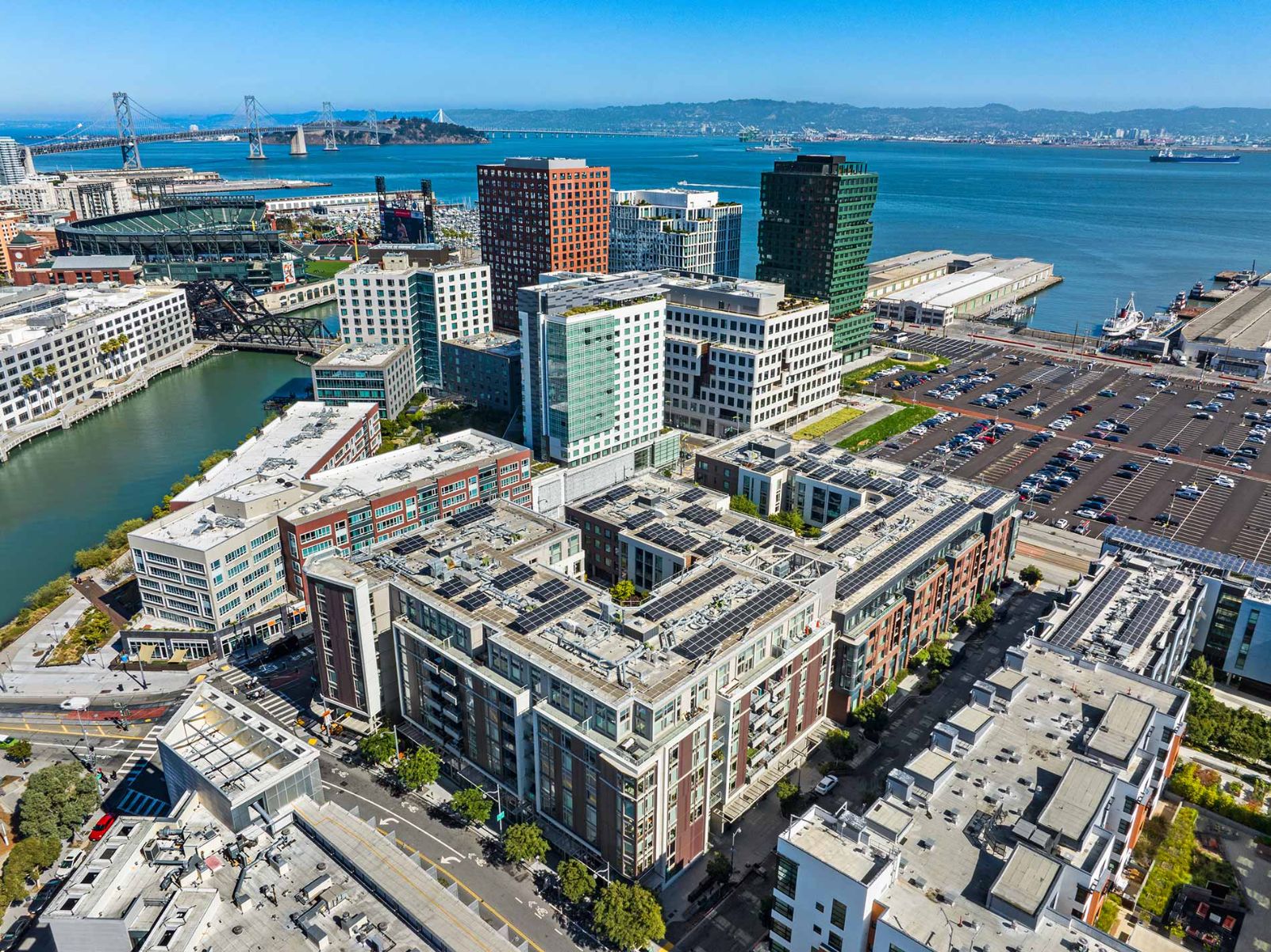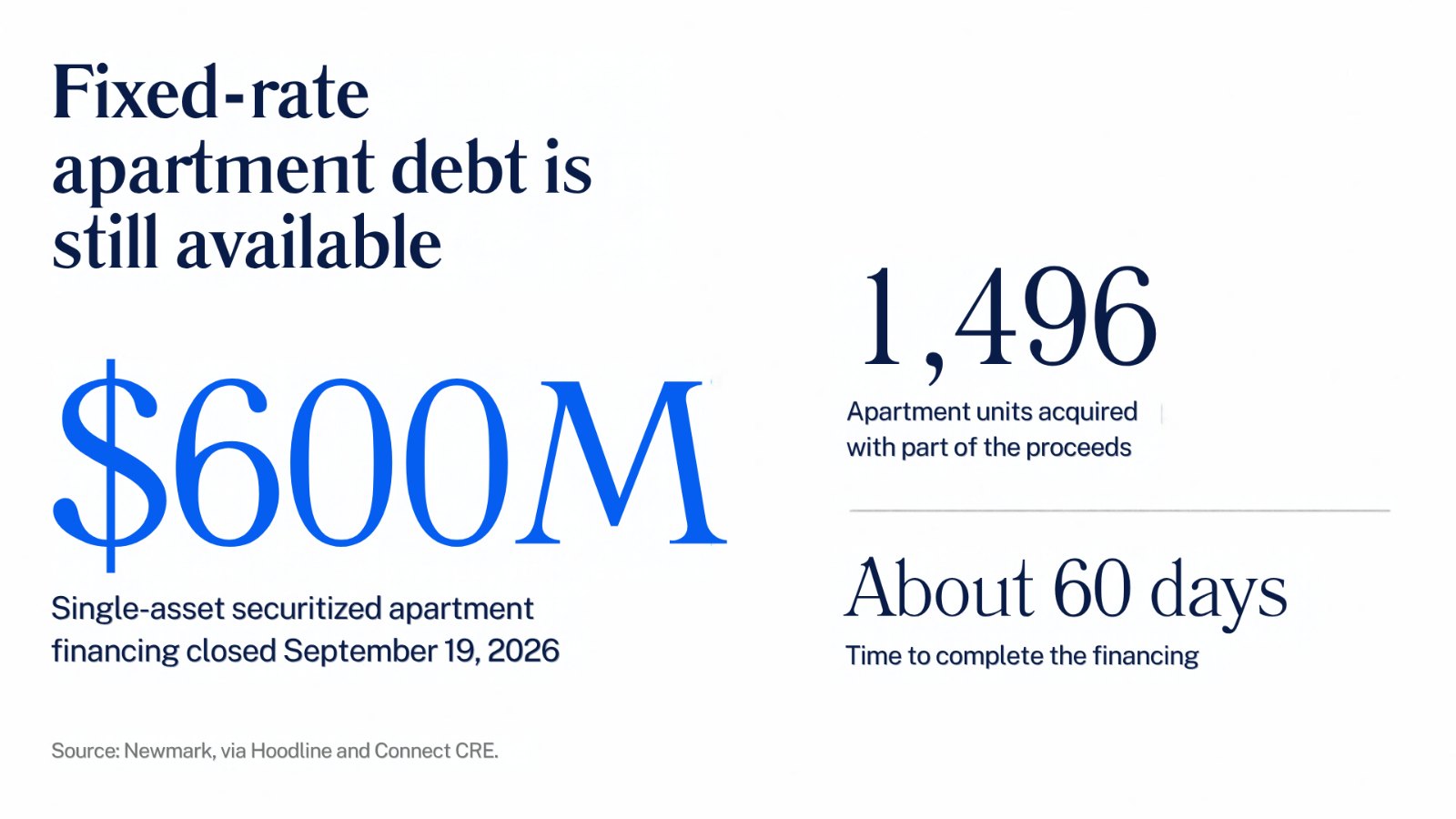
On September 19, Boston-based apartment owner West Shore closed a $600 million financing that refinanced five of its properties and paid for three new acquisitions totaling 1,496 units across three states. The loan, arranged with Citi as a single-asset, single-borrower commercial mortgage-backed security, took about 60 days to complete and lifted West Shore’s portfolio above 18,500 apartments. Newmark, which arranged the financing, pointed to strong investor demand for the bonds.
The deal came two weeks before the 10-year Treasury yield reached 5.3% and the 30-year mortgage rate climbed to 7.28%. On its face, the timing looks unlucky. We think it illustrates the right way to put capital into rental housing at today’s rates. The opportunity in apartments now sits with existing, stabilized buildings bought with fixed-rate debt that runs well past the business plan, and with capital that can step into the gap left by loans written in 2021 and 2022. Floating-rate bridge financing and new development are the places to avoid.
Higher rates usually mean waiting to buy apartments
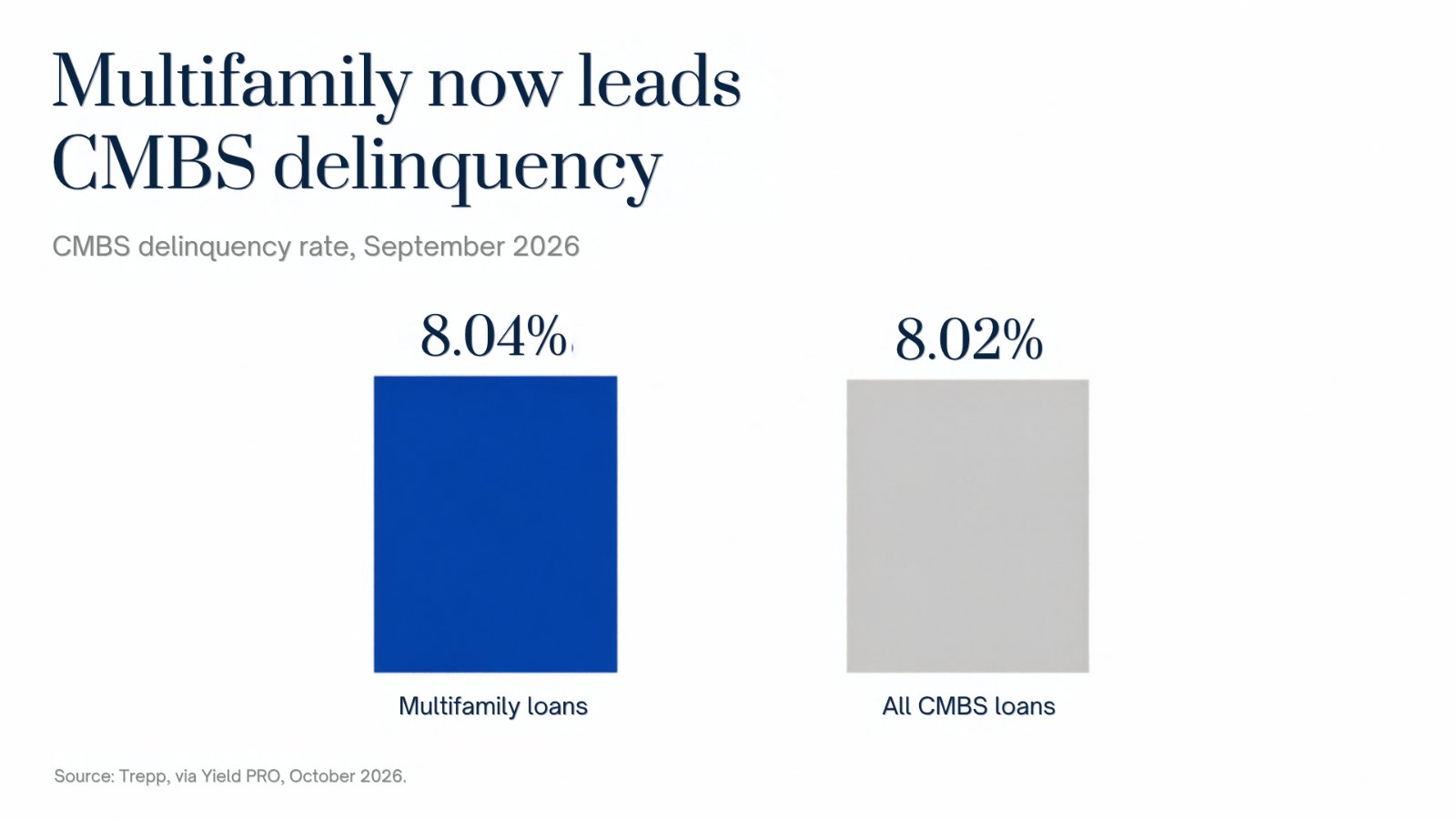
The common view is that rising rates make this a poor time to buy. Apartment values depend on the spread between cap rates and borrowing costs, and that spread has narrowed sharply. Multifamily loans in commercial mortgage-backed securities were 8.04% delinquent in September, according to Trepp, above the rate for the CMBS market as a whole for the first time since the pandemic. Yardi Matrix expects national rent growth of only 1.4% this year. On that reading, buyers should wait for distress to reprice the sector.
Fixed-rate capital is open while floating-rate capital is not
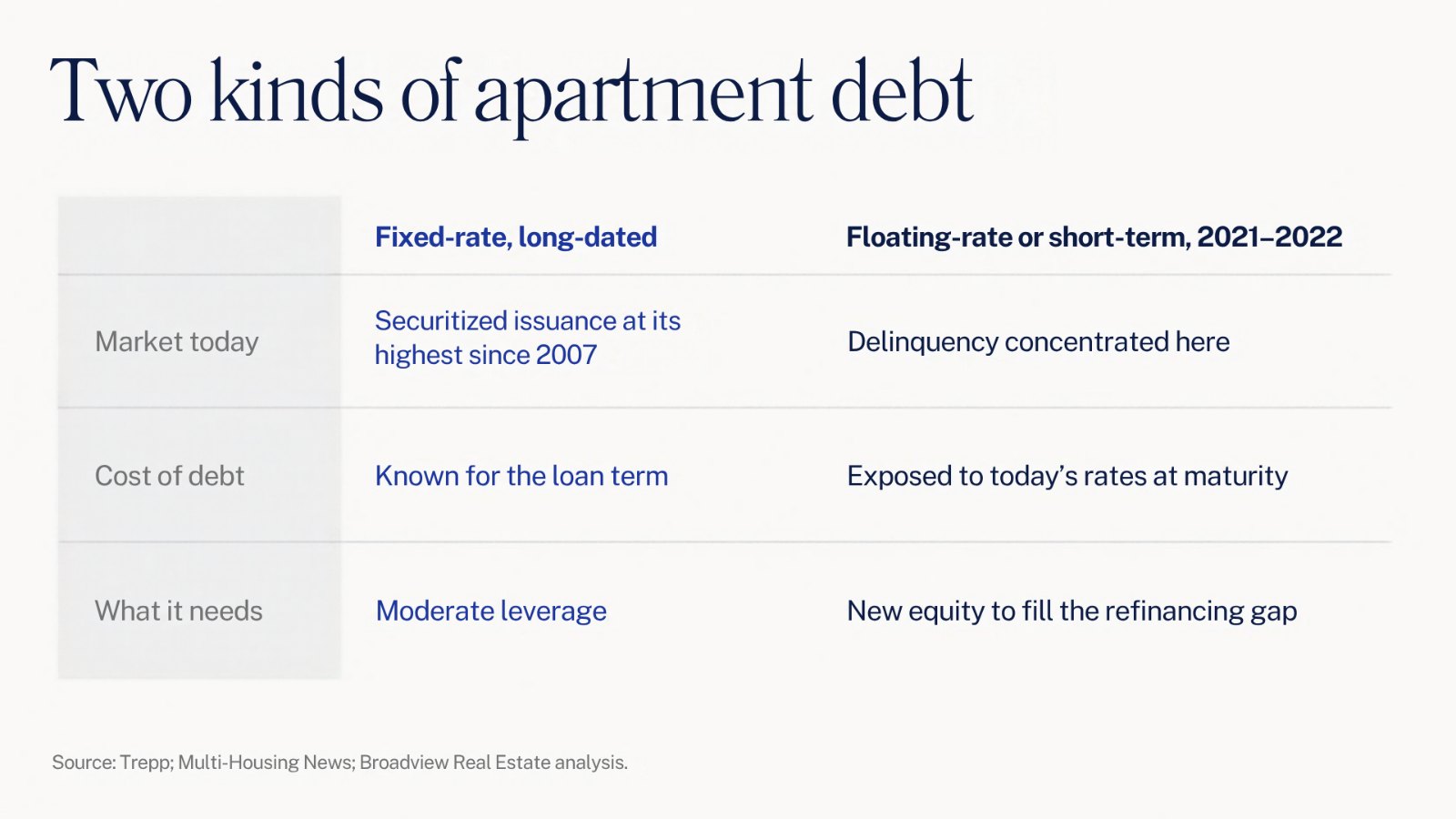
The financing markets tell a more specific story. Private-label CMBS issuance in 2025 reached its highest level since 2007, and investors continue to buy well-structured multifamily bonds, as West Shore’s deal showed. That capital is typically lent at fixed rates for terms of five to ten years. The distress, by contrast, sits mainly in apartment loans that were written on floating rates or short terms in 2021 and 2022, when values assumed rent growth that did not arrive.
The two markets therefore point in different directions. A buyer with fixed-rate financing on a stabilized building can lock in a known cost of debt for the term of the loan. An owner with a maturing bridge loan on a building bought at the top of the market faces a refinancing gap that equity must fill.
How we would put capital into rental housing now
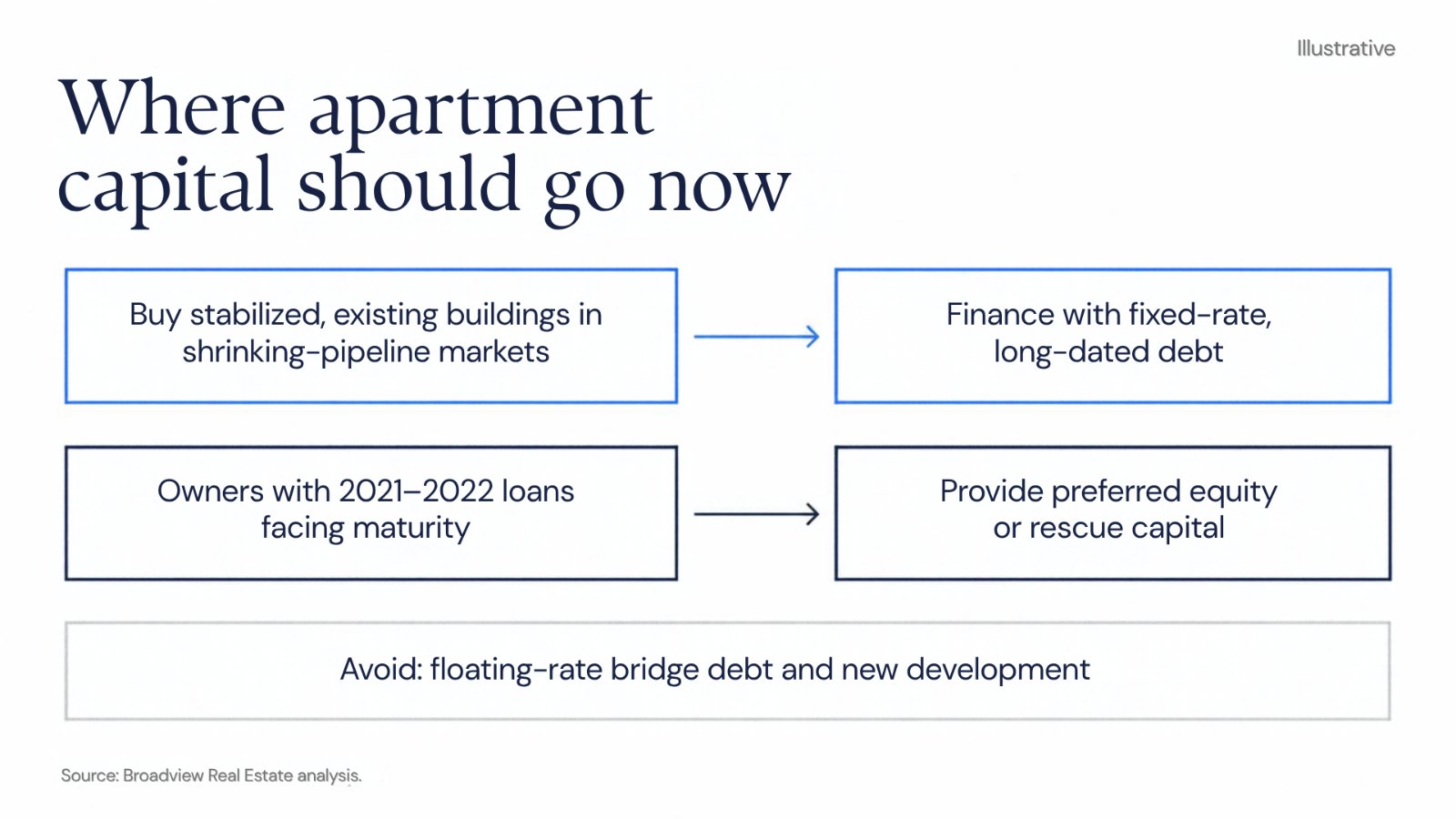
Acquisitions should focus on existing, stabilized buildings in markets where the construction pipeline is shrinking. Census data show apartment starts fell 21.7% in August, and the number of units under construction has dropped from more than 1 million at the end of 2023 to 683,000. Buildings bought today will face less new competition from 2027 onward. Underwriting should assume modest rent growth in the near term and a gradual recovery as supply falls, with exit cap rates at or above entry. Diligence should compare each building’s in-place rents with those of new properties still leasing within a few miles, because those buildings set the near-term ceiling on rents through their concessions.
Financing should be fixed-rate and long-dated. Agency and single-asset securitized debt both provide that structure, and the cost of locking it in now is lower than the cost of refinancing into a weaker market later. Floating-rate bridge loans, which made sense when rates were expected to fall, carry the risk that has produced today’s delinquencies.
The second use of capital is to recapitalize owners who bought in 2021 and 2022 and now face maturities they cannot refinance. Preferred equity and rescue capital can earn returns that reflect that need, with a priority position above the sponsor’s common equity. The diligence here is on the building more than the borrower: whether the property can carry a fixed-rate loan at today’s rates once the gap is filled.
The CMBS market of 2007 is a fair warning
The last time securitized issuance was this strong was 2007, and the loans written that year performed poorly when the cycle turned. A reasonable objection is that today’s strong demand for these bonds reflects the same complacency, and that buyers using that debt are repeating the pattern.
We take the comparison seriously, and the difference lies in what is being financed. In 2007, loans were sized against projected income and rising values. Lenders today are underwriting at a 5.3% Treasury and flat rents, which forces more conservative loan sizes. The risk to watch is structure: interest-only periods and high leverage can still create problems. Buyers should keep leverage moderate even when bond markets would allow more.
Fix the debt, and buy what is already built
Rental housing faces higher borrowing costs and slow rent growth now, and a shortfall of new supply in the years after 2027. Capital that buys stabilized buildings with fixed-rate debt will hold assets that benefit from the shortfall without being exposed to the refinancing problems of the last cycle. Capital that helps recapitalize those earlier loans can earn a premium for solving them. West Shore’s timing looks less unlucky once the debt it locked in is set against the debt that others still have to refinance.
“Capital that buys stabilized buildings with fixed-rate debt will hold assets that benefit from the shortfall without being exposed to the refinancing problems of the last cycle.”
Sources: Newmark via Hoodline and Connect CRE (September 2026); Trepp via Yield PRO and Multi-Housing News; Yardi Matrix; U.S. Census Bureau via TD Economics and NAHB; Freddie Mac; Bisnow via CRE Daily.