On September 16, the Census Bureau estimated U.S. retail and food services sales at $773.9 billion for August, up 1.2% from July and 6.0% from a year earlier. Sales rose in twelve of the thirteen major retail groups. Store-based sales, which exclude online purchases and restaurants, rose 0.6%, and Marcus & Millichap described them as reaching a record. Restaurants and bars were up nearly 6% from August 2025.
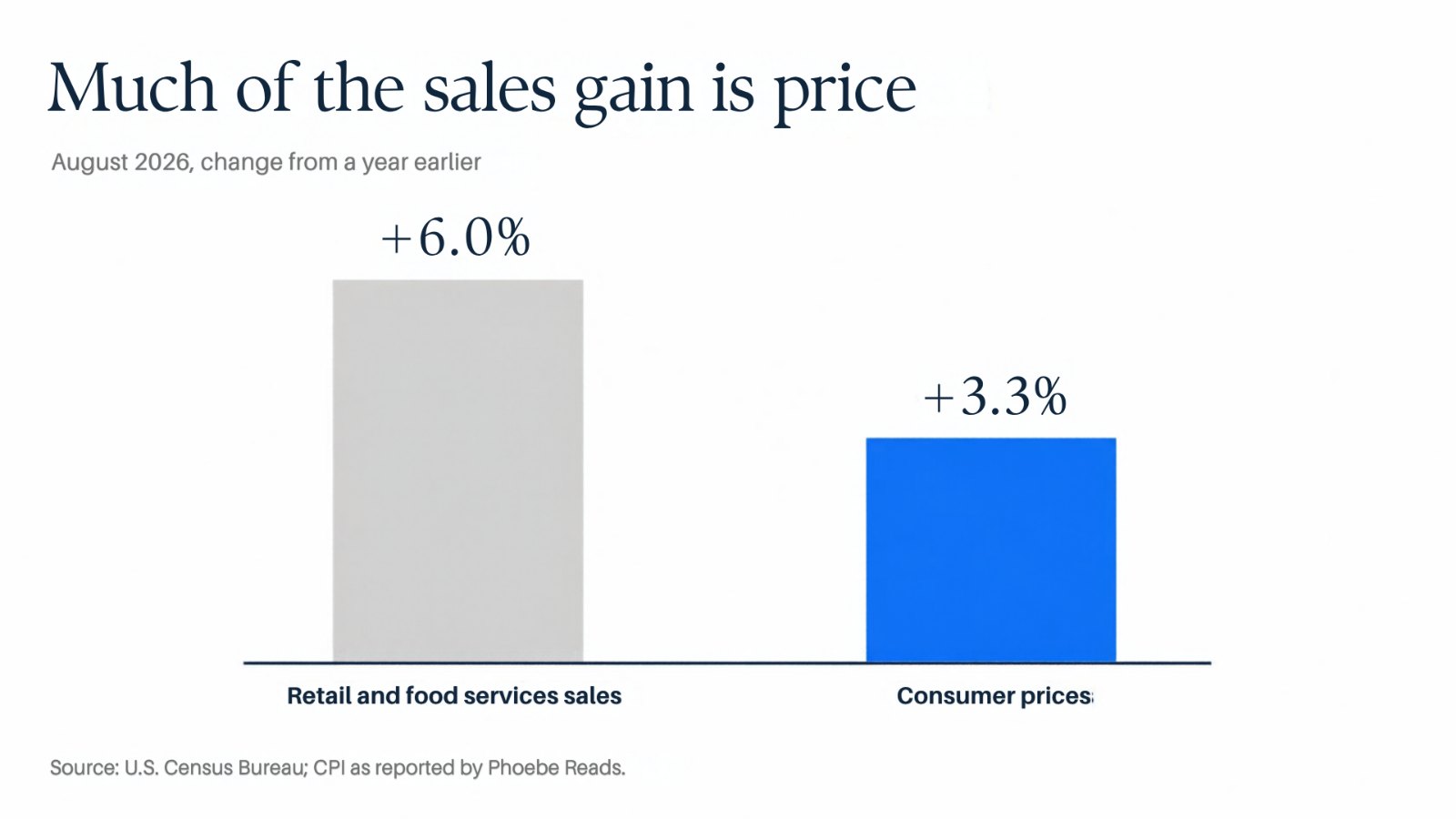
The figures were widely read as proof that the consumer remains strong, and by extension that retail real estate is healthy. We agree that retail property is in good condition, but we think the reason is supply more than spending. Adjusted for inflation, the year-over-year sales gain is much smaller than the headline, and a quarter of it came from gasoline. What keeps retail vacancy low is that almost no new space is being built and the space vacated in last year’s wave of closures has largely been absorbed. That distinction matters for where the market goes next.
A 6% sales gain is read as a strong consumer
The headline numbers invite a simple interpretation. Sales growth of 6% over a year, with gains across almost every category, points to households with money to spend. TD Economics estimated that inflation-adjusted consumer spending was tracking about 3% annualized growth in the third quarter. If shoppers keep spending at that pace, retailers will need more stores, and landlords will gain pricing power.
The real gain is smaller, and uneven
The inflation-adjusted picture is more modest. Consumer prices rose 3.3% over the same twelve months, so much of the 6% nominal increase reflects higher prices. Of the $43.9 billion increase in monthly sales from a year earlier, about $10.8 billion, or roughly a quarter, came from gasoline stations. The gains also varied by category. Restaurants grew strongly, with spending at bars and restaurants rising every month since April, according to TD Economics, while furniture stores reported lower sales than a year earlier.
That pattern describes a consumer who is still spending but spending selectively, with dining and necessities ahead of large purchases. It does not, on its own, describe a surge in demand for new store space.
Supply is doing most of the work
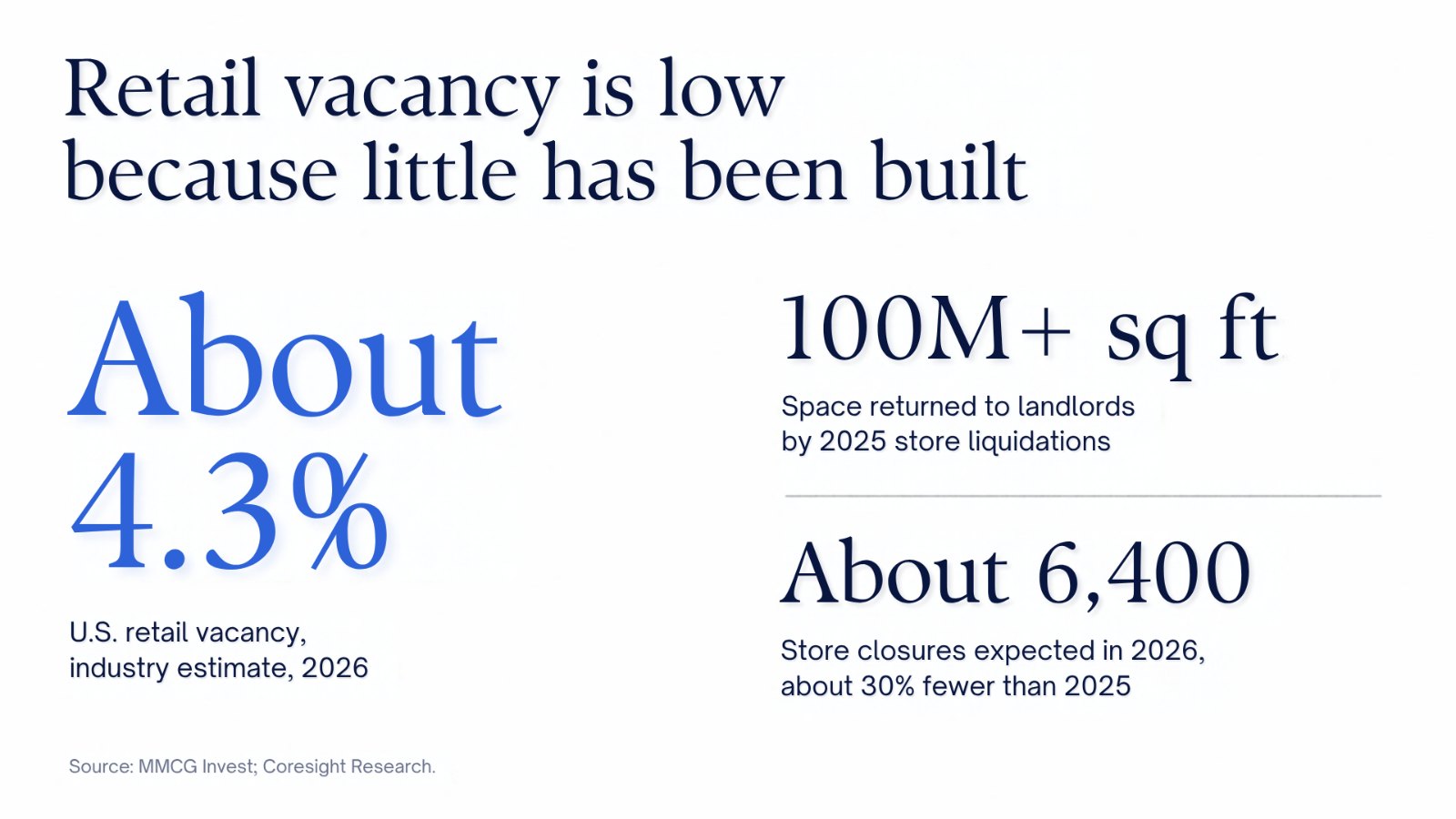
The stronger case for retail property comes from the space side. Industry estimates put national retail vacancy at about 4.3%, although published figures range up to 6% depending on the source and the definition used. New construction remains limited, and a large share of what is being built is pre-leased before completion. Retail developers face the same higher construction and financing costs that have slowed apartment and office building.
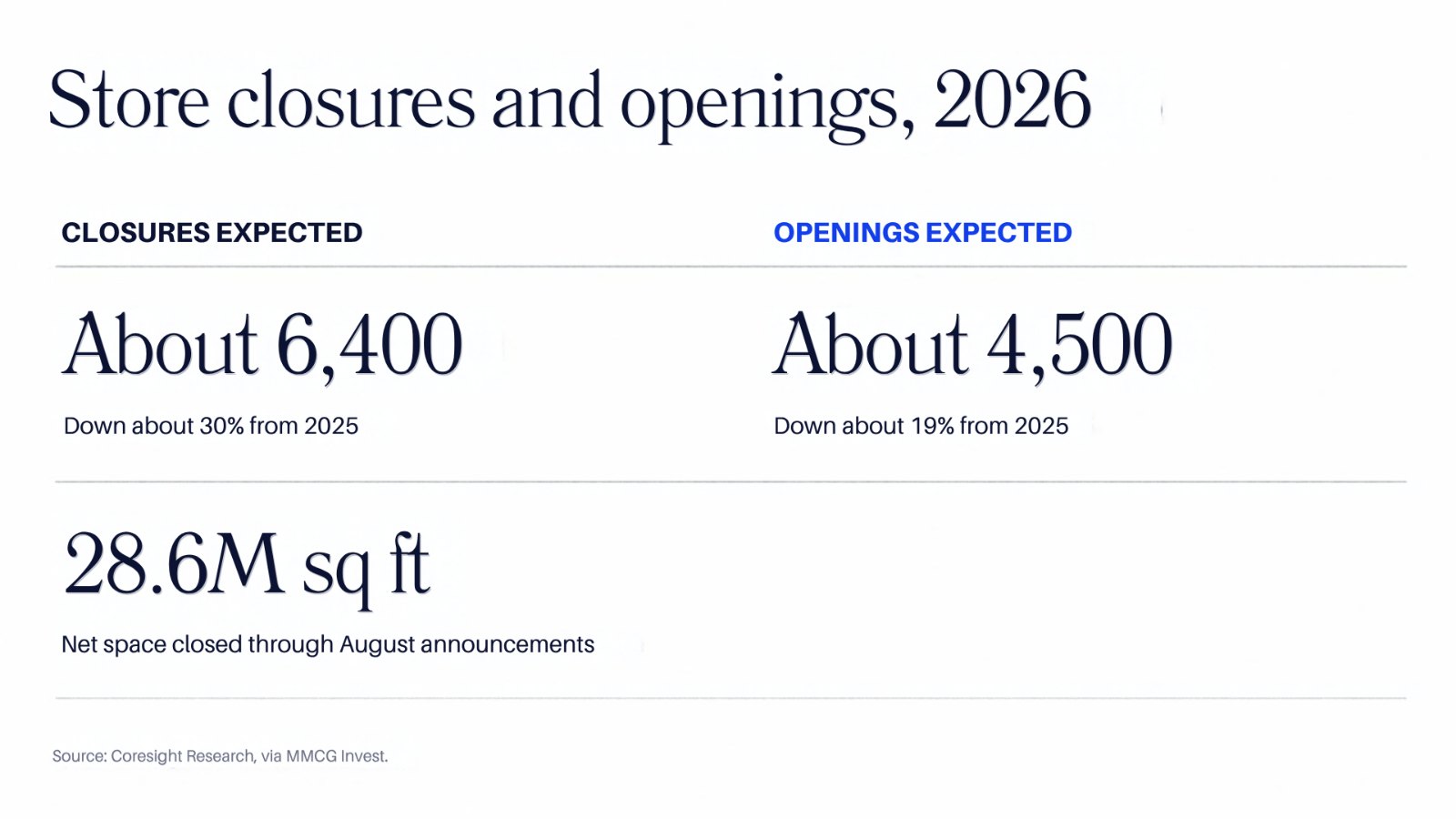
The space freed by store closures has also been taken up. In 2025, the liquidations of Joann, Party City, Rite Aid, Big Lots and Forever 21 returned well over 100 million square feet to landlords. Much of that space was re-leased to growing retailers that had been unable to find suitable boxes. Coresight Research now expects about 6,400 store closures in 2026, roughly 30% fewer than last year, against about 4,500 openings.
The 2025 closures show what the market can absorb
The closure wave of 2025 offers a useful test. A loss of that much space would once have pushed vacancy sharply higher for several years. This time, it was absorbed largely within the year, because few new shopping centers had been built for more than a decade and expanding tenants were waiting for space. The experience suggests that retail vacancy is now set mainly by the scarcity of well-located space, and that a moderate slowdown in consumer spending would show up first in rents and tenant mix, and only later in vacancy.
The objection is that the consumer is weaker than it looks
A reasonable objection holds that the consumer is more fragile than the sales data suggests. Higher borrowing costs and spending financed partly on credit could slow retail sales quickly, and retailers with thin margins would close stores again. Coresight’s cumulative tracker shows about 28.6 million square feet of net retail space closed through August announcements this year.
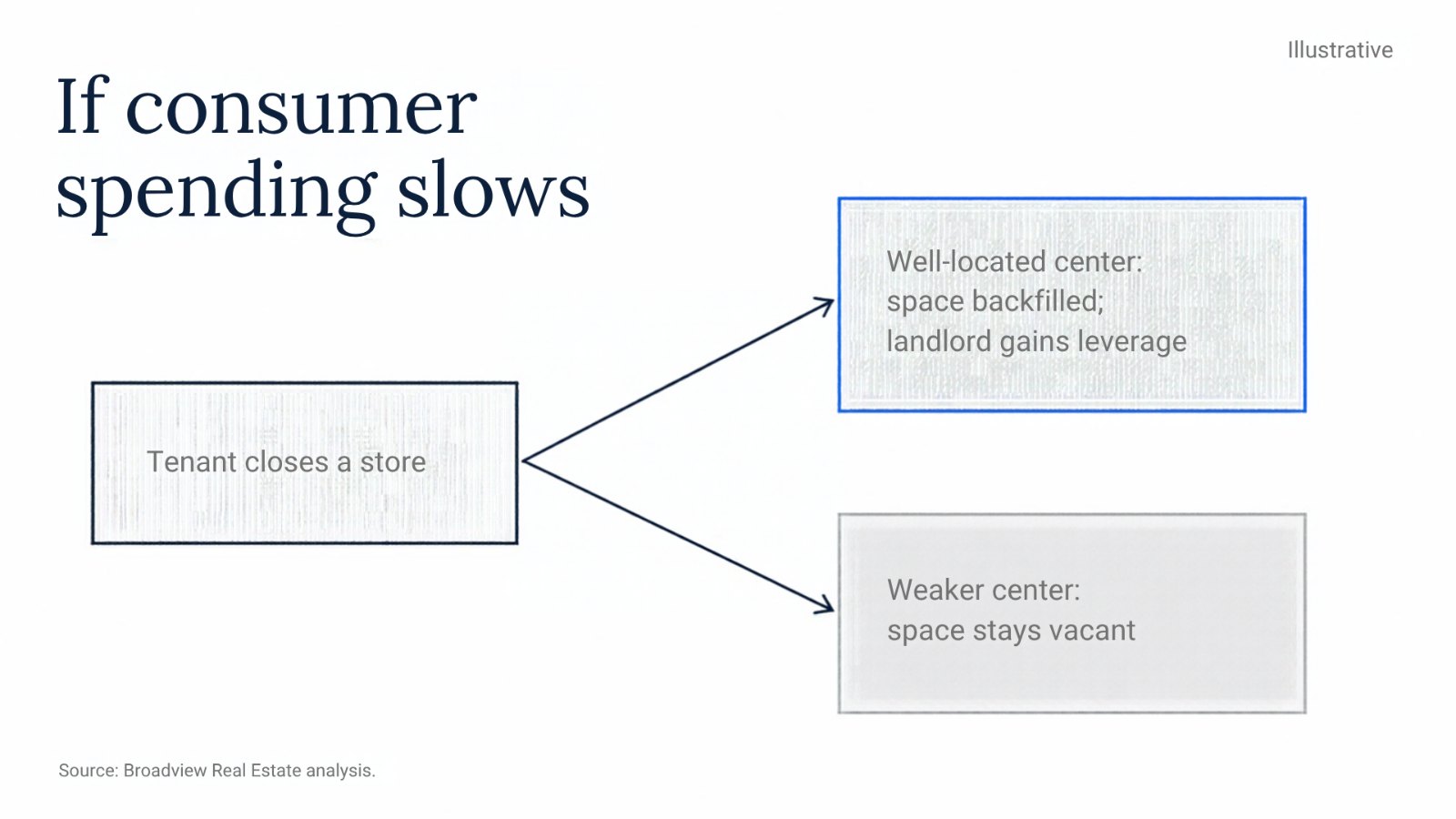
We accept that a slowdown would hurt weaker tenants and weaker centers. The market’s response would still differ from past cycles. With little new space coming, closures in well-located centers are likely to be backfilled, while centers in weaker locations would struggle to replace tenants. A slowdown would widen the gap between those two groups more than it would raise national vacancy. Landlords with centers in strong trade areas would also gain bargaining power with replacement tenants, who have had few alternatives since the closure wave of 2025.
Low vacancy, and a wider spread between centers
Over the next year, we expect national retail vacancy to remain low while rent growth continues in well-located grocery-anchored and neighborhood centers. The difference in performance between strong and weak properties should widen. For investors, the useful question is less about the strength of the consumer and more about whether a center’s tenants could be replaced if they left.
“For investors, the useful question is less about the strength of the consumer and more about whether a center’s tenants could be replaced if they left.”
August’s sales report will be read as good news for retail landlords. For property, the more lasting good news is that so little new retail space has been built.
Sources: U.S. Census Bureau, Advance Monthly Retail Sales (September 16, 2026); TD Economics; Marcus & Millichap; Phoebe Reads; MMCG Invest; Coresight Research via MMCG Invest.