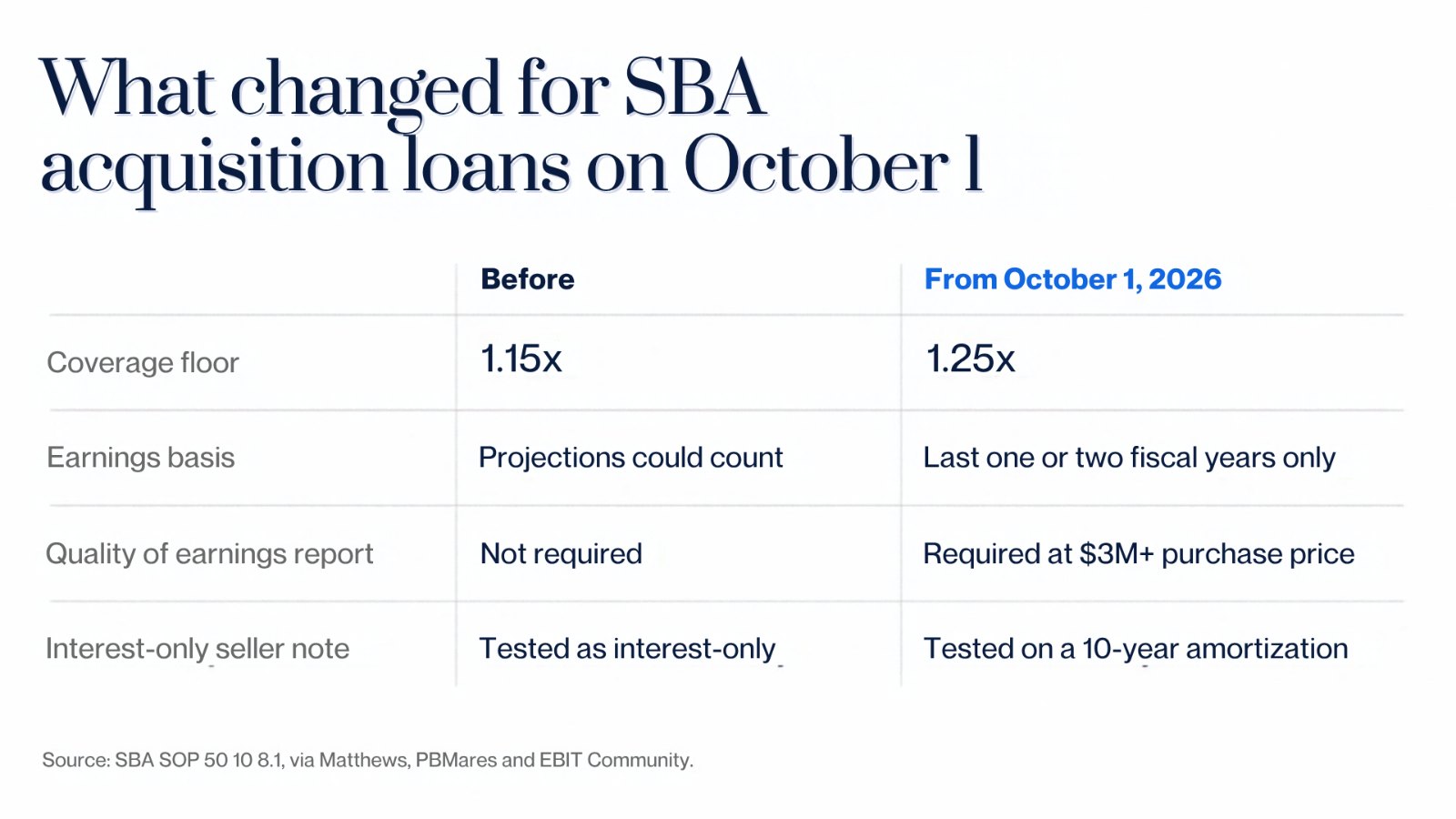
On October 1, a revised Small Business Administration rulebook, SOP 50 10 8.1, took effect for 7(a) loans used to buy a business. For a first-time acquisition, the business must now show debt service coverage of at least 1.25 times, up from 1.15 times, and lenders can no longer use projected earnings to reach that figure. Deals with a business purchase price of $3 million or more require an independent quality of earnings report ordered by the lender. Any interest-only seller note that is not on full standby must be tested as if it amortized over 10 years.
The rule applies to every industry that uses SBA acquisition loans, and much of the commentary has treated it as a general tightening of small-business credit. We think it matters most for one corner of real estate: the market for small and mid-sized hotels, where SBA debt has long been a standard way to finance a purchase. The new rules reprice hotels according to how they are expected to earn. Hotels whose value rests on documented past income keep their buyer pool. Hotels whose value rests on a plan, such as a brand conversion or a property improvement plan, lose a large part of theirs.
The rule looks like a small change to a ratio
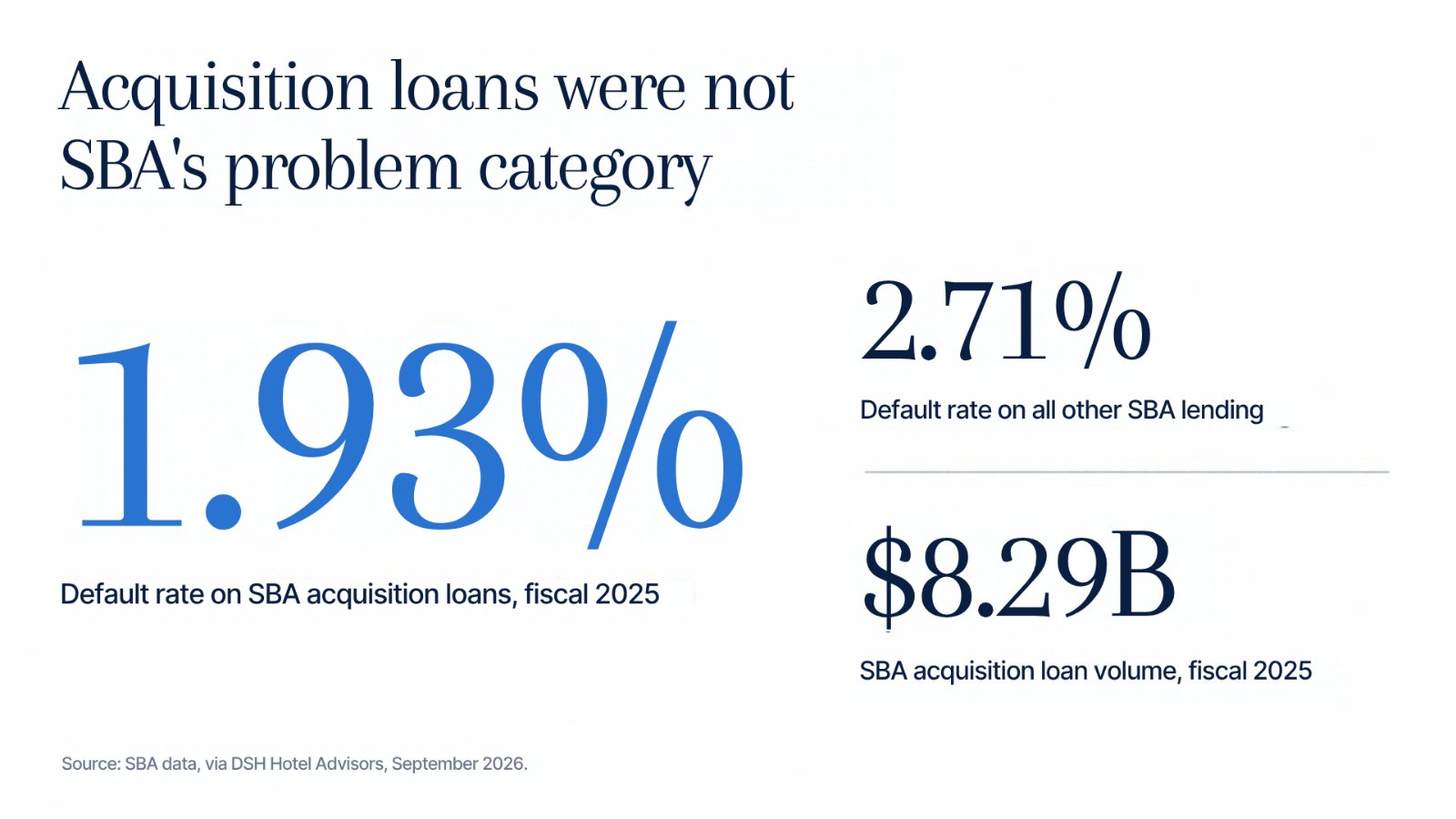
Read in isolation, a move from 1.15 to 1.25 times coverage looks modest. SBA’s own figures suggest acquisition lending is not a problem category. DSH Hotel Advisors, citing the agency’s fiscal 2025 data, reported $8.29 billion of acquisition loan volume with a default rate of 1.93%, below the 2.71% default rate across the rest of SBA lending. This is also the third rewrite of the SBA rulebook in about sixteen months, and acquisition lending continued through the previous two.
On that reading, lenders and borrowers will adjust, structures will shift at the margin, and deal volume will recover within a few months.
The change reduces what a given hotel can borrow
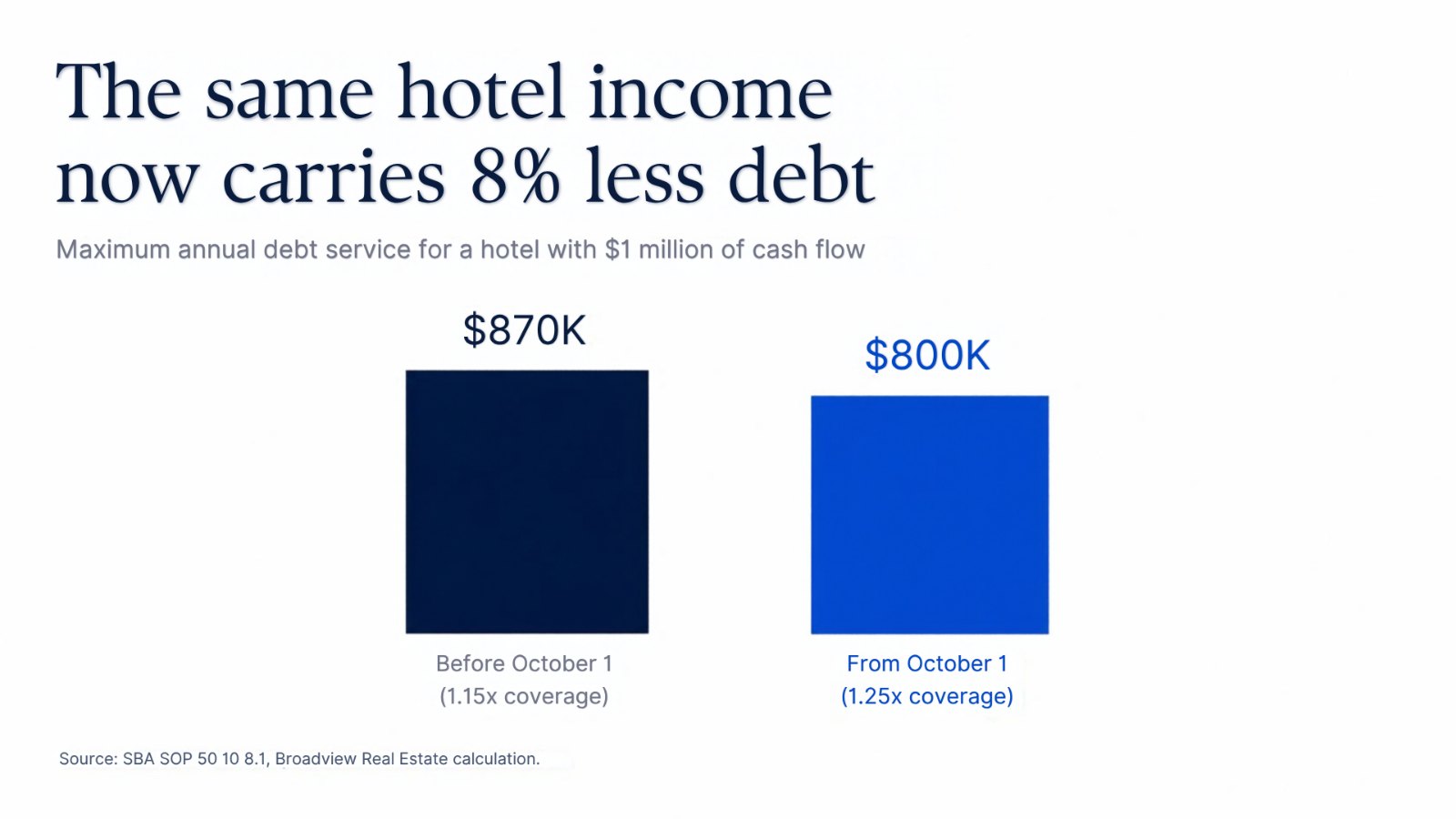
The arithmetic is larger than the ratio suggests. For a hotel producing $1 million of cash flow available for debt service, the maximum annual debt payment falls from about $870,000 at 1.15 times to $800,000 at 1.25 times, on our calculation. That is an 8% reduction in the debt the same income can carry. A buyer who cannot add equity has to offer a lower price.
The other changes compound that effect. Seller notes have been a common way to close the gap between what a hotel seller wants and what a lender will fund. Under the new SOP, total transaction debt, including any seller note that is not on full standby, is capped at the appraised business valuation, and an interest-only note is tested on a 10-year amortization. A note that once flattered first-year coverage now counts against it.
Projections no longer carry value into the price
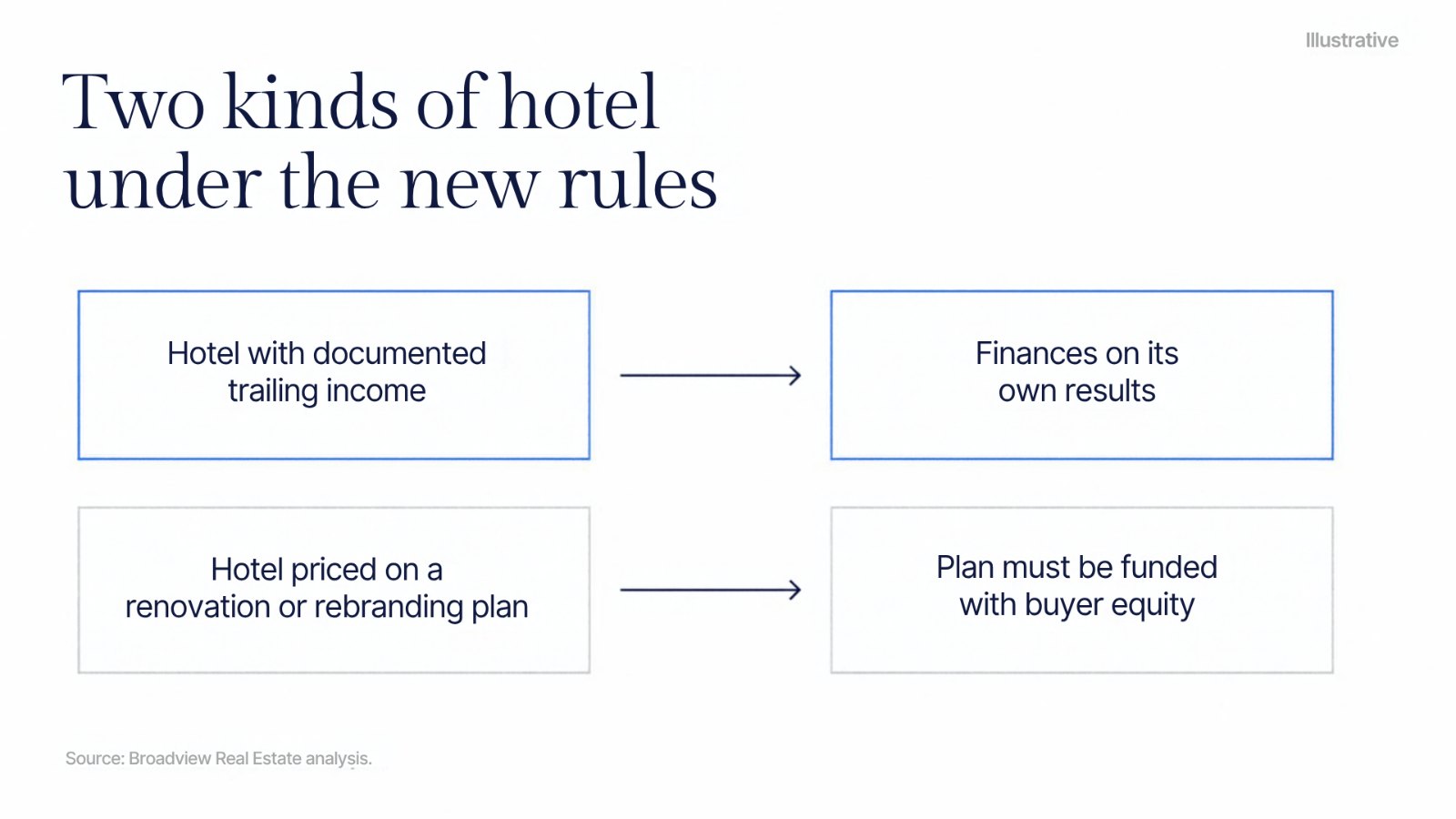
The removal of projections is the change with the largest effect on hotels. Many smaller hotel trades over the past few years were priced on what the property could earn after a renovation or a new flag. Lenders could underwrite that story within SBA rules. From October 1, coverage must be met on the last one or two fiscal years of actual results.
That shifts value toward hotels that have already done the work. A select-service property that completed its improvement plan two years ago and can show the resulting income in its books now finances on equal terms with any other business. A comparable hotel that still needs its plan carries that cost entirely in equity. DSH Hotel Advisors described the result as a flight to quality, in which demand concentrates on hotels that can prove their cash flow on paper.
Who gains and who loses
The gainers are owners of hotels with clean, documented trailing income, and well-capitalized buyers. With conventional and CMBS debt more expensive after the 10-year Treasury yield reached 5.3% on October 1, some buyers who would normally finance larger deals have moved into SBA territory, according to DSH. They will now compete for a narrower set of hotels that pass the new tests, which should hold up pricing for those assets. Buyers with substantial equity also gain, because they can still pursue value-add hotels while the field of competing bidders shrinks.
The losers are sellers whose asking price depends on a business plan, sellers who planned to bridge a valuation gap with a seller note, and smaller first-time buyers with limited equity. The economy segment is especially exposed. Economy hotels saw RevPAR fall 4.4% in 2025, according to STR data cited in an MMCG Invest industry analysis, and lenders that average the last two fiscal years will be underwriting from that weak 2025 base.
The objection is that lenders will find workarounds
A fair counterargument is that markets adapt. Buyers will use more equity, sellers will put notes on full standby, and some deals will move to conventional lenders. Hotels in World Cup host markets may even find that their 2026 trailing figures, which include an exceptional summer, flatter their coverage.
We agree that deal flow will continue. The question is at what price and for which hotels. Each workaround costs something. More equity lowers returns and a standby note defers the seller’s cash, while conventional debt is more expensive and more selective at current rates. A temporary lift in 2026 trailing income will also fade as lenders look at a second year of results. None of those adjustments restores the old ability to finance a hotel on its future.
Paying for the hotel as it stands
The SBA rule is small in the text of a long operating procedure, and its effect on hotel economics is concentrated. For the next several quarters, we expect the gap between asking and bid prices to widen for value-add hotels and to narrow for hotels with documented, stable income. Sellers who planned to be paid for a property’s potential will find that the most common financing source in their market now pays only for its past. For the mid-market hotel trade, the plan has become something the buyer funds with equity, and the price a lender will fund reflects the hotel as it stands today.
“Sellers who planned to be paid for a property’s potential will find that the most common financing source in their market now pays only for its past.”
Sources: SBA SOP 50 10 8.1 (via Matthews, PBMares, EBIT Community and Sundance Financial Group); DSH Hotel Advisors (September 2026); STR via MMCG Invest; Bisnow via CRE Daily.