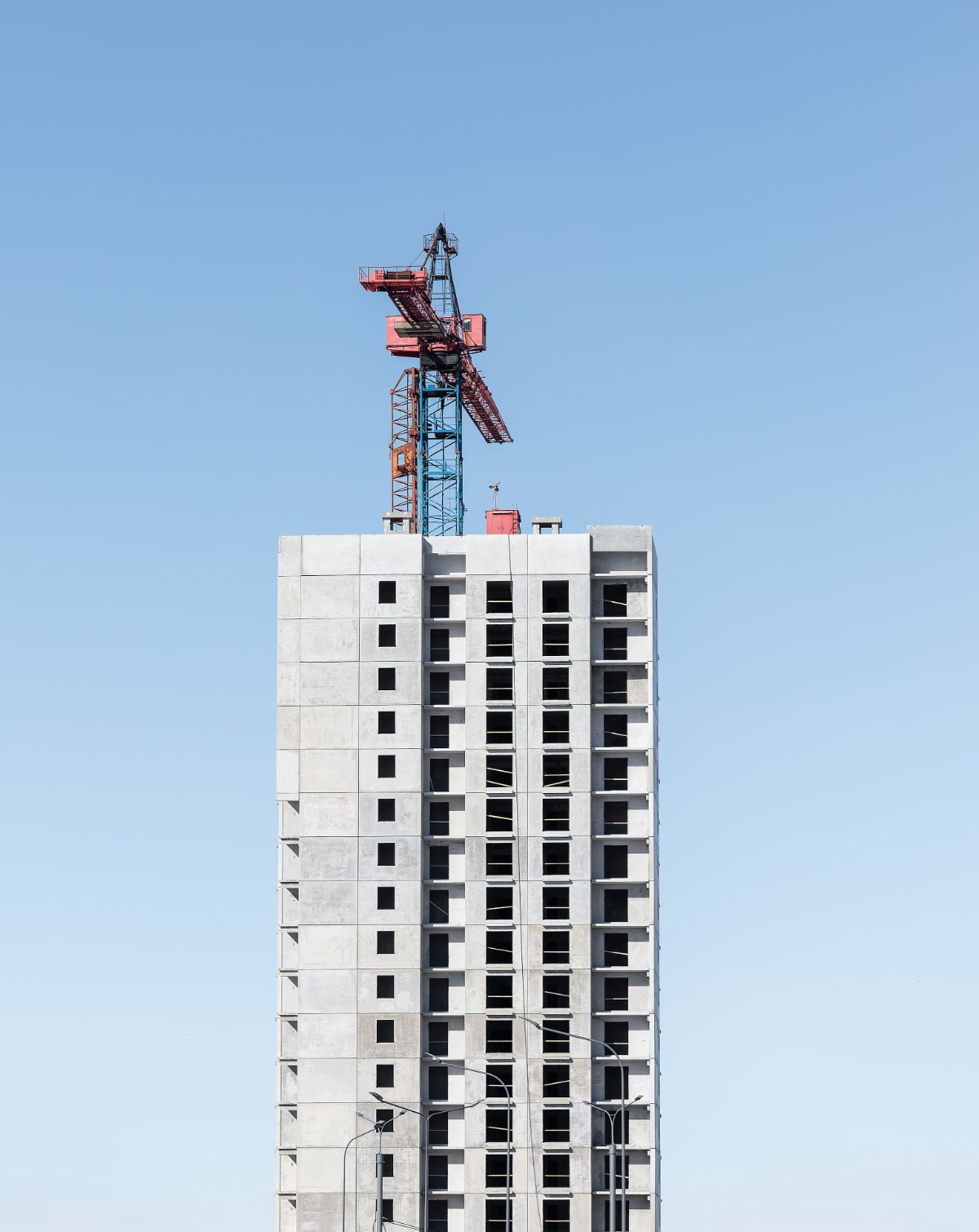
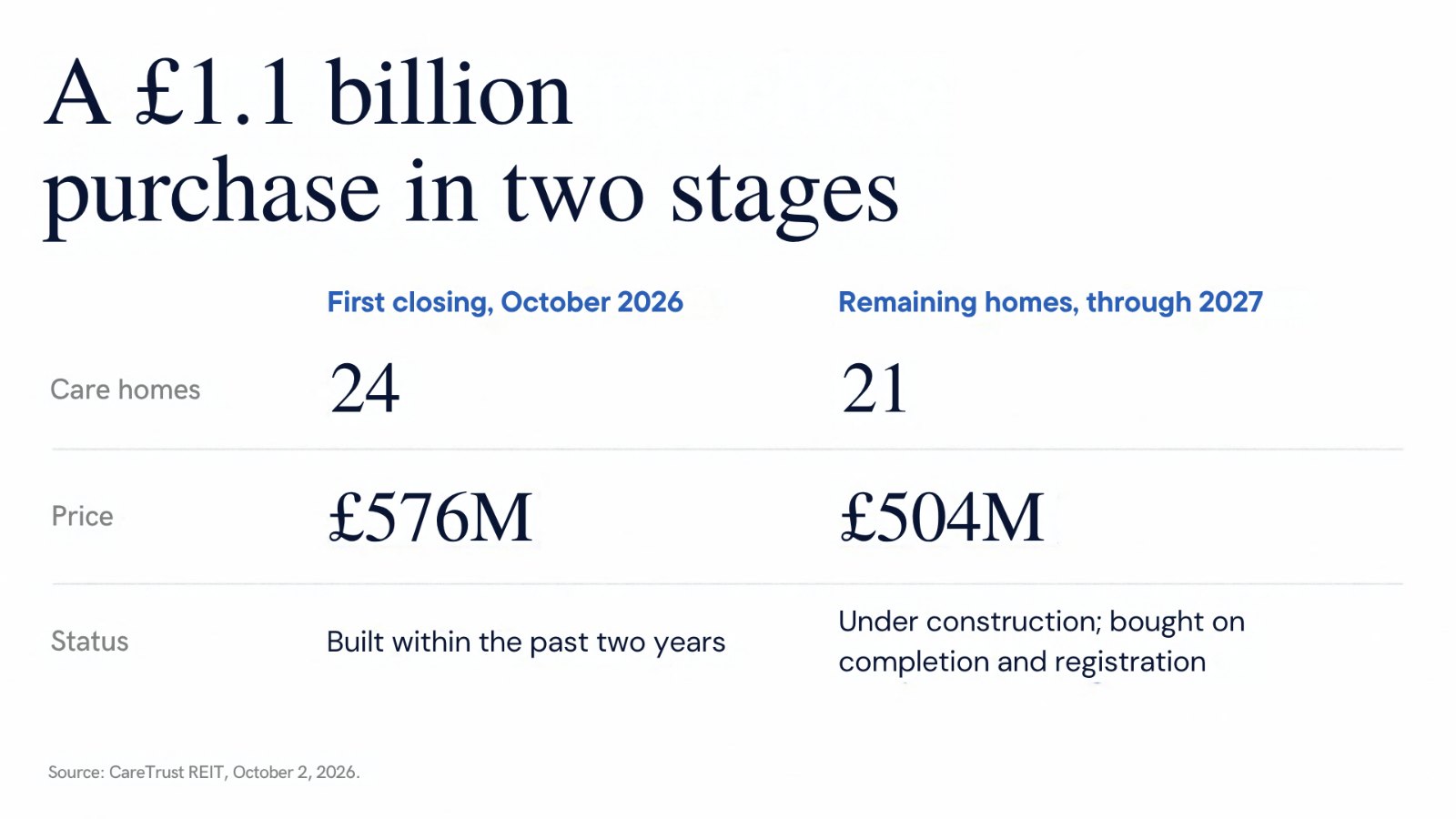
On October 1, CareTrust REIT closed the first stage of a roughly £1.1 billion agreement to acquire 45 newly built care homes in the United Kingdom from LNT Care Developments. The first closing covered 24 homes, all completed within the past two years, for about £576 million, or about $764 million. The remaining 21 homes are under construction, and CareTrust will buy them for about £504 million as each one is completed and registered with the regulator during 2027.
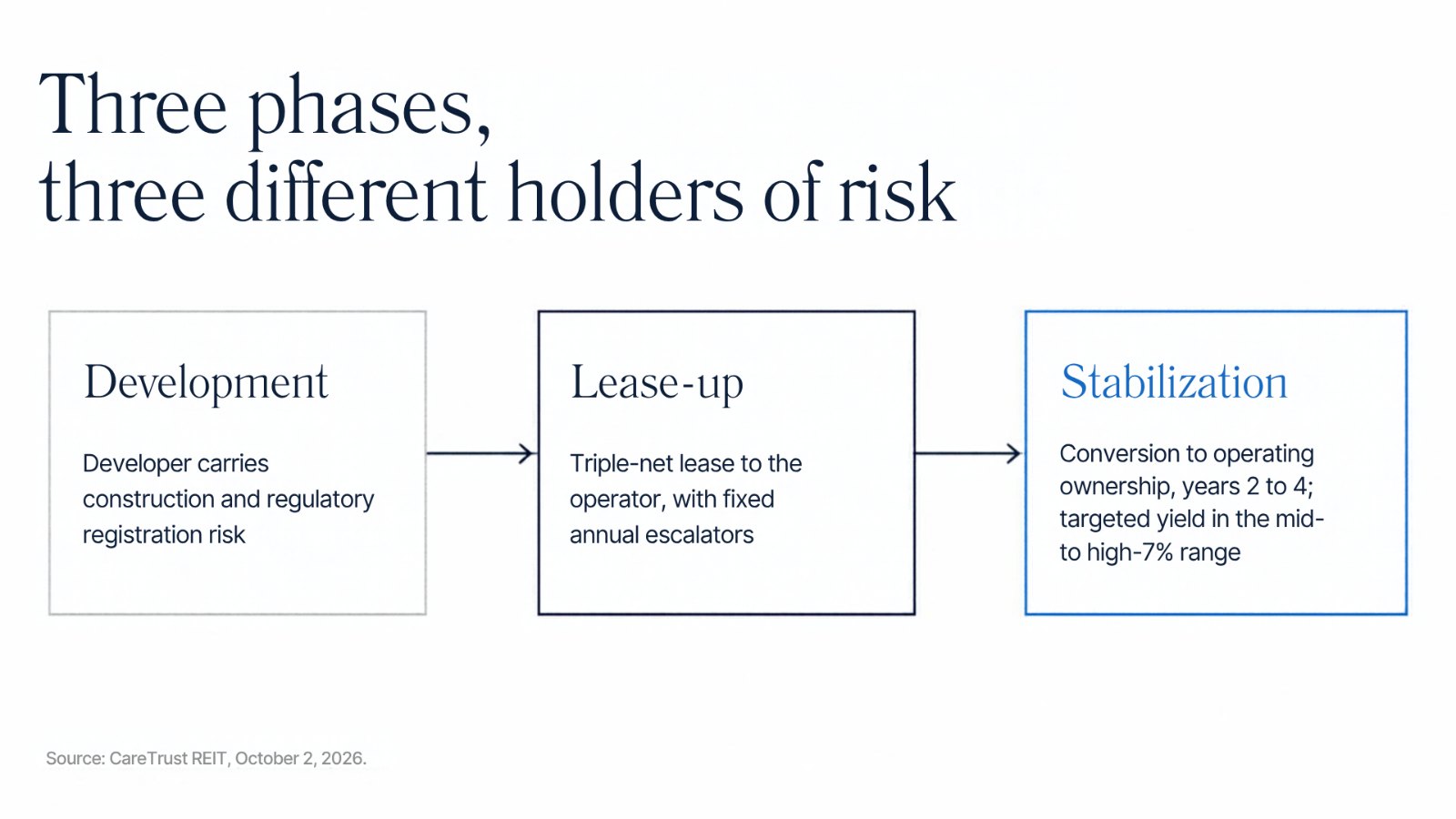
The size of the deal drew attention, but its structure is the more useful lesson. Each home is leased on a triple-net basis to the developer’s own operating company while it fills, and CareTrust expects to convert the homes to an operating structure that gives it a direct share of resident income once they stabilize, between two and four years after completion. We think this sequence, fixed rent during lease-up and operating income after stabilization, is the best available answer to how capital should enter senior care at today’s interest rates, in the United States as well as abroad.
“We think this sequence, fixed rent during lease-up and operating income after stabilization, is the best available answer to how capital should enter senior care at today’s interest rates.”
The case for senior care is clear, and the hard part is entry
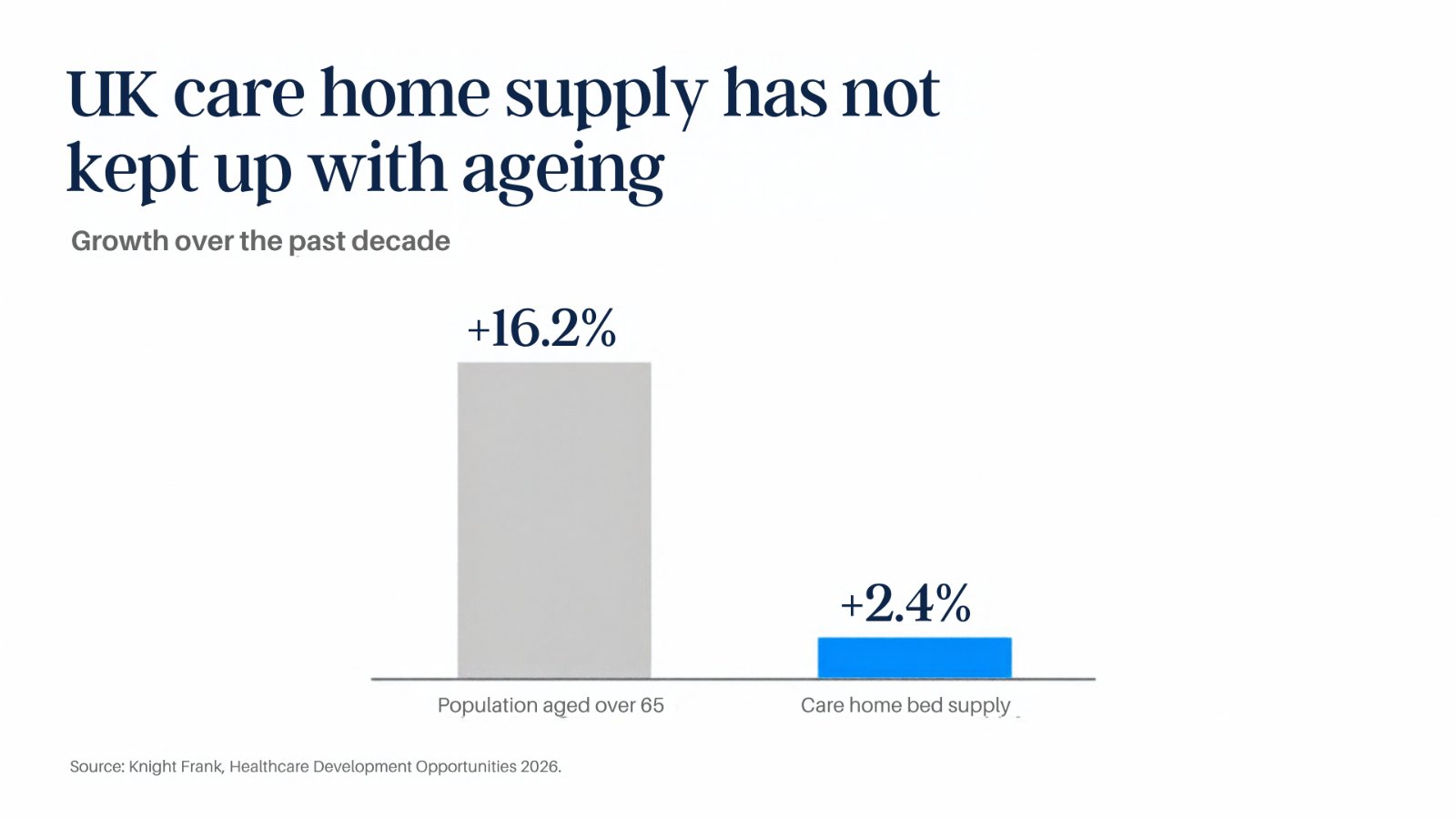
The demand case on both sides of the Atlantic is strong. In the United States, NIC MAP reported senior housing occupancy of 90.4% in the third quarter, with development running at about a tenth of what would be needed to hold that level. In the United Kingdom, Knight Frank’s 2026 development report found that care home bed supply grew just 2.4% over the past decade while the population aged over 65 grew 16.2%. Net supply rose by only 136 beds last year to about 480,000, and 79% of homes are more than 20 years old.
The common conclusion is that investors should buy as much stabilized senior care as they can. The difficulty is price and timing. Stabilized assets in strong markets are expensive, and new assets, which serve the shortage best, spend their first years losing money as residents move in.
Lease-up is where most senior care investments lose value
A new care home or senior housing community does not earn its stabilized income for several years. Staff must be hired before residents arrive, and occupancy builds one move-in at a time. An owner with operating exposure from day one carries those losses directly. An owner on a triple-net lease from day one gives up most of the income growth that follows. CareTrust’s chief investment officer described the LNT structure as one in which the company is "paid to be patient while the homes fill."
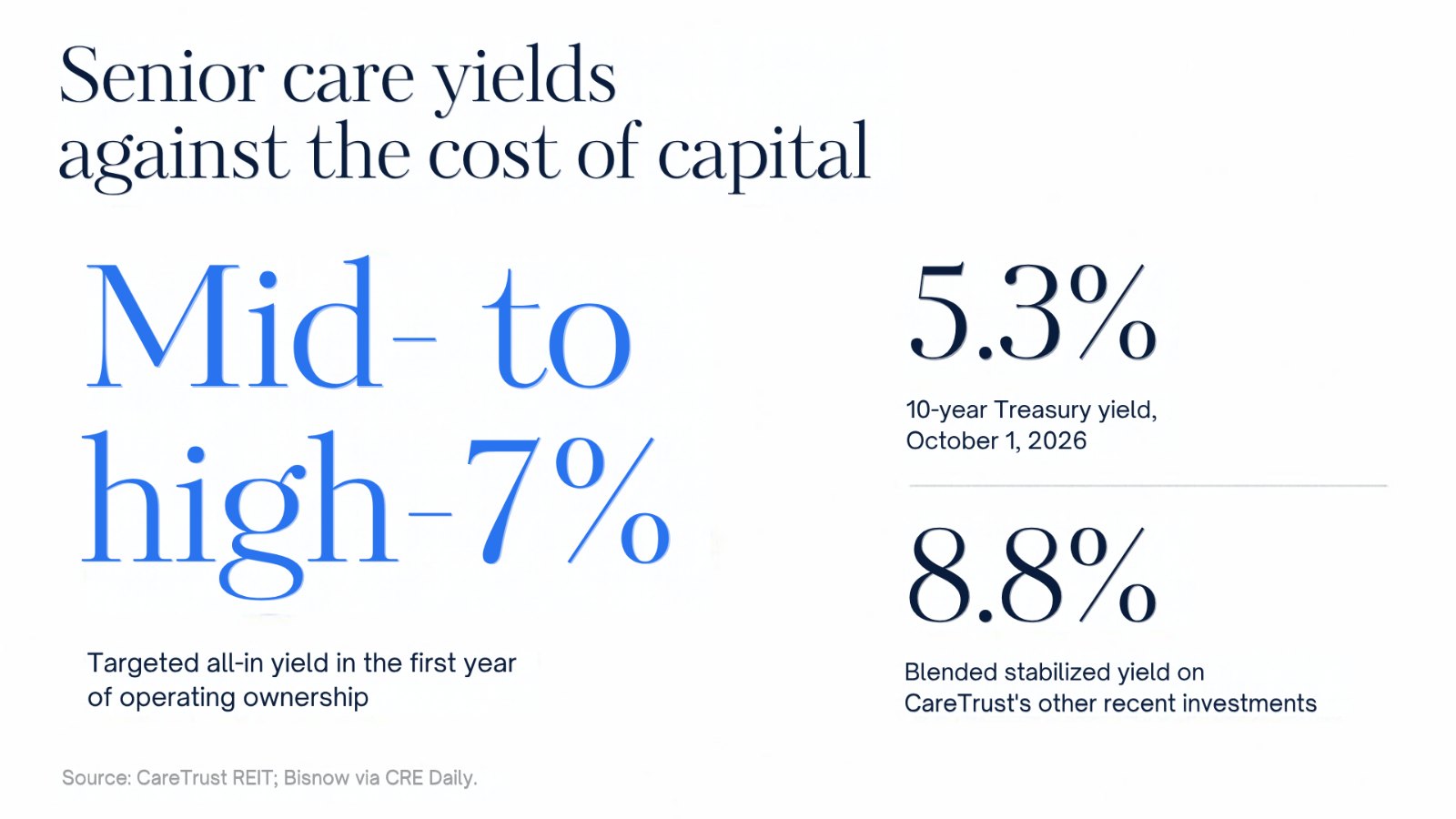
The company expects the transaction to add to normalized funds from operations during lease-up and to produce an all-in yield in the mid- to high-7% range in the first year of operating ownership. Development risk stays with LNT until each home is complete and registered with the Care Quality Commission, because CareTrust buys only finished buildings.
The last cycle showed the cost of the wrong structure
The structure exists because of what happened in the last cycle. The REIT Investment Diversification and Empowerment Act of 2007, known as RIDEA, allowed healthcare REITs to take direct operating income from senior housing through taxable subsidiaries. Many did so in the years before the pandemic. When occupancy fell to a low of 78.7% in the second quarter of 2021, according to NIC, operating portfolios absorbed the full decline in income, while owners of triple-net leases continued to collect rent from operators, at least where those operators stayed solvent.
The lesson most investors took was to choose one exposure or the other. CareTrust’s deal uses both, in sequence: lease income through the phase when operating results are weakest and least predictable, and operating income once the asset has proven its occupancy.
How we would put capital into senior care now
Underwriting should start from the spread between the stabilized yield and the cost of capital. With the 10-year Treasury at 5.3% on October 1, a mid- to high-7% stabilized yield offers a spread of roughly 2.2 to 2.5 percentage points. CareTrust reported a blended stabilized yield of 8.8% on its other recent investments, mostly skilled nursing on triple-net leases, which shows how much the market charges for operator and reimbursement risk in that segment.
Structure should place each risk with the party best able to carry it. Developers carry construction and registration risk. Operators carry lease-up risk under a lease with fixed escalators. Capital takes operating exposure only after stabilization, ideally through pre-agreed put and call rights over the operating companies, as in the LNT agreement.
Diligence should focus on the operator during lease-up. In this case the tenant is the developer’s own operating company, so the rent guarantee is only as strong as that company’s balance sheet and track record. Staggered closings, tied to completion and regulatory approval, keep capital out of buildings that are not yet finished.
The counterargument concerns who is guaranteeing the rent
The serious objection is that the structure moves risk less than it appears to. A lease to an affiliated operator during lease-up can turn into a disguised development subsidy if occupancy builds more slowly than planned. Cross-border investment adds currency exposure: CareTrust priced the first closing at an exchange rate of 1.327 dollars to the pound, and its guidance assumes no material change. Labor costs, which drive operating margins in care, are higher and harder to forecast than in other property types.
We accept each of these risks, and they argue for careful terms. Completion and registration conditions on each closing, together with defined windows for the conversion to operating ownership, make the risks visible and priced at entry. An investor who buys stabilized assets instead carries the same labor and occupancy risks, at a higher entry price and without the option to walk away from an individual home that fails to complete.
Structure is the scarce resource in senior care
Demand for senior care is well documented and widely shared among investors. The supply of finished, high-quality buildings is limited, and the terms on which capital can own them through lease-up are scarcer still. CareTrust has also taken an option to acquire LNT’s entire platform, which suggests the company values the pipeline as much as the 45 homes. For investors entering senior care at current rates, the deal structure is likely to decide returns more than the choice of market.
Sources: CareTrust REIT (Business Wire, October 2, 2026); Knight Frank, Healthcare Development Opportunities 2026 (via Healthcare Management UK and IREI); NIC MAP (via Senior Housing News and IREI); NIC (2021); Bisnow via CRE Daily.