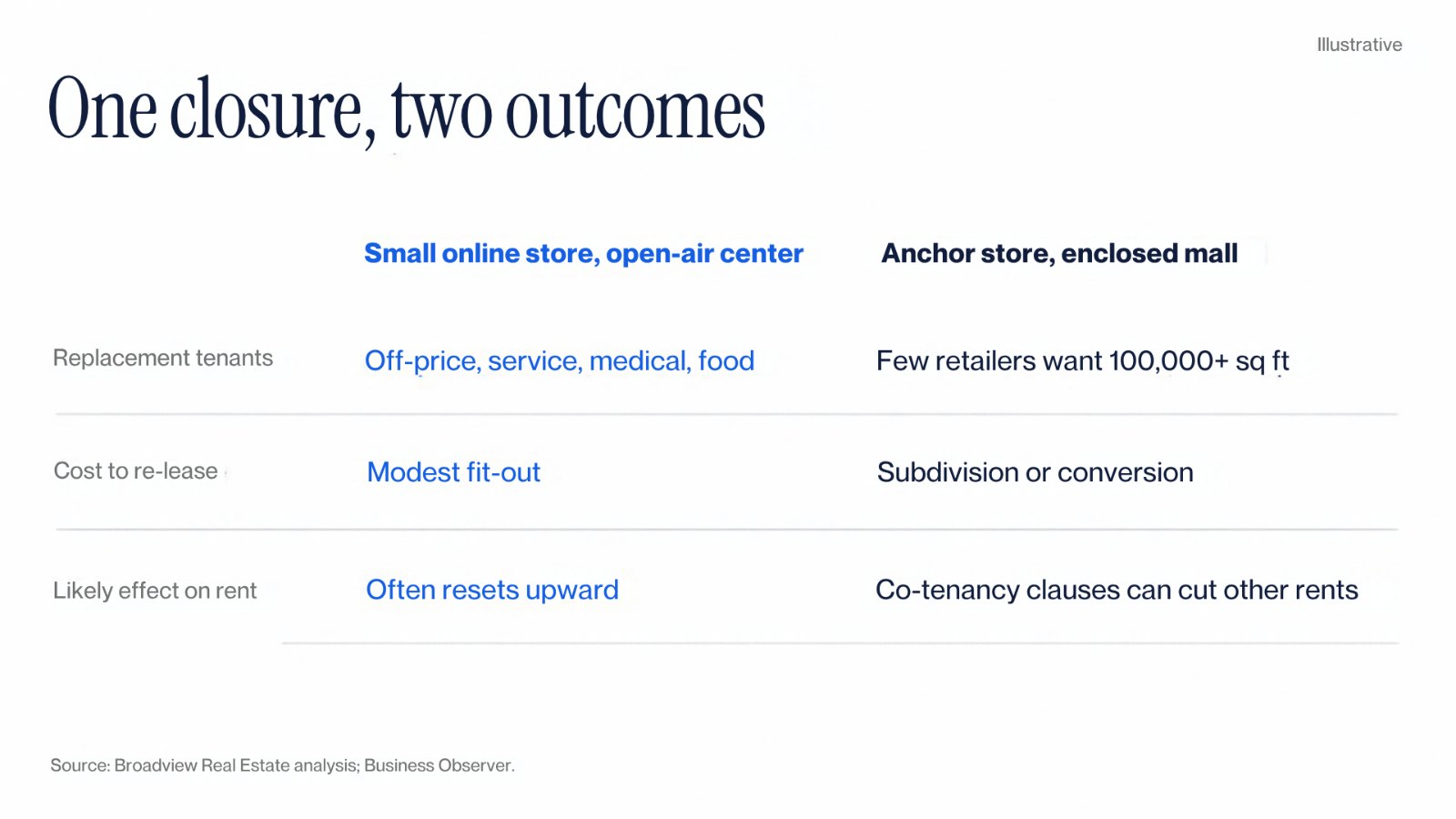
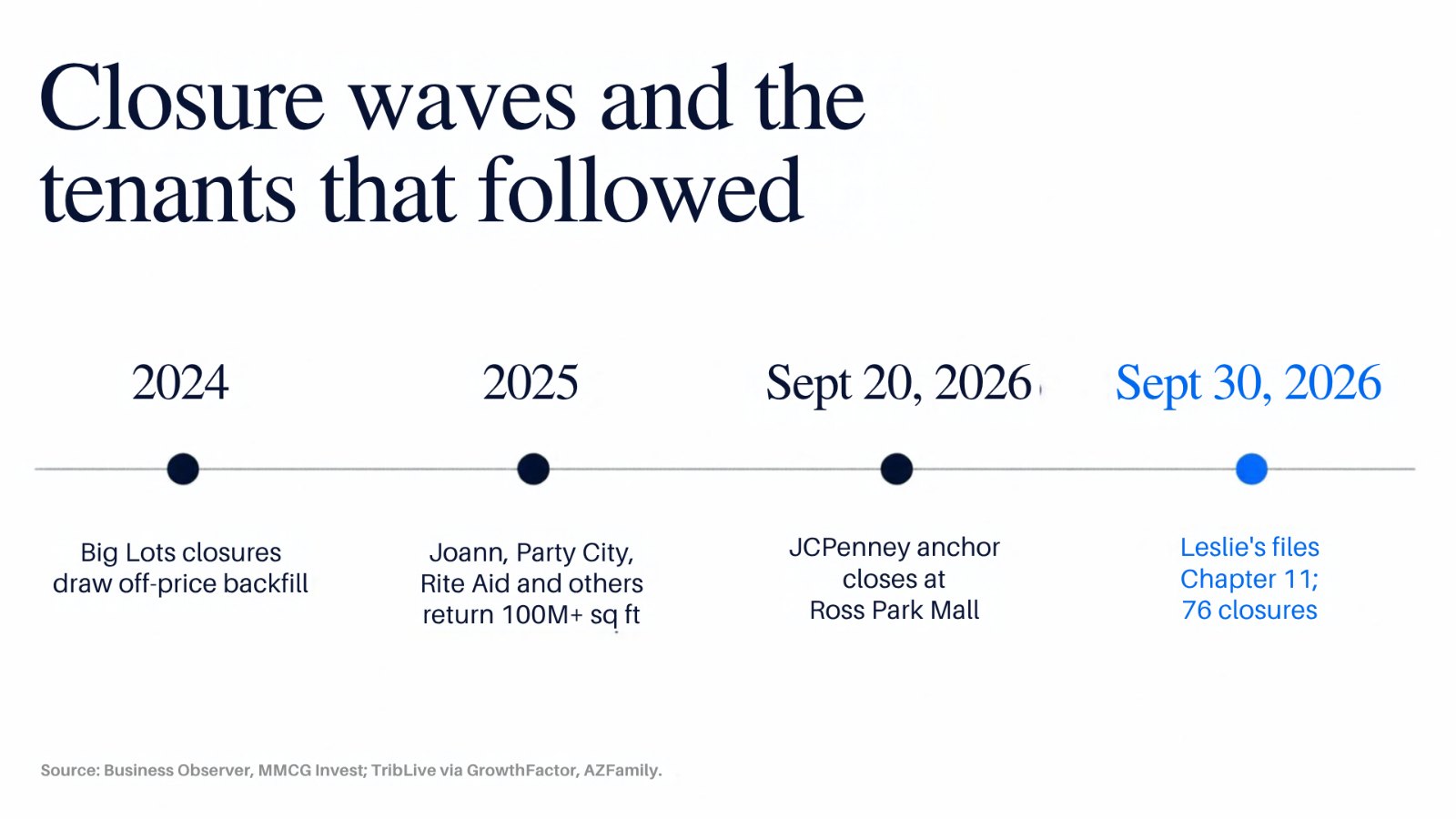
On September 30, Leslie’s, the pool supply retailer with more than 940 stores in 38 states, filed for Chapter 11 bankruptcy protection in federal court in Texas and said it would close 76 stores. The company had already closed about 80 underperforming locations earlier in its fiscal year. Its petition listed $1.21 billion of liabilities against $722.2 million of assets, and the restructuring is expected to eliminate about $685 million, or roughly 90%, of its funded debt. In its most recent quarter, sales fell 8.4% and comparable sales 6.2%, which the company attributed mainly to lower store traffic.
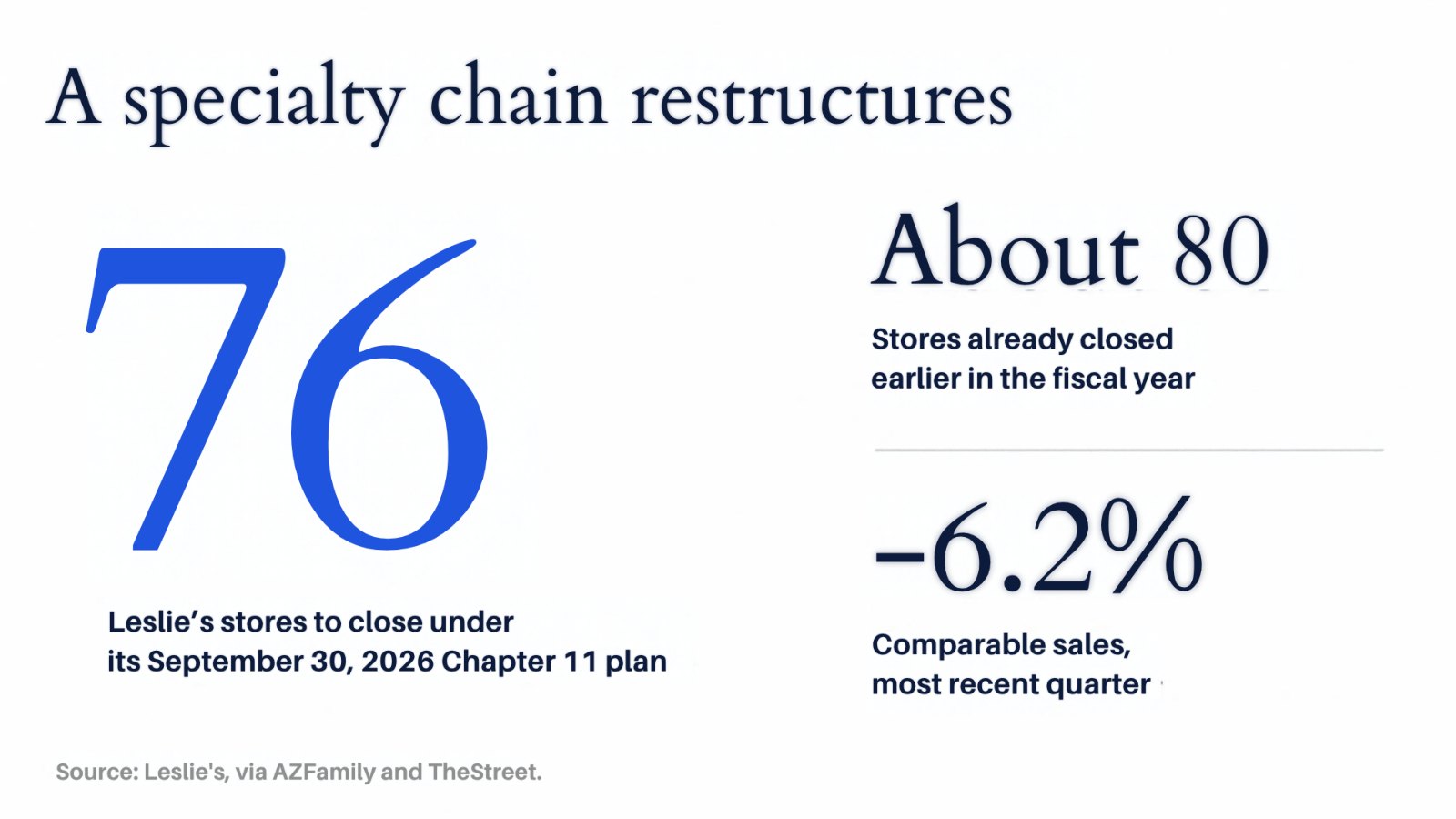
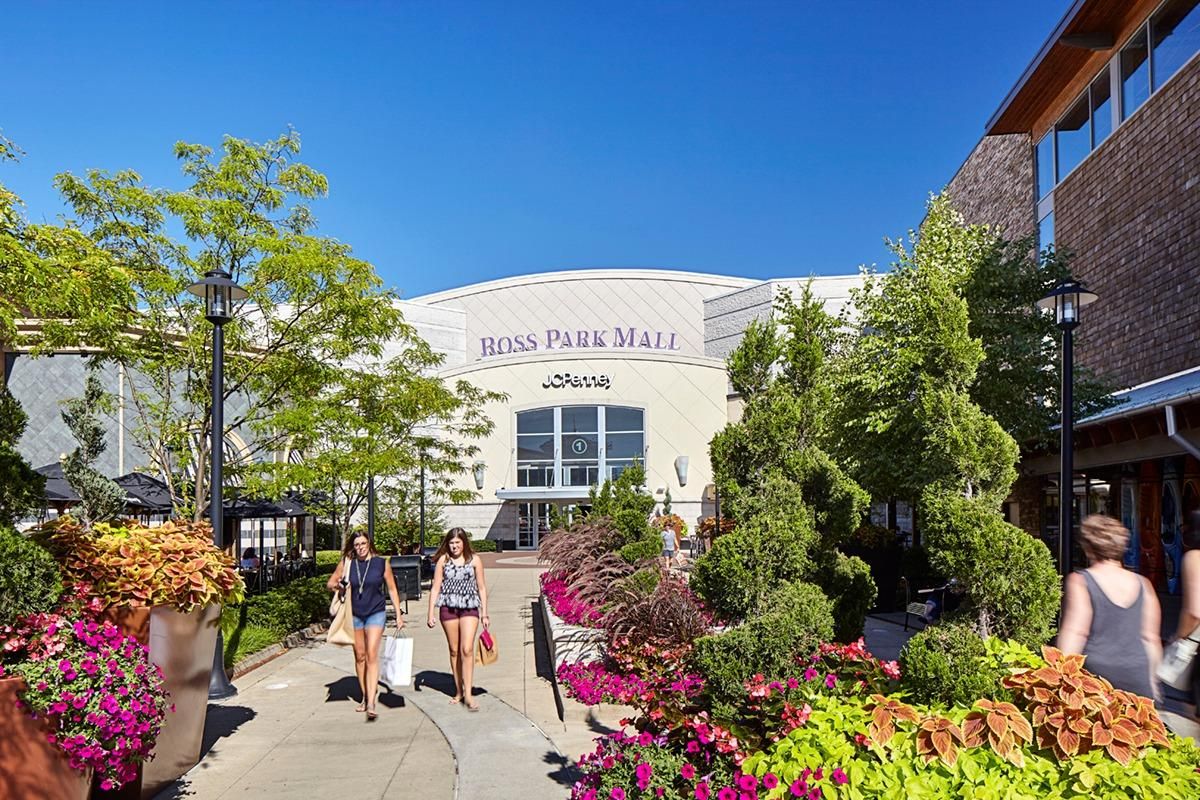
Ten days earlier, the JCPenney store at Ross Park Mall outside Pittsburgh closed after nearly 40 years as the mall’s last original anchor. Both events will be counted as further evidence of retail weakness. We think they say more about how the economics of retail space are being redistributed. Closures of specialty chains in well-located shopping centers now hand landlords space they can re-lease to stronger tenants, often at higher rents. Closures of mall anchors leave owners with large boxes that are harder and more expensive to refill. The same headline produces gains in one format and losses in another.
Store closures are read as a sign of weak retail property
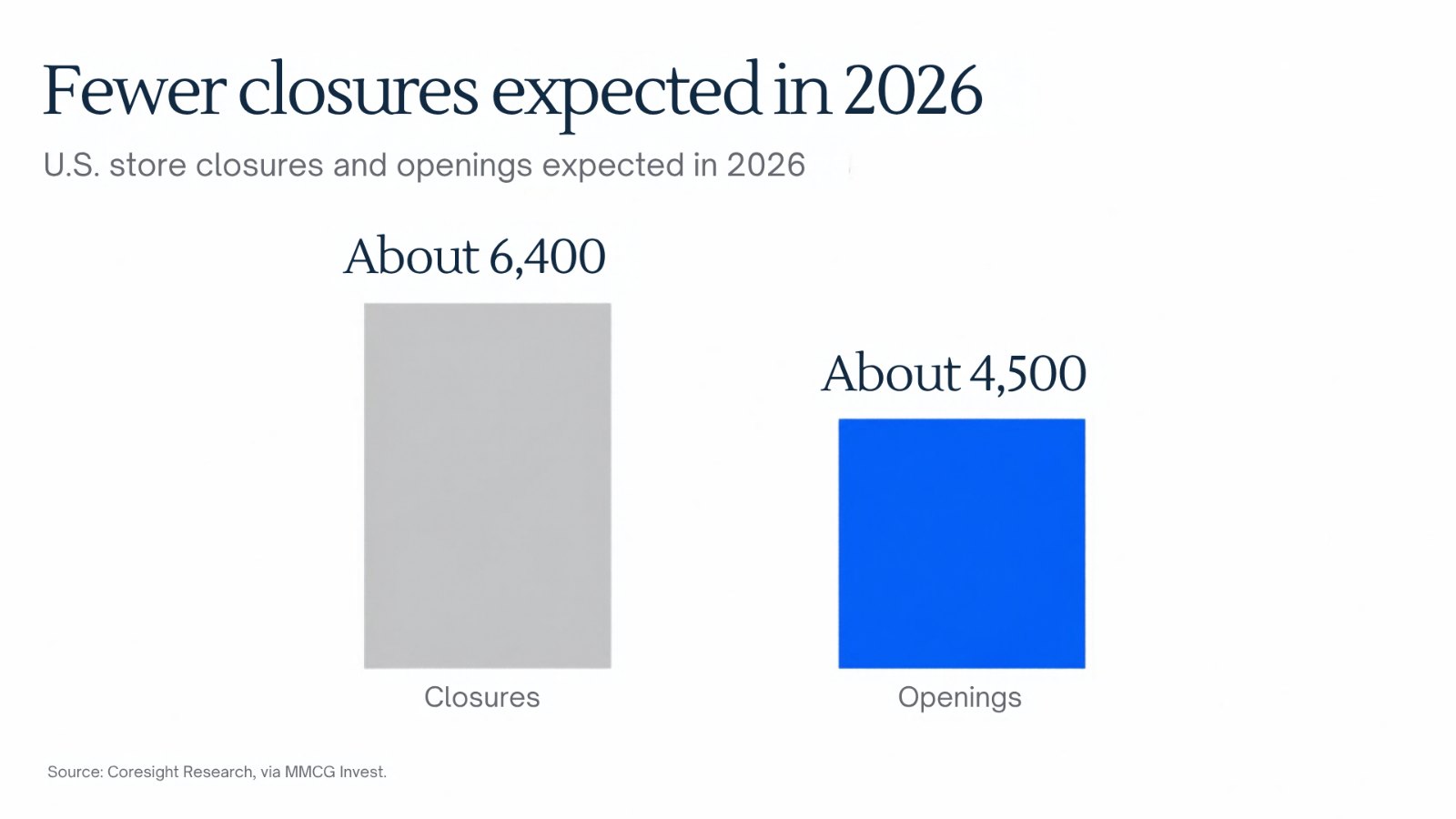
The common reading links store closures directly to property risk. When a national chain shuts dozens of stores, landlords lose rent and property values fall. Coresight Research expects about 6,400 U.S. store closures in 2026, and its tracker counted about 28.6 million square feet of net retail space closed through August announcements. Leslie’s adds to that total in the fourth quarter.
In strip centers, closures now create re-leasing opportunities
The experience of the past two years points the other way for open-air centers. When Big Lots began closing stores in 2024, a line of off-price retailers formed to take over the locations, according to a CoStar analyst quoted by the Business Observer. Bealls, Burlington, Marshalls and Ross were among the most active. Landlords that had once resisted entertainment and fitness tenants because of parking concerns have since become more willing to accept them, because there is little else available to lease.
Leslie’s stores are typically small, inline units in neighborhood and community centers, the format where demand from service, medical, food and off-price tenants is strongest. Spending at restaurants and bars rose nearly 6% over the year to August, according to the Census Bureau. A pool supply store with falling traffic is replaceable in a well-located center, and its space may re-lease to a tenant with stronger sales and a better credit profile.
Mall anchors are a different calculation
The JCPenney closure shows the other side. An anchor box can exceed 100,000 square feet, and few retailers want space of that size inside an enclosed mall. Replacing an anchor often requires subdividing the box or converting it to non-retail use, and both take capital and time. The loss of an anchor can also trigger co-tenancy clauses that allow other tenants to reduce rent or leave, which spreads the cost of one closure across the rest of the mall.
As a result, closures affect property values unevenly. The owner of a strip center with a vacant Leslie’s unit has an opportunity to raise rent. The owner of a mall that loses its last original anchor has a redevelopment project.
“The owner of a strip center with a vacant Leslie’s unit has an opportunity to raise rent. The owner of a mall that loses its last original anchor has a redevelopment project.”
Who gains and who loses
The gainers are owners of grocery-anchored and neighborhood centers in strong trade areas, who can replace weaker tenants with stronger ones, and the off-price and service tenants that have been waiting for space. Many inline leases in these centers were signed when market rents were lower, so re-leasing a vacated unit often resets its rent upward to the current market level. The losers are owners of malls and power centers that depend on large-format tenants in declining categories, and the specialty chains whose goods compete most directly with online sales and whose store traffic is falling.
The objection is that closures will spread
A reasonable objection holds that the current wave could widen. Higher borrowing costs and a softer labor market could push more retailers into restructuring, and even strong centers have limits on how many vacancies they can fill at once.
We accept that a broader wave would test strip centers as well. The market’s recent record still matters. The 2025 closure wave, which included Joann, Party City, Rite Aid, Big Lots and Forever 21, returned well over 100 million square feet to landlords, and much of it was re-leased within the year, according to industry estimates. A similar wave in 2027 would meet the same shortage of new space.
Underwrite the replacement tenant
For retail real estate, the practical lesson is to judge a closure by what replaces it. In well-located open-air centers, the departure of a weak specialty tenant is increasingly an opportunity to improve the rent roll. In enclosed malls, it is often the start of a costly redevelopment. Leslie’s 76 closures and one JCPenney store will be reported as one trend, and for property owners they describe two very different outcomes.
Sources: Leslie’s, via AZFamily and TheStreet (September and October 2026); TribLive via GrowthFactor; Business Observer; Coresight Research via MMCG Invest; U.S. Census Bureau via TD Economics.